Can Logic Defeat Confusion? The Polish School That Believed So
The Professor Who Packed the Hall

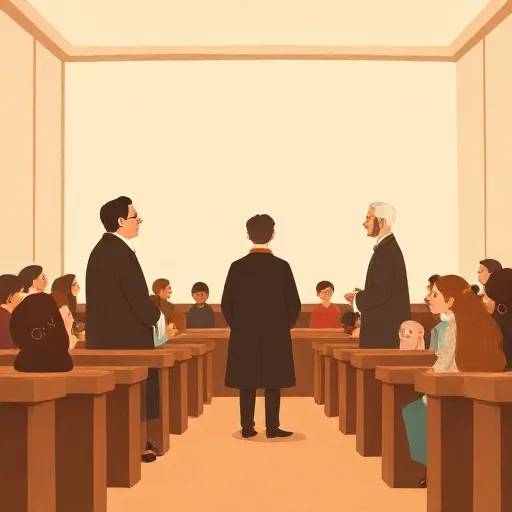
In the 1890s, a small university in the city of Lvov suddenly found itself overrun by students hungry for philosophy. The man they raced to hear was Kazimierz Twardowski (1866–1938). He had arrived from Vienna, where he had studied with the sharp‑minded Franz Brentano, and he brought with him a bold plan. Twardowski wanted to turn philosophy into a real science. That meant no fuzzy thinking, no prettily‑phrased guesses, and absolutely no taking shelter in grand mysteries nobody could check.
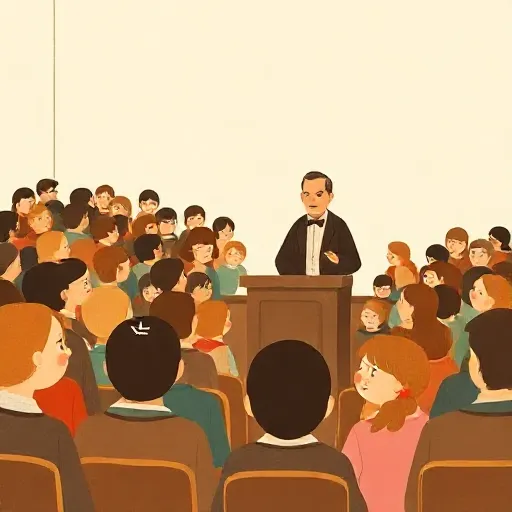
Twardowski wasn’t flashy, but he was electric in a quieter way. He believed that every philosophical sentence should be scrubbed as clean as a laboratory instrument. He taught his students to write and speak with razor‑edge clarity, to demand reasons for every claim, and to keep their personal “world‑views” separate from the arguments they made. Within ten years, his lectures sometimes drew two thousand listeners. His seminar, where reading and reasoning happened together, became a legend. A photograph from 1925–1926 shows a packed room of serious faces—the first wave of a philosophical army.
He did something else that was radical for his time: he made logic a friendly subject even for those who didn’t see themselves as mathematicians. Twardowski himself was not a logician, but he planted the seed. It soon grew into one of the most creative logic movements in history.
Philosophy as a Science: Clear Words, No Magic
The group that grew around Twardowski called itself scientific philosophers. That didn’t mean they wore lab coats or looked through microscopes. They meant that philosophy, like physics, should work with claims that anyone can inspect and test. Most members of what became known as the Lvov‑Warsaw School (LWS) shared a few deep commitments.
First, anti‑irrationalism: any idea that wants to be taken seriously must be communicable across different minds and open to checking. If you couldn’t explain it clearly enough for someone else to argue with, it didn’t belong in philosophy. Second, they held that philosophy is a collection of disciplines—logic, ethics, epistemology, metaphysics—each answerable to the same demand for clarity. Third, they mistrusted huge, sweeping metaphysical systems that claimed to reveal the secret of everything without anything you could publicly verify.
They didn’t agree on a single big theory. What united them was a common method: start by analyzing the language the problem is dressed in. Twardowski had taken from Brentano the habit of dividing a thought into the act of thinking and the content that the thinking is about. Picking apart fine distinctions like that became the school’s signature move. For most of them, logic was the tool that kept the analysis honest.
Warriors with Logic: Warsaw’s Fierce Clarity

When the University of Warsaw reopened in 1915, philosophy there got a jolt. Two of Twardowski’s students, Jan Łukasiewicz (1878–1956) and Stanisław Leśniewski (1886–1939), were appointed professors—stunningly, inside the Faculty of Mathematical and Natural Sciences. Neither was a native mathematician, but both had a talent for treating logic like a precise craft. Together with a rising tide of young mathematicians, including the brilliant Alfred Tarski (1901–1983), they turned Warsaw into a logic laboratory.
Their collaboration produced something rare: mathematicians and philosophers talking as equals. They didn’t see logic as a servant to mathematics or philosophy; they treated it as a full‑fledged autonomous science, worthy of investigation for its own sake. That freedom let them ask wild questions about what a logical system could be. And they believed their work had a moral dimension. Łukasiewicz said bluntly, “Logic is morality of thought and speech.” Tarski, looking at a world torn by ideologies, observed that ideology divides people, while logic unites them. They genuinely thought that teaching clear reasoning was a form of public service—a defense against the foggy irrationalism that was already darkening Europe.
The first decade in Warsaw was quiet, filled mostly with teaching. Then, around 1929, a burst of publications poured out: new axiom systems, new methods for proving independence and consistency, and new concepts that would shape logic for the next century. The spirit was playfully rigorous. They competed to find the most economical set of axioms for a system. The ideal? A single, “organic” axiom as short as possible, from which everything else followed, like a seed carrying a whole tree.
True, False, and Maybe: A Third Truth Value

One of the most astonishing inventions to come out of the school was Łukasiewicz’s many‑valued logic. In 1918, he started thinking about sentences concerning the future. Take the sentence “I will visit Warsaw next year.” At the time you say it, it isn’t true yet, and it isn’t false yet; it’s merely possible. Standard logic says every sentence is either true or false—the principle of bivalence. But Łukasiewicz asked: what if there is a third value?
He introduced a number, ½, to stand for that “possible” value, perched halfway between true (1) and false (0). He then worked out how the logical connectives—negation, conjunction, disjunction, implication—would behave in a three‑valued system. For example, if a sentence has the value ½, its negation also gets ½. A conjunction of two sentences each worth ½ stays ½. Famously, the law of excluded middle (“either p or not‑p”) can fail, because when p is ½, “p or not‑p” isn’t fully true.
He later extended the idea to logics with four values, five, and eventually infinitely many values. He also had to solve tricky technical puzzles: how do you set up axioms for a logic with three truth values? His colleague Mordechaj Wajsberg (1902?–1942?) produced a tidy axiom set for three‑valued logic, and Jerzy Słupecki (1904–1987) fixed the problem of making the system functionally complete by adding a new operator. Łukasiewicz himself eventually became less concerned with whether the many‑valued systems described the real world exactly, and more interested in exploring what kinds of reasoning they made possible. Still, his starting hunch—that the future is genuinely open and that logic should be able to reflect that—kept the work feeling urgent.
Truth and the Liar Who Couldn’t Lie

Alfred Tarski took on a deeper problem: what does it even mean to say a sentence is true? The ancient inspiration was Aristotle’s idea that to say of what is that it is, and of what is not that it is not, is true. But in the early twentieth century, the whole concept of truth had become suspect because of paradoxes like the Liar. Imagine a sentence that says “This sentence is false.” If it is true, it must be false; if false, true. Bumpy.
Tarski’s genius was to step outside the language that was causing the trouble. He insisted that any rigorous definition of truth must be given for a specific, well‑crafted formal language (call it L), but the definition itself should be stated in a different, richer metalanguage (call it ML). The metalanguage contains the first language plus the tools to talk about it. The definition has to be formally correct—no circularity, no contradictions—and also materially adequate. That means it must capture our basic intuition, which Tarski boiled down to the T‑scheme: a sentence s is true if and only if P, where s is a name of a sentence and P is the translation of that sentence into the metalanguage.
For example, in the metalanguage you might say: “Snow is white” is true if and only if snow is white. None of the scary paradoxes sneak in because the phrase “is true” always lives one level up from the sentence it describes. Tarski then gave a precise mathematical definition: a sentence is true if and only if it is satisfied by all infinite sequences of objects from the universe of discourse. That definition allowed him to prove deep results. He showed that for any formal system containing enough arithmetic, you cannot define truth for that system inside the system itself—a hard limit on what formal reasoning can capture. His work became the foundation of model theory, the part of logic that studies how languages relate to structures, and it reshaped the philosophy of science by giving a crisp account of logical consequence.
Can Words Invent Reality? Two Radical Ideas

Not every thinker in the LWS was building formal systems. Some took the spirit of linguistic analysis and pushed it into startling territory. Tadeusz Kotarbiński (1886–1981) developed reism, the view that only material, spatio‑temporal things exist. No properties, no relations, no facts—just concrete physical objects. He paired this with a semantic side: words that seem to name abstract items (like “justice” or “whiteness”) are really onomatoids, apparent names that don’t refer to anything real. A sentence like “Whiteness is a property of snow” just looks meaningful until you rephrase it as “Snow is white,” which talks only about snow—a concrete thing. Kotarbiński thought reism was a vaccine against inventing ghosts simply because our grammar tempts us to.
Kazimierz Ajdukiewicz (1890–1963) went in a different direction with his early radical conventionalism. He argued that the meanings of words in a language are bound up with three kinds of meaning‑rules: some sentences you accept unconditionally (axiomatic rules), some you accept if you’ve accepted others (deductive rules), and some you accept when you have a certain experience (empirical rules). A language that is both closed (you can’t add new expressions without changing meanings) and connected (no part is isolated from the rest) forms a tight conceptual apparatus. If two such apparatuses are distinct, they are, he claimed, mutually untranslatable. The upshot was startling: no amount of experience forces you to accept or reject a sentence—you can always keep your view by swapping your whole conceptual apparatus. Ajdukiewicz later abandoned the idea that closed, connected languages really exist, partly because of Tarski’s semantic results. But the challenge it posed—to show where the world pushes back against our language—remained alive.
Why Their Workshop Still Matters

The Lvov‑Warsaw School was shattered by the Second World War. Twardowski and Leśniewski had died just before it began. Many Jewish members were murdered by the Nazis, including Adolf Lindenbaum, Moses Presburger, and Mordechaj Wajsberg. Others fled: Łukasiewicz to Dublin, Tarski to Berkeley, and many more to England and America. The organized school never returned. But its habits didn’t vanish—they travelled inside individual minds.
Today, every time you hear a hot‑taking headline and wonder whether it holds together, you’re doing what the school trained people to do. They showed that clarifying your words, checking whether a sentence can even be tested, and asking what counts as a good reason are not just academic games. They’re protections. Łukasiewicz called logic the morality of thought. That might sound lofty, but it simply means taking your own reasoning seriously enough to let someone else examine it. The Polish logicians invented whole new kinds of logic and gave the world an exact language for talking about truth. Yet their deepest gift may have been the ordinary, stubborn insistence that confusion is not a deep mystery—it’s something you can work on, together, with care.
Think about it
- If a sentence about the future (“It will rain tomorrow”) is neither true nor false when you say it, does that change how you should treat promises about the future?
- Can you describe an object in your room without ever using a word that seems to name an abstract quality? If you can’t, does that mean those qualities exist?
- Suppose you change the meaning of a single word you use every day. Could the whole web of sentences you accept shift with it, even without new evidence? Why or why not?