
Is Hendrix Really Making His Guitar Wail? Leibniz’s Strange Answer
Is Hendrix Really Making His Guitar Wail?

It’s 1969, and Jimi Hendrix is on stage at Woodstock. He bends a note on his Fender Stratocaster, and the crowd loses its mind. Your first thought is obvious: his fingers plucked the strings, so he caused the sound.
But the philosopher Gottfried Wilhelm Leibniz (1646–1716) would tell you that’s not quite right. When Hendrix appears to make his guitar scream, three very different stories could be true. Leibniz spent decades arguing for the strangest one. This is a debate about what it really means for one thing to cause another—and Leibniz’s answer still quietly unsettles how we think about choice, action, and even freedom.
Physical Influx: The Common-Sense Theory (and Why It Can’t Work)

The theory most people believe without thinking is called physical influx. The idea is simple: when a cause and an effect interact, something actually flows from the cause into the effect. Hendrix’s hand moves, that motion is transferred to the guitar strings, and the strings vibrate. Motion, like a baton, is passed from one substance to another.
A substance, for Leibniz, is something that exists on its own and has its own properties—like a person, a guitar string, or a stone. Accidents are the particular states or moments of a substance: the motion of the string, the redness of a berry, the thought of a song. Physical influx says accidents can literally migrate from one substance to another.
Leibniz thought this picture was a dead end. He gave several reasons. First, he couldn’t imagine how an accident could pack its bags and leave its owner. Accidents are not little traveller; they belong to the substance they are in. “Monads have no windows,” he later wrote—meaning nothing can fly in or out. Second, he said the law of conservation of motion shows that if a mind could push a body, new motion would pop into the world like a magic coin, breaking the universe’s energy budget. Third, he worried that a cause that really “gives away” something would slowly drain itself, and for Leibniz, a genuine substance can never lose its power to act. So physical influx, however natural it feels, couldn’t be the last word.
Occasionalism: When God Presses Every Button

If one created thing can’t transfer anything to another, maybe the real cause is always God. That’s occasionalism, a view held by the French philosopher Nicolas Malebranche (1638–1715) and others. On this picture, finite substances like Hendrix, his fingers, and the guitar have zero causal power. When Hendrix wills his fingers to move, that will is caused by God. When the strings vibrate, that’s God again, acting on the occasion of Hendrix’s will. Only God—the one infinite substance—is a real cause.
Leibniz respected occasionalism but ultimately rejected it. His main objection was that it forces God to perform endless miracles. For Leibniz, a miracle isn’t just something rare and spectacular; it’s any event that comes directly from God rather than from the natures of created things. A world where God must nonstop intervene to keep things running is, he argued, a less perfect world—like a clockmaker who never got the design right and has to keep flicking the gears with his finger. A perfect God would create a world that unfolds on its own, without constant tinkering. Leibniz also thought occasionalism slid dangerously towards Spinozism—the idea that only one huge substance (God or Nature) really exists, and everything else is just a temporary wave in it. He wanted to save the genuine activity of individual things, not dissolve them into God.
Pre‑Established Harmony: Two Clocks That Never Meet
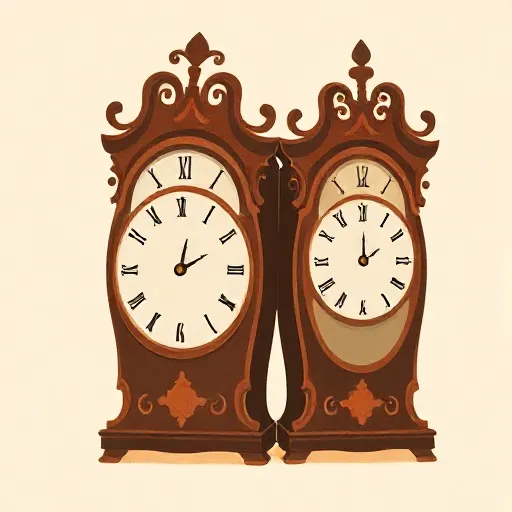
So physical influx seems impossible, and occasionalism makes God work too hard. What’s left? Leibniz’s own solution: pre‑established harmony. This is a version of parallelism—the view that there is no causation between finite substances, but there is real causation within each substance itself.
Think of two perfect watches. They always tell the same time, but they never send signals to each other. How? The watchmaker built them so exquisitely that each one, from its own internal machinery, will run in perfect step with the other forever. Leibniz said the universe is like that. At the moment of creation, God gave every finite substance a complete inner plan—a sort of blueprint—that “lists” all the states it will ever have. A substance’s states unfold from its own depths, with nothing pushing it from outside. Yet because God set all the blueprints to match, every time Hendrix’s soul has the perception of strumming, his body and the guitar are in the physical state of vibrating—without any causal traffic between them.
Leibniz called the basic units of his universe monads. A monad is a simple, windowless substance. All change in a monad comes from an internal active power. What we call causation between things, he said, is really each monad’s own internal unfolding, happening to mirror everyone else’s. This is intrasubstantial causation: the cause of a monad’s next state is the monad itself, especially its previous states and its built‑in tendency toward certain perceptions.
To handle a puzzle Bayle raised—how can our perceptions feel so jumpy and disconnected?—Leibniz added that we have countless tiny unconscious perceptions (he called them petites perceptions) that smooth everything out. The present moment always implicitly contains the next, like a melody in which every note implies the one that follows.
God’s Invisible Hand: Continual Creation Without Micro‑Managing

You might think Leibniz just made God unnecessary except as a starter button. But for him, God’s role is much bigger—and it’s the part of his view that feels hardest to pin down. Leibniz is a concurrentist: he holds that both God and created substances are causally responsible for a substance’s states, at the same time. God continually creates and conserves every monad, moment to moment. “Conservation is continual creation,” Leibniz wrote.
But how can God do everything without making substances into puppets? Leibniz used an analogy: God continually produces us and our actions “by a kind of emanation, just as we produce our thoughts.” When you think, you don’t drain your mind’s power; thinking flows from you without leaving you weaker. Similarly, God’s constant causal influence pours out without diminishing God and without robbing you of your own genuine activity. Substances still act from their own inner force; God simply keeps that force—and the substance itself—in existence. Leibniz believed this let him avoid occasionalism’s miracle problem while still giving God a proper role in every moment of reality.
Why a 300‑Year‑Old Puzzle Still Matters to You

Leibniz’s picture raises huge questions about freedom. If every state of your life was already “written” in your individual blueprint at the dawn of time, are you anything more than a character in a movie? Leibniz said yes: you are free because your actions flow from your own nature, not from some external shove. Certainty is not the same as compulsion. But many thinkers have found his compatibilism tricky to swallow.
The debate lives on in quieter forms. When scientists say the laws of physics determine every particle’s motion, are they describing a kind of pre‑established harmony—a universe that plays like a vast wind‑up clock? If everything is determined from within, does it still make sense to praise a musician for a beautiful solo, or to hold someone responsible for a wrong? Leibniz didn’t settle these questions, but he gave us an uncommonly vivid way of seeing what’s at stake: the world might be more like a perfectly synchronised orchestra than a chain of bumps and pushes. And that possibility still makes a twelve‑year‑old practicing guitar look up and wonder—am I really the one making these notes sing?
Think about it
- If two watches were made to stay in sync forever without ever talking to each other, would you say one watch caused the other to tick? Why or why not?
- Leibniz thought a perfect God would design a world that runs on its own, without needing constant fixes. Can you think of a machine or a living thing that works so well you never have to tinker with it? Does that kind of perfection feel more like freedom or like being a robot?
- Imagine a supercomputer that could predict every note Hendrix ever played before he was born. Would his music still feel creative to you, or would it seem like a pre‑written script? What would change?