Why Do Bad Arguments Feel So Convincing?
The Cafeteria Trap

“Everyone I know already has this phone,” your friend says at lunch. “So it must be the best one.” That argument sounds almost right. But if you stop and think, you notice something off: popularity isn’t the same as quality. You’ve just met a fallacy — an argument that seems convincing but doesn’t actually hold up.
The word comes from the Latin fallacia, meaning deception. For more than two thousand years, philosophers have been collecting and naming these tricky moves. The first big catalog was written by Aristotle (384–322 BCE), the ancient Greek thinker who wanted to understand why some arguments fool us even when they shouldn’t. Many centuries later, John Locke (1632–1704) added a whole new family of fallacies built around appeals to emotion and authority. Today, learning about fallacies isn’t about memorizing long lists — it’s about training your brain to spot the moment when an argument looks solid but is secretly wobbly.
Word Tricks: Ambiguity and Double Meanings

Sometimes a fallacy hides inside a single word. Equivocation happens when a key term shifts its meaning in the middle of an argument. Here’s a classic example:
The end of life is death. Happiness is the end of life. So, death is happiness.
In the first sentence, “end” means the stopping point. In the second, it means the goal or purpose. The argument sounds almost logical because the words stay the same, but the idea has snuck sideways. That’s what makes equivocation so slippery: your brain registers a familiar word and doesn’t notice the meaning has changed.
A cousin of equivocation is amphiboly, where the confusion comes from grammar rather than a single word’s meaning. Suppose someone says, “The police were told to stop drinking on campus after midnight.” Does that mean the police were drinking too much and need to quit? Or does it mean they were instructed to stop other people from drinking? The sentence is built in a way that leaves it unclear. An argument that depends on that wobbly sentence can’t be trusted, even if it sounds reasonable at first.
The Argument That Eats Its Own Tail

Imagine someone tells you, “You should believe me because I never lie.” That claim might be true, but it doesn’t actually give you any new reason to trust the person. It just rewraps the same idea. This is begging the question (philosophers sometimes call it petitio principii). The conclusion is already stuffed inside the premise, like hiding a coin in your other hand and then pulling it out as if it appeared by magic.
A more involved version is circular reasoning. Suppose two people argue: “This book is true because it was written by a genius,” and “We know she’s a genius because she wrote this brilliant book.” Each claim leans on the other, forming a loop that never touches the ground. Aristotle spotted this problem, and later thinkers like René Descartes warned that circular reasoning can make big ideas feel solid when they’re really floating in midair.
Jumping to Causes and Sliding Down Slopes

You’ve probably heard someone say, “I wore my lucky socks and we won the game, so the socks caused the win.” That’s post hoc ergo propter hoc, a Latin phrase meaning “after this, therefore because of this.” The fallacy mistakes timing for causation. In real life, many events happen around the same time for unrelated reasons — a drop in unemployment might follow a tax cut, but that doesn’t mean the tax cut caused it. A warm spring might follow a rooster’s crowing, but the rooster isn’t pulling the sun up.
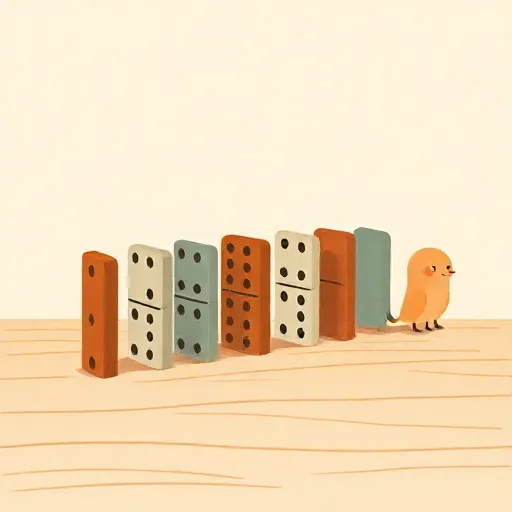
Another trap is the slippery slope argument. It takes a small first step and claims it will lead, domino by domino, to a terrible final outcome. “If you skip one homework assignment, you’ll get a bad grade, then fail the class, then drop out of school, and then you’ll never get a job.” Each step might be possible, but the argument ignores all the places where the chain could break — a teacher who offers extra credit, a different class where you work harder, a change of plans. Slippery slopes feel dramatic, but they often skip over the real-world wobbliness of life.
When the Attack Misses the Argument

Sometimes an argument gets derailed not by a flaw in the reasoning, but by a sneak attack on the person making it. Ad hominem (Latin for “to the person”) is the fallacy of rejecting someone’s idea because of who they are or what they’ve done. If a classmate proposes a plan for the science fair and someone else says, “Why should we listen to you? Last month you forgot your library book,” that’s an abusive ad hominem. The forgotten book has nothing to do with whether the science-fair plan is good.
A quieter version is the straw man fallacy. Instead of wrestling with a real argument, someone builds a flimsy fake version — a straw man — and knocks it down. If you say, “We should eat more vegetables,” and someone responds, “Oh, so you think we should never eat pizza again?” they’ve twisted your position into something extreme and easy to defeat. Both moves feel like winning in the moment, but they actually avoid the real conversation.
Locke noticed that people are also swayed by appeals that don’t engage with facts at all. An appeal to authority treats a famous person’s opinion as proof, even if they’re not an expert on the topic. (A movie star saying a certain kind of car is the best doesn’t make it mechanically superior.) An appeal to popularity follows the crowd instead of the evidence. These tactics aren’t always wrong — sometimes experts really do know best — but they become fallacies when they replace real reasoning rather than support it.
Why Spotting Fallacies Still Matters

Fallacies aren’t just dusty museum pieces from ancient philosophy. They show up in lunch-table debates, social media posts, political speeches, and advertisements every day. The same word tricks that Aristotle catalogued in Greece more than two thousand years ago are still causing confusion on your phone screen. When you learn to notice them, you’re less likely to be pushed around by a flashy but empty argument.
More than that, knowing about fallacies makes you a fairer arguer yourself. It’s easy to accidentally slip into begging the question or building a straw man when you really want to win a debate. Catching those habits helps you build arguments that stand on their own feet — and that earns respect from others. You don’t need to memorize every Latin name. You just need to keep asking, “Does this really follow?” That question is the heart of philosophy, and it’s yours to take anywhere.
Think about it
- If a friend argues that a movie must be great because “everyone on social media is raving about it,” how would you test whether that’s a good reason?
- Can you think of a time when someone attacked the person instead of the argument, and it made you doubt something true? Why did the trick work?
- Is it ever fair to use an appeal to popularity or authority in an argument? Where would you draw the line?