Do You Really Choose, or Was It Always Going to Happen?
The Boy Who Questioned Everything

In 1716, a thirteen-year-old boy named Jonathan Edwards (1703–1758) entered Yale College. He devoured the works of Isaac Newton (1642–1727) and John Locke (1632–1704), and he started two private notebooks — one about the natural world, another about the human mind. Edwards grew up in a family of New England ministers, and from his earliest years he was gripped by one huge puzzle: if God is all‑powerful and knows absolutely everything, do you and I ever really choose anything?
Edwards would go on to become a pastor, a leader of the Great Awakening revivals, and later a missionary to Native Americans. But his notebooks and his major treatises never let go of that puzzle. His answer — worked out with relentless logic — is both startling and unsettling. He argued that every single thing you do is determined by causes outside your control, and yet you are still morally responsible. He also insisted that true goodness isn’t just being nice to your friends: it’s loving the whole of reality, and that requires something he called a sense of the heart. Over the next few sections, we’ll walk through Edwards’s chain of reasoning — and then ask why it still keeps philosophers up at night.
The Domino Chain of Your Choices
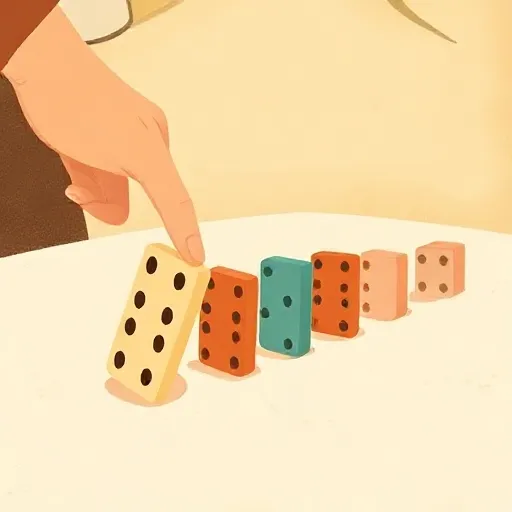
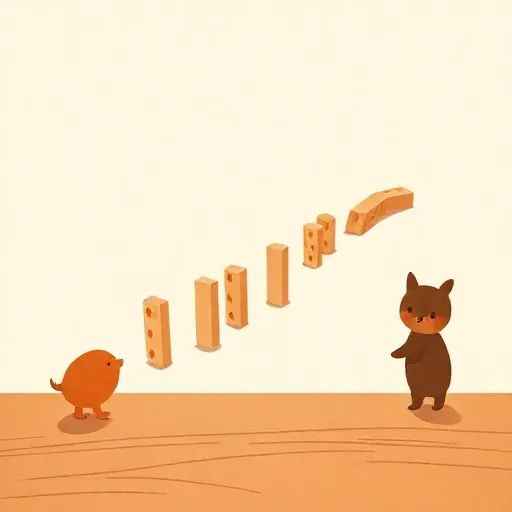
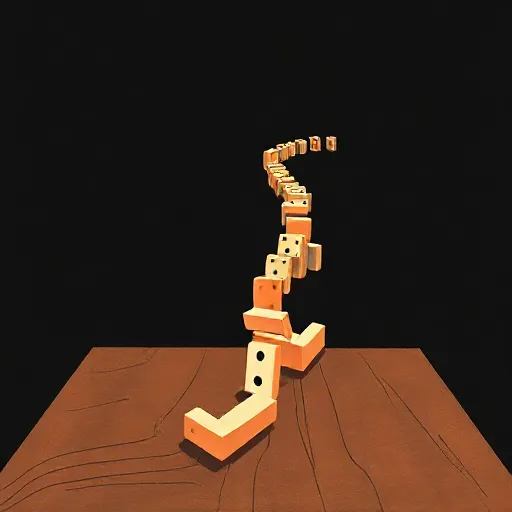
Edwards believed that human choices are completely determined. This position is called theological determinism — the idea that God’s plan fixes every event, including your every thought and decision. He thought the opposite view, called libertarianism (the idea that some choices are genuinely free in a way that isn’t forced by past causes), was simply incoherent.
He looked at what libertarians mean by a “self‑determined” will and found two possibilities, neither of which worked. If a free choice means that one act of willing is caused by another act of willing before it, then you have an infinite regress: you would need an endless chain of earlier choices just to make the first one. The second possibility is that a free choice has no sufficient cause at all — it just pops up. But if your acts of will happen accidentally, Edwards said, then they can’t make you “better or worse, any more than a tree is better than other trees because it oftener happens to be lit upon by a swan or nightingale; or a rock more vicious than other rocks, because rattlesnakes have happened oftener to crawl over it.” A random act, in other words, isn’t really your act, and you can’t be praised or blamed for it.
Edwards also argued that libertarianism clashes with ordinary moral judgment. If being forced to sin completely excused a person, then having a strong inner bias toward sin ought to partially excuse them. But in real life we do the opposite: a person who acts from deep‑seated malice is seen as more detestable, not less. So our natural way of assigning blame, Edwards noticed, assumes that character‑driven necessity does not cancel responsibility.
Why Your Choice Could Never Go the Other Way

Edwards backed up his determinism with two powerful arguments. The first rests on how motivation works. He claimed that willing is the same thing as your strongest inclination or preference. If you could choose against your strongest motive, you would have two opposite strongest desires at the same moment — which is logically impossible. So whenever you have a prevailing motive, your choice follows necessarily. It can’t be otherwise.
The second argument comes from God’s foreknowledge. If God knows the future perfectly, then he has always believed, say, that you will eat cereal on Tuesday. Because God’s belief can’t be wrong, your eating cereal must happen. His past belief is already fixed and can’t be changed by anything you do now. And if a necessary fact (the unchangeable past belief) guarantees a future event, that event is itself necessary. Edwards added a clever twist: even if someone says God is outside of time, there are still divinely inspired prophecies in the Bible — past utterances that are now fixed and that are linked to future human actions. So those actions are just as locked in.
Edwards was careful to keep a distinction between what he called philosophical necessity and vulgar (ordinary) necessity. In everyday speech, something is necessary if you can’t help it even if you want to — like being forced down into your chair. Causal necessity isn’t like that: a habit or a strong emotion may causally make you lash out, but that doesn’t mean you couldn’t have refrained if you had chosen differently. So the ordinary‑language idea that you’re only responsible when you act as you choose is fully compatible with determinism. Freedom, Edwards concluded, just means having the power and the opportunity to do what you will — not some spooky power to choose without any cause at all.
The Only Real Cause in the Universe

Edwards went further. He didn’t think created things have any real causal power of their own. This view is called occasionalism. Ordinary causes — fire heating water, one billiard ball striking another — are only “vulgar” causes. They are the occasions on which God produces the effect according to stable habits he has freely set up. Why?
A real cause, Edwards argued, must be present where and when its effect happens, must make the effect happen necessarily, and must be sufficient all by itself. Ordinary physical causes fail all three tests. A flame and the boiling water are distinct in space; the lighting of a match doesn’t force a fire to appear — it’s just what usually happens; and if second causes were enough, God’s activity would be a useless extra. God, by contrast, is not limited by space or time, his omnipotent will can’t fail to bring about what he intends, and he needs no help.
Edwards extended this reasoning to substance. Material things, he thought, are nothing more than collections of sensible ideas — colors, resistance, motion — that exist only in minds. A billiard ball’s solidity is just resistance; resistance itself is either a quality of our perceptions or a divinely maintained pattern of those perceptions. In the end, “the material universe exists only in the mind.” Human minds aren’t independent substances either. A mental substance would be something that subsists by itself and holds up mental properties; but Edwards concluded that only God’s active will does that. So what we call a spirit is just a stream of perceptions and ideas connected by divine laws. God is the only true substance and the only true cause. Edwards’s universe is a fabric of thoughts, held together second by second by God’s power.
True Virtue: Loving All of Being
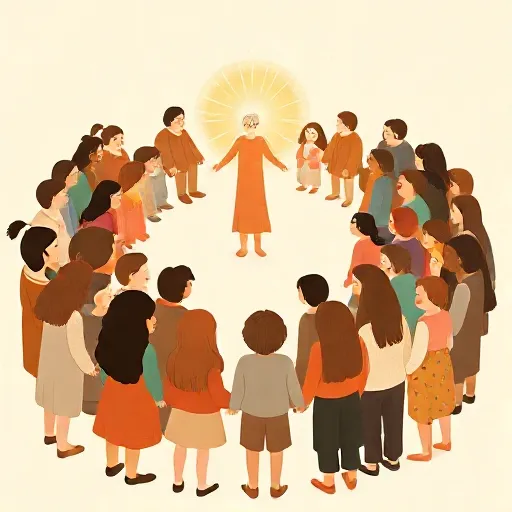
If God determines everything, and if he is the only real substance, what does it mean to be a good person? Edwards answered this in his short masterpiece True Virtue (published 1765). True virtue, he said, is benevolence to being in general — a settled desire to promote the well‑being of everything that exists, simply because it exists. It also includes complacence, a delighted approval of benevolence itself, whenever you see it.
Because God is infinitely the greatest, most beautiful, and most excellent being, true virtue must principally be a supreme love to God — both wanting his glory and delighting in his excellence. Any narrower loyalty, whether to yourself, your family, your country, or even the whole human race, is only a partial love. Edwards called such partial loves “counterfeits” of true virtue unless they are subordinated to a love of Being in general.
What about actions driven by conscience or by natural feelings like pity? Edwards acknowledged that these impulses are useful — societies would fall apart without them — but he denied that they are truly virtuous. He dissected conscience as a product of imagination, a sense of what fits, and self‑love. When you imagine yourself in the place of someone you’ve harmed, you feel uneasy because you seem to be at odds with yourself. That unease, said Edwards, is powered by self‑love, not by disinterested goodness. Even pity, which seems purely other‑regarding, fixes on a small slice of reality — people in severe distress — and can sometimes pull you away from treating all beings equally. True virtue, he concluded, is a supernatural gift, not something you can work up on your own.
Seeing with a New Sense

If true virtue is supernatural, how does anyone come by it? Edwards’s answer rests on what he called a sense of the heart. When God regenerates a person, he plants a new spiritual disposition — a love for being in general. That love is the basis of a new simple idea, an immediate perception of the beauty of holiness. Edwards compared it to a new color that someone has never seen before; you can’t build it by mixing other ideas, and you can’t describe it to someone who lacks it. Only the “saints” (the truly converted) possess this sense.
For Edwards, this spiritual perception isn’t a fuzzy feeling. It’s genuinely objective. Benevolence, he thought, agrees with the way things really are, because reality itself is held together by God’s infinite love. Delighting in benevolence for its own sake just is perceiving its spiritual beauty, much as seeing red is perceiving a real quality of surfaces. And because the new principle dwelling in the believer is actually God himself, acting from within the soul, the redeemed person’s vision can’t fail to match reality.
This sense also transforms reasoning. Edwards saw that accurate thinking requires vivid, concrete ideas, not vague words. To truly understand an argument about God’s justice or Christ’s sufficiency, you need to possess the right affections and the idea of spiritual beauty. Without them, the clearest evidence will seem weak or irrelevant. So right reasoning about religion, he claimed, depends on a heart that loves what is lovable.
Why It Still Matters

Edwards died in 1758, just weeks after becoming president of the College of New Jersey (now Princeton). He never finished the grand “History of the Work of Redemption” he dreamed of writing. But the questions he raised are very much alive.
When you stand in front of the fridge, deciding between chocolate ice cream and vanilla, it certainly feels like you could go either way. Edwards would say that feeling is real — you have the power to do what you want — but the wanting itself was fixed by your character, your circumstances, and ultimately by God’s plan. That thought can be uncomfortable. But it also makes you wonder: if everything about you is determined, does being a genuinely kind person require something more than just developing the right habits? Is there a depth of goodness — a love for all of existence — that you can’t reach on your own?
Edwards pushes us to think about what we really value. If the only love worth the name is love for being in general, then every clique, every “just us” loyalty, falls short. And if knowing the truth about the deepest things depends on your heart, not just your brain, then becoming a good thinker might be a whole‑person project. That’s a challenge that stretches far beyond a 1700s New England pastor. It’s a challenge for anyone who wants their mind and their life to line up.
Think about it
- If a supercomputer could perfectly predict every choice you will ever make, would it still be fair to praise or blame people for what they do?
- Can you love everyone equally — strangers, enemies, people far away — with the same care you give to your closest friends? If not, is that kind of universal love even something worth aiming for?
- Think of a time you suddenly saw beauty in something you had ignored for years — a piece of music, a landscape, an idea. Did something change in the world, or did something change in you?