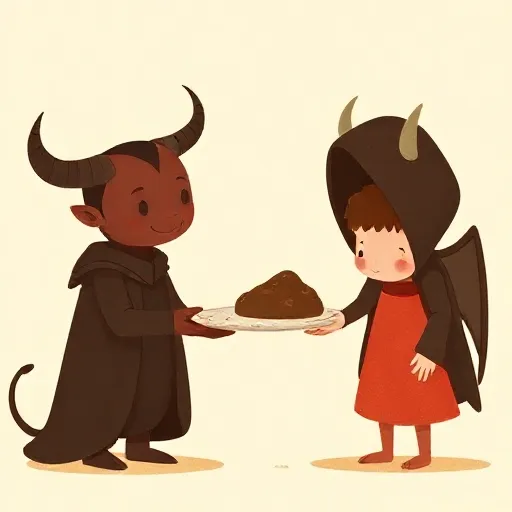

Can a Demon Make a Mud Pie Good? The Fitting‑Attitude Puzzle
A Demon, a Mud Pie, and a Question
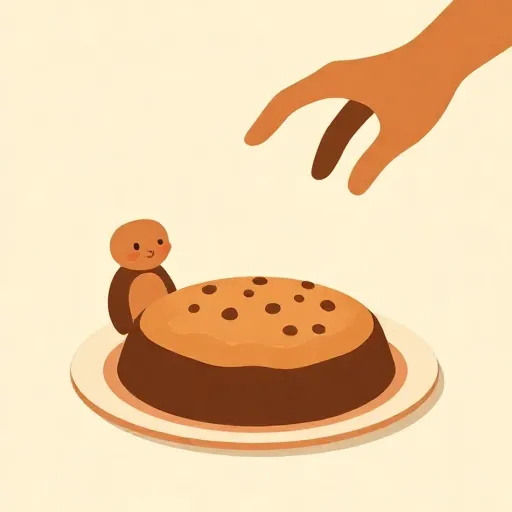
Imagine a terrifying demon appears and says, “You will die unless you love this mud pie.” Suddenly, you have a powerful reason to make yourself feel affection for a lump of dirt. But does that reason suddenly make the mud pie genuinely lovable? Hardly. The mud pie is still just mud — ordinary, worthless, and meant for nothing.
This strange scenario gets at one of philosophy’s oldest puzzles: what makes something valuable? Not just useful or pleasant, but truly good in a way that calls for admiration, respect, or love? Some philosophers think value isn’t a spooky invisible property. It’s just a matter of whether a certain human response — like admiring, fearing, or loving — is fitting. This is the central claim of fitting‑attitude (FA) theories. They say that saying “the Grand Canyon is awesome” means it’s fitting to feel awe; saying “a person is admirable” means admiration fits them. The demon’s threat fails to make the mud pie valuable because loving a mud pie isn’t fitting — the mud doesn’t merit love.
But as you’ll see, the idea is trickier than it sounds. For over a century, philosophers have argued about whether value can really be explained by our responses, and two big problems — the wrong kind of reason and value without anyone to value it — are still wide open.
From Mysteries to Fitting Responses
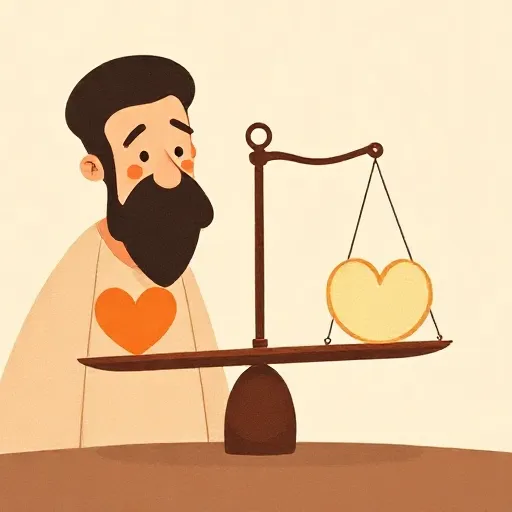
Long before FA theory became popular, many thinkers treated value as a basic, unexplainable quality. The English philosopher G.E. Moore (1873–1958) famously argued that good is a simple property, like yellow — you can’t break it down into simpler parts. According to this view, called primitivism, whenever something is good, that’s just a fundamental fact; you can’t explain why it’s good in any other terms.
Primitivism faced a tough challenge, though. In the mid‑20th century, Peter Geach (1916–2013) argued that there’s no such thing as being “just plain good.” Goodness, he said, is always attributive — a thing is good as a certain kind of thing (a good knife, a good joke), never good simpliciter (just plain good). If Geach is right, then Moore’s simple property crumbles, and all talk of something being “valuable in itself” is nonsense.
Enter FA theory. Its early defenders, like Franz Brentano (1838–1917) and Henry Sidgwick (1838–1900), proposed that value facts are not primitive at all — they are grounded in facts about what responses are fitting. Something is fearsome just because fear fits it; someone is admirable just because admiration fits them. In the contemporary version, most FA theorists say that evaluative facts are always explained by normative facts about human responses, and never the other way around.
The American philosopher T.M. Scanlon (born 1940) gave the idea a name: buck‑passing. On his account, to call something valuable is to say it has other properties that provide reasons for valuing it. The value itself doesn’t add any extra reason — the real work is done by lower‑level features (like a painting’s harmony or a person’s kindness). Value is just a label for the fact that those features give reasons for a positive response.
Why It Works So Well

For all its complications, FA theory has genuine strengths. First, it can explain why value and fitting responses always seem to go hand in hand. It’s nearly impossible to deny that something is valuable if and only if it’s fitting to value it (or that a joke is funny just when amusement fits it). An FA theorist can say: this isn’t a coincidence — the value fact is made true by the fact about fittingness.
Second, FA theory can give a crisp answer to skeptics like Geach. If “good simpliciter” means fitting to value, then the skeptic’s challenge melts away. We may not be able to point to a physical glow called “goodness,” but we can grasp the idea that certain things merit our appreciation — a beautiful landscape, a brave act — whether or not we label them “good” as a separate substance.
Third, FA theories unify the many varieties of value. A knife is good if it’s fitting for anyone who wants a knife to value it; a person is good in a distinct way; an outcome can be good for someone. All these different kinds of value, the FA theorist says, have in common that they can be fully explained in terms of which responses (admiration, desire, respect) are fitting for which agents. That’s a powerful unifying story.
The Wrong Kind of Reason
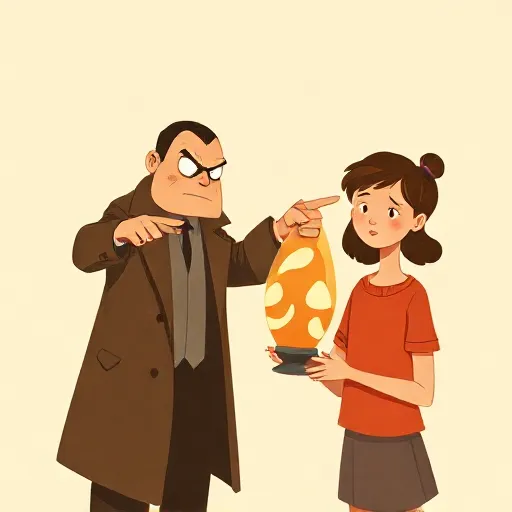
Now remember the demon. According to an FA theory that explains value entirely in terms of reasons for valuing, the demon’s threat would be a reason to value the mud pie. If value just is having reasons to value, then the mud pie would become valuable. But that can’t be right — the mud pie is still worthless. This is the Wrong Kind of Reason (WKR) problem.
FA theorists have two main replies. Some argue that the demon’s threat isn’t a real reason at all; it just gives you a reason to try to make yourself value the mud, not a reason to value it itself. But many find that answer hard to swallow. If you really had to save your life by loving the mud, wouldn’t that fact count in favor of loving it?
A more popular strategy concedes that not all reasons for a response are the “right” kind. Right‑kind reasons are those that make the response fitting — they show that the object merits the response. A demon’s threat might give a reason, but it doesn’t contribute to fittingness; the mud doesn’t earn your love. So many FA theorists now define their theories in terms of fittingness rather than just any reason. On this view, the threat fails to make the attitude fitting, so the theory no longer falsely predicts that mud is valuable.
The move to fittingness seems to solve the worst of the WKR problem. But skeptics point out that “fittingness” itself can feel a bit mysterious — we can’t observe it directly with our senses. So the debate isn’t over.
When No One Is Around to Care

Even if fittingness helps with the demon, a deeper challenge lurks: can there be value without any possible valuer? Philosopher Krister Bykvist asks us to imagine a world containing happy egrets but no past, present, or future beings capable of valuing anything. Plausibly, the egrets’ pleasure is good. But in that world, no one can have a fitting valuing response. So an FA theory seems forced to say the pleasure isn’t valuable — which feels wrong. This is the Wrong Kind of Value (WKV) problem.
One response is that the fittingness can still hold for us, in our world, even though we aren’t in that egret‑only world. The thought is: it’s fitting for any possible valuer (like you or me) to value the egrets’ pleasure, even if we happen not to be there. Another response claims that FA theories can be stated counterfactually: something is valuable if, were there any beings around, valuing it would be fitting. Both moves are clever, but they have their own complications — especially when we consider cases where valuing something would destroy its value, a scenario raised by Andrew Reisner.
The WKV problem may not sink all FA theories, but it raises a key point: perhaps FA theory works best for evaluative properties that are inherently tied to human responses — like shameful or disgusting — and less well for “bare” goodness that seems to float free of anyone’s reactions. Many FA theorists today embrace that kind of selectivity.
Why It Matters: From Mud Pies to Your Values

So where does this leave you, without any demon but with plenty of opinions about what’s worth caring about? Every time you defend why a song is “actually great” or a friend is “genuinely kind,” you’re tapping into the FA insight: that value is not just a private feeling, but something that can be backed by reasons, by pointing to features that make a response fitting.
The debate over fitting‑attitude theories isn’t just for dusty books. It shapes how we think about moral value, personal value, and even advertising. If a company bombards you with reasons to desire a product (it’s popular! it’s limited edition!), but none of those reasons make it fitting to truly admire the thing, has the product become valuable? The FA tradition urges us to ask: does the object merit the response, or just manipulate us into it?
Philosophers continue to wrestle with the wrong‑kind reasons, the egret problem, and the niggling fear that “fittingness” is too slippery. Yet the core idea — that value is deeply connected to what we owe the world in admiration, love, and awe — remains one of the most compelling attempts to demystify what makes life worth living.
Think about it
- If a mad scientist could make you sincerely love an ordinary rock, would the rock become valuable, or would your love be fake?
- Can you imagine something that is good even if no one, in any possible world, could ever appreciate it?
- When a friend argues that your favorite video game is boring, but you genuinely find it exciting, who is right about its value — and why?