Can You Be Happy Just by Thinking? Dante’s Bold Experiment
A Poet Without a City, Asking a Dangerous Question
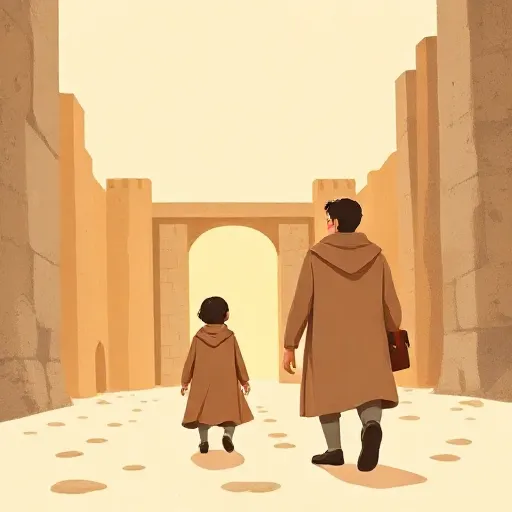
Florence, 1302. A poet named Dante Alighieri (1265–1321) is thrown out of his hometown. He will never return. He loses his money, his friends, his place in politics. For the next twenty years he wanders from city to city, writing some of the most ambitious poetry the world has ever seen.
During that long exile, Dante wrestles with a question many of us have asked: Can I find real happiness just by using my own mind? Not money, not power, not even romantic love—can thinking deeply and understanding the world be enough to make a person truly happy?
Dante’s life story is hard to separate from his poems, because he constantly rewrote his own past. He tells us he first met Beatrice Portinari when he was nine and she was eight, and that she became the inspiration for everything he wrote. He also claims—maybe with some creative storytelling—that his family descended from ancient Roman knights. What certainly is true is that he grew up in a Florence torn apart by warring factions, and that his banishment plunged him into a philosophical quest for meaning.
A Love That Pointed Beyond Itself

Before Dante turned to philosophy, he was one of a group of Italian poets who wrote about love in a new, brainy way. His early friend and rival, Guido Cavalcanti (c. 1255–1300), treated love almost like a biological force that could overwhelm reason. For Cavalcanti, falling in love was dangerous—a kind of blindness.
Dante started out sharing that view, but his own book of poems and commentary, the Vita Nuova (The New Life), shows him changing his mind. He decides to stop writing about his own suffering and instead devote his poetry entirely to praising Beatrice. In one of his most famous poems, he says that when she greets someone, that person is so humbled and transformed that it’s as if they’re saved from evil. Love isn’t just a violent accident anymore—it’s a path toward something higher.
This shift mattered enormously, because it cracked open the door to philosophy. If a human being could be so perfect, so beautiful, wasn’t she a sign of something greater? Dante began to wonder whether the mind could climb, step by step, toward a happiness that wasn’t just about feelings, but about understanding.
The Lady Who Was Wisdom: Can Reason Make You Happy?

In his unfinished book the Convivio (The Banquet), written around 1304–1307, Dante gives philosophy a face: a noble lady, the donna gentile. He describes falling in love with her. But this isn’t an ordinary crush. Philosophy is the “love of wisdom,” and Dante argues that through her, a person can achieve the highest natural happiness possible on earth—a state the philosophers called beatitude.
How does that work? Dante uses a bold metaphor. The universe, he says, is moved by heavenly intelligences—pure minds that turn the stars and planets because they are drawn by love toward God. Human beings, too, have intellect, a spark of that same mind-power. When we truly come to know something, we share, in a small way, in that cosmic activity. As Dante puts it, philosophy “has for its subject understanding and for its form an almost divine love for what is understood.” Loving wisdom brings the mind close to God, without ever needing a church.
But there’s a catch. The Convivio is full of tension. At times Dante insists that our natural desire for perfect knowledge can never be fully satisfied in this life—we’re too limited, we see only “as if in a dream.” At other moments he can’t resist claiming that philosophy actually unites us with divine wisdom, almost as if we ourselves became one of those heavenly intelligences. Scholars still argue about what Dante really believed: was he saying that human reason by itself could save us, or just that it gives us a temporary taste of salvation?
The Emperor, the Pope, and the Two Suns

Dante didn’t just think about personal happiness. He was also convinced that reason had a public, political job. In his Latin treatise Monarchia, he makes a startling claim: the entire human race needs a single world emperor, and that emperor’s authority does not come from the Pope.
Why an emperor? Because Dante believed that humanity as a whole has one mission: to actualize its full intellectual potential. Just like one ship needs one captain, all of humanity needs one ruler to keep peace and direct everyone toward wisdom. That ruler must follow philosophy, especially the ethics of Aristotle (384–322 BCE), to know what true justice and nobility are.
Dante’s most daring position is that God has set two separate goals for us. The first is happiness in this life, reached by practicing moral and intellectual virtues under the guidance of philosophy. The second is eternal happiness after death, which requires faith and the theological virtues, given by the Church. One path is not simply the servant of the other. The Emperor and the Pope are like two suns, each lighting a different road. This was a radical idea in an age when Popes claimed authority over kings. Dante’s vision, in the Monarchia, pushes philosophy’s authority right up to the edge of heaven.
Beatrice Returns and Changes Everything

Dante’s greatest work, the Divine Comedy, takes all this and weaves it into a story. The poem is a journey through Hell, Purgatory, and Heaven. The guide for most of the trip is the Roman poet Virgil, who stands for the highest human reason can achieve. But at the top of Mount Purgatory, Beatrice takes over. She is no longer just a girl he loved; she becomes a symbol of divine wisdom that philosophy can hint at but never fully deliver.
The Comedy is tricky to interpret. It gently pokes fun at the overconfidence of pure philosophy. Even Aristotle, the “master of those who know,” lives in Limbo, a place of sadness because the souls there have no hope of seeing God. Reason got them so far, but not far enough. Yet philosophy isn’t thrown away. Dante still fills his poem with philosophical arguments, cosmic diagrams, and debates about free will. The idea seems to be: you can’t reach the mountaintop without climbing the lower slopes first. Philosophy is the necessary training ground, but it isn’t the final summit.
The poem also leaves us with a puzzle about Dante’s own earlier claims. Did he change his mind after the Convivio? Or did the Comedy dramatize a tension that was always there—the human desire to find ultimate happiness through thought, versus the need for something that thought alone cannot give?
Why It Still Matters

Dante’s struggle belongs to a world of medieval politics and gorgeous poetry, but the question is entirely ours. You’ve likely felt the thrill of finally understanding something—a tough math problem, why a story hits so hard, how the planets move. That spark can feel like pure happiness. Is it enough? If you could spend your whole life learning and reasoning, would that be a good life? Or does that leave out something essential, like love, or beauty, or a sense of belonging to something bigger than yourself?
Dante never gave a tidy answer. He wrote a book that makes philosophy look like a divine woman, and then he wrote a poem where that woman can only take you so far before something else is needed. That tension is why people still read him, not just for the poetry, but for the honest, unresolved wrestling with what it means to be a thinking human who also longs for happiness.
Think about it
- If you could spend your life studying and understanding everything, but you were always alone, would you be truly happy?
- Dante believed both a world emperor and a spiritual leader were needed for a good society. Do you think one person could ever rule the whole world justly?
- Dante used philosophy to get closer to God; others use it to reject the idea of God. Can reason be trusted to settle the biggest questions, or does it depend on what you already believe?