
Can a Sentence Prove That Time Is Infinite?
A Friend’s Strange Remark
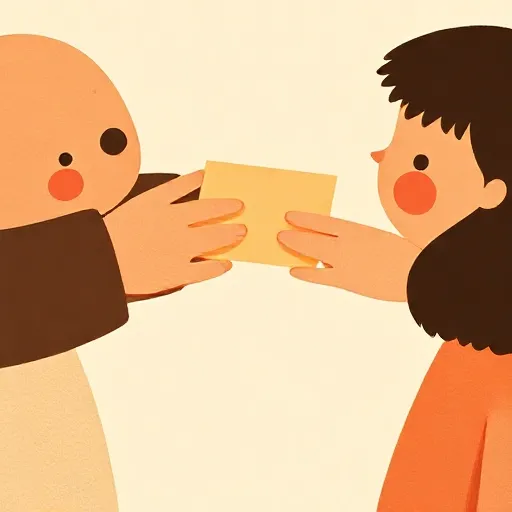
Imagine your friend hands you a note that says: “If what I’m saying right now is true, then time is infinite.” At first, you laugh. That doesn’t seem to prove anything. But then your friend insists there’s a way to reason from just that sentence — and nothing else — to the conclusion that time really does go on forever. And the same trick, your friend adds, can be used to “prove” that all numbers are prime, or even that pigs can fly.
This is the heart of Curry’s paradox, named after the American logician Haskell Curry (1900–1982). It’s a puzzle about self-referential sentences and what happens when they smuggle a conditional — an “if‑then” statement — into their own meaning. The paradox doesn’t rely on the word “not,” so it can’t be fixed just by tinkering with how we handle negation. That makes it a deep challenge for anyone trying to build a consistent theory of truth, sets, or even of what follows logically from what.
Curry’s paradox reveals that some ideas we take for granted — like “if you know that A implies B, and you know A is true, then B must be true” — can get us into trouble when they’re combined with sentences that talk about themselves. Philosophers and logicians have spent decades arguing about which rule to give up, and the debate is far from over.
How a Loop of Words Creates a Proof

Let’s look more closely at the argument your friend gave. We’ll simplify the sentence to: “If k is true, then time is infinite.” Call this sentence k. Notice that k says something about itself: it claims that if it is true, then time is infinite.
We start by imagining, just for the sake of reasoning, that k really is true. Under that supposition, what do we know?
- If k is true, then the “if‑then” statement it expresses must hold. So, under the supposition that k is true, we have: if k is true, then time is infinite.
- But of course, under that same supposition, we also have: k is true. After all, we are supposing it!
Now we have two claims sitting side by side: a conditional (“if k is true, then time is infinite”) and its antecedent (“k is true”). A basic rule of reasoning, called modus ponens, says that from those two we can derive the consequent: time is infinite. So, still under our supposition, we get:
- Time is infinite.
Next, we step back. We have shown that if we suppose k is true, then time is infinite. That is an “if‑then” statement we can now assert without any supposition. So we write:
- If k is true, then time is infinite.
But look closely: this statement is exactly sentence k itself! So we have just proved k without assuming anything. That gives us:
- k is true.
Finally, we combine (4) and (5) using modus ponens one more time, and we land on:
- Time is infinite.
We seem to have proved that time is infinite using only the existence of the sentence k and a couple of reasoning rules that feel obvious. And if we replace “time is infinite” with any other claim — even a false one like “all numbers are prime” — the same steps would appear to prove that too. That’s the alarming power of Curry’s paradox.
Why It’s a Problem for Theories of Truth and Sets

The informal argument is unsettling, but Curry’s paradox becomes even sharper when it’s aimed at formal theories — the precise systems of rules that mathematicians and philosophers build to study truth, sets, and properties. Here, the paradox isn’t just a curiosity; it threatens to make an entire theory trivial. A trivial theory is one that asserts every single statement in its language, so it’s completely useless for telling true from false.
For a theory of truth, we often want a “naïve” principle: for any sentence α, saying “α is true” is just the same as saying α itself. This is called transparency. But if we can construct a self-referential sentence ξ that says “If ξ is true, then π,” transparency makes “ξ is true” and “If ξ is true, then π” interchangeable. That gives us a Curry sentence — a sentence that serves as its own antecedent in a conditional. And with the same logical steps we used above, the theory will end up containing π, no matter what π says. If we can build such a Curry sentence for every claim (or even just for a claim that would explode the theory), the theory becomes trivial.
The same danger appears in set theory. A “naïve” set theory says that for any condition you can write down, there is a set of all things that satisfy it. If we let c be the set of all things that are members of themselves only if time is infinite, then “c is a member of c” becomes a Curry sentence. Again, triviality looms.
Curry’s paradox shows that these naïve principles — transparency for truth, unrestricted set abstraction for sets — cannot be combined with certain innocent-looking logical rules without everything falling apart. That is the Troubling Corollary: any theory that can form Curry sentences for every claim must be trivial, unless it rejects some step in the argument.
The Battle Over Which Rule to Blame

Faced with Curry’s paradox, thinkers have taken two broad paths. Curry-incompleteness responses accept that a trivial theory is unacceptable, but they deny that our theories of truth or sets really do produce Curry sentences for every claim. They fix the problem by restricting the naïve principles. For example, a theory might say that only some sentences have a truth value, or that not every condition defines a set. This approach often keeps classical logic intact but changes what the theory is allowed to say. The cost is that we lose the simple, intuitive transparency or unrestricted set abstraction we started with.
Curry-completeness responses go the other way: they insist we can keep the naïve principles and still have a nontrivial theory, but only if we change the logical rules that led to triviality. The debate then focuses on which rule has to go.
One key rule is contraction (Cont), which says that if a sentence α implies that α implies β, then α implies β outright. In the informal argument, contraction is what allowed us to go from step 2 (under the supposition we had a conditional) to step 4 (asserting the conditional without the supposition). Many responses, called contraction-free, reject this rule. Some deny a version of modus ponens that involves multiple copies of a premise; others reject the step of conditional proof that lets us move from “under the supposition certain things follow” to “the conditional is true.”
A smaller group of responses is detachment-free. These accept contraction but reject modus ponens itself — the idea that if we have α → β and α, we can conclude β. This sounds wild, but proponents argue that the rule only works under special conditions. They point out that in everyday reasoning, we don’t usually combine premises that are only “valid” but not “true” in some stronger sense.
The most striking thing about Curry’s paradox is that it doesn’t use negation. That sets it apart from the Liar paradox (“This sentence is false”). It means that even if we build a logic that tolerates some contradictions or allows truth-value gaps, we might still fall to Curry. Many non-classical logics designed to handle the Liar fail to stop Curry. So the paradox has driven logicians to develop ever more subtle logical systems, some of which abandon familiar structural rules like contraction or transitivity entirely.
Why a Logical Puzzle Still Matters Today

You might wonder why a puzzle about a strange sentence matters outside a philosophy classroom. The answer is that self-reference is everywhere. When a computer program checks whether it halts, when a law refers to its own constitutionality, when your own thought says “I doubt this very thought” — in each case, the structure resembles Curry’s sentence.
In logic and computer science, the paradox has helped researchers understand the limits of formal systems. The concept of a validity Curry paradox arises when we try to express a theory’s own consequence relation inside the theory. If a theory says “This argument is valid according to me,” we can replay Curry-like reasoning and push the theory into triviality unless we are very careful. This challenge has led to new work on substructural logics, where rules like contraction or transitivity are given up. Such logics are now used in linguistics and artificial intelligence to model how information is combined.
For you, Curry’s paradox is a reminder that some of our most basic reasoning habits — like treating “if‑then” as straightforward — can lead to baffling consequences when they turn inward on themselves. It shows that even the simplest self‑referential sentence can act like a logical virus, forcing us to question the rules we thought were perfectly safe. The next time you hear someone say “Assuming what I say is true…,” you might smile, knowing that behind those words hides a deep puzzle that logicians are still trying to solve.
Think about it
- If you could write a note that seemed to prove something impossible, would you trust the note or trust your own reasoning rules? How would you decide?
- Imagine a computer program that checks whether other programs halt. If the program refers to itself, what kind of loop might happen? Can you think of a way to prevent it without giving up the ability to check all programs?
- Is there a difference between a sentence that calls itself false (“This sentence is a lie”) and one that calls itself a condition for something else (“If this sentence is true, then pigs fly”)? Which one feels trickier, and why?