
Can You Trust That the World Is Real? A Medieval Puzzle
A Strange Eclipse and a Sharper Question

In the early 1330s, a Dominican friar named William Crathorn (early 1300s) lectured at Oxford on a book called the Sentences. He had a careful mind and a taste for picking fights with the most famous philosopher of his day, William of Ockham (c. 1287–1347). But Crathorn did not just criticize — he built an astonishing picture of what happens inside your head when you think, look at a tree, or wonder if anything outside you is real. His answer: when you think of something white, part of your mind actually turns white. That claim opened a door to deep doubt, and Crathorn walked right through it.
To understand why he went so far, you have to climb inside a medieval debate about how we know the world. Crathorn thought the only way the human mind touches reality is through species — mental likenesses that resemble the things around us.
The White Feather in Your Mind

Crathorn borrowed an idea from Roger Bacon (c. 1214–1292): objects send out “species” through the air, like light spreading from a candle to illuminate a wall. A species is a kind of messenger that travels from a thing to your senses, carrying the thing’s qualities with it. But Crathorn pushed this idea harder than Bacon ever did. He insisted that the species you receive in your mind has exactly the same nature as the quality outside. It is not a fainter copy — it is the very same kind of material quality, just now living inside you.
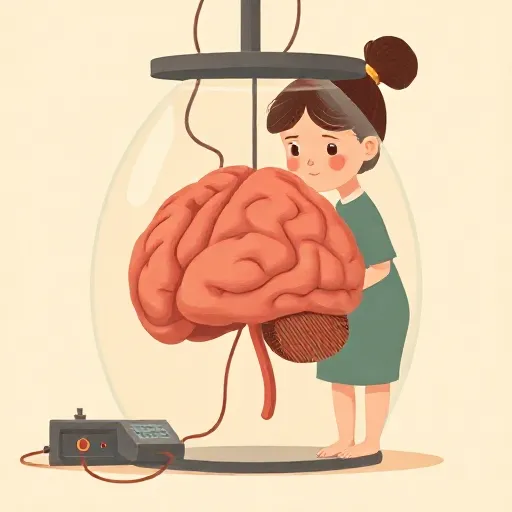
That means when you stare at a snowbank, the whiteness you experience is not a picture or a symbol. Crathorn would say that whiteness itself, as a real quality, now exists subjectively in your soul — he even located it in a particular part of your brain. The word “cognition,” he wrote, just is that quality existing in the mind. There is no difference in being between the white outside and the white inside, only a difference in location.
This leads to a breathtaking rule: your mind can hold only qualities, never substances. If you tried to think of a substance — a whole dog or a human being — your mind would have to become a new substance, which Crathorn thought was impossible. You cannot become a dog by thinking of one. So all your natural concepts are concepts of qualities: whiteness, heat, roundness. When you think of a hot fire, your mind literally heats up in a certain brain chamber. When you imagine something infinite, you run into trouble — your mind would have to become infinite. Crathorn took this as proof that you can only ever naturally know the qualities of things.
How Do You Know the Chair Is Real? The Big Doubt

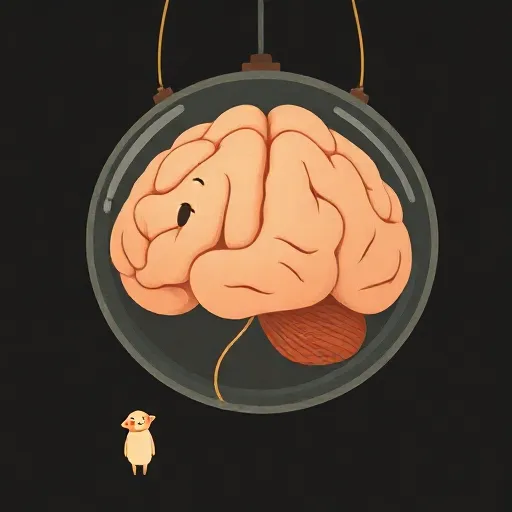
Now comes the twist that makes Crathorn unforgettable. If you only ever meet qualities inside your mind, and those mental qualities are identical in nature to outer qualities, how can you tell the difference? If the whiteness in your brain feels exactly like the whiteness on a feather, you have no evidence that the feather itself exists. You might be trapped in a private mental movie, with no way to peek outside the screen.
Crathorn faced this skeptical challenge head-on. He agreed that, naturally, you cannot be certain that an external world matches your experience. Your unaided reason cannot prove that the chair you see and feel is anything more than a collection of qualities dancing in your head.
His solution was as radical as the problem. He appealed to a principle that he claimed was known per se — self-evidently true: God does not produce an effect supernaturally in order to lie or to lead people into error. Because a benevolent God would not systematically trick you with illusions, you can trust that the qualities in your mind usually come from real things. The only escape from total doubt, Crathorn thought, runs through the character of God.
But then you might worry: is that principle itself certain? What if you doubt even that? Crathorn had one last move, drawn from Augustine (354–430). He argued that even if you doubt everything, you cannot doubt your own existence, because doubting is a mental activity you must be doing. The proposition “I am” is impossible to doubt — if you did not exist, you could not doubt. So at the very least, you are certain of your own thinking mind. This is an early version of the famous cogito argument, which most people associate with René Descartes (1596–1650), centuries later. Crathorn got there first.
Do You Think in a Secret Language? Not According to Crathorn

Many of Crathorn’s contemporaries, especially Ockham, believed that all human thinking happens in a universal mental language — a natural system of concepts shared by every person, regardless of which spoken tongue they learned. Words like dog or tree were supposed to attach to these shared mental signs.
Crathorn rejected that. Because he held that your mind contains only qualities and no mental substances, most words cannot correspond to natural mental likenesses. What natural mental copy could stand for a logical particle like “if” or “but,” or for a verb like “runs”? None, he argued. So mental language cannot be natural. It must be conventional, just like English, Latin, or Arabic. More than that, Crathorn insisted that conventional spoken language comes first: you learn a public language, and then your inner voice just internalizes it. When you think to yourself in sentences, you are using a mental reflection of the speech you hear around you. If you were raised speaking French, your inner monologue runs in French — not because you translate from a secret mental code, but because thoughts are the echoes of the words you learned.
This made Crathorn a lone voice in his century. He was the only thinker of his time to say that public, conventional words are more basic than private mental ones. Meaning is born in a community of speakers, and only later sinks into the solitary mind.
Why It Still Matters: Scratching the World Through a Screen

You probably do not go around worrying that your mind turns white when you picture a polar bear. But Crathorn’s questions have not disappeared. He was asking something kids today understand in their bones: how can you be sure that what you see, hear, and feel matches a world outside you, and not just a vivid simulation inside you? Every time you get lost in a dream and believe it’s real until you wake up, you live a tiny version of his doubt. When you watch a video or put on virtual reality goggles, you are dealing with mental copies — not the things themselves.
Crathorn gambled that a trustworthy God guarantees the connection. Later thinkers tried different guarantees, but the basic worry remains. Even if you don’t share his medieval answer, you are stuck with his problem. The white feather you perceive might be bright and certain, but the step from that sensation to a real feather outside you is a leap. Crathorn was one of the first to measure how far that leap really is.
Think about it
- If you close your eyes and imagine a ripe lemon, the yellowness feels present in your mind. Could you prove to someone else that there is a real lemon on the table, not just the mental one? If so, how?
- Suppose you grew up speaking a secret language only your family used. Would the inside of your thoughts sound different? Could you still think the same thoughts if you never learned any language at all?
- If a friend said “every time you see a chair, you are seeing qualities in your brain,” how would you test whether the chair exists outside your mind? Is there any test that could never be fooled?