
Is It Corruption If No Law Is Broken?
The Boxer Who Took a Dive
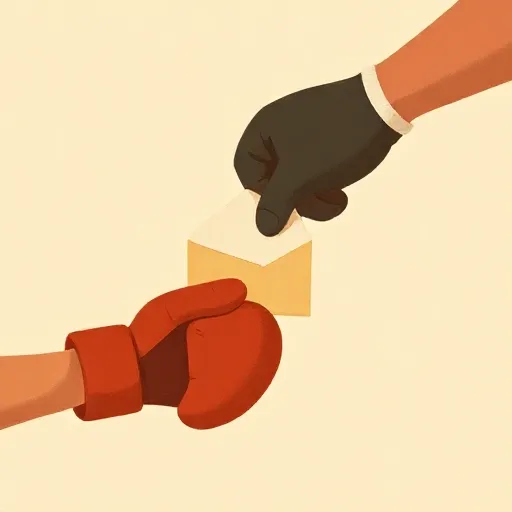
It’s the last round of a championship fight. The crowd roars. But the stronger boxer, muscles tensed, suddenly drops his fists and lets a punch land that he could easily have dodged. He loses. Later, reporters discover a gambler paid him to throw the match. Most people call this corruption — the boxer sold the outcome for private gain. Yet neither the boxer nor the gambler holds a public office. They aren’t government officials. Is it still corruption?
For a long time, many thinkers defined corruption simply as “the abuse of public office for private gain.” That definition works well for a politician who takes a bribe to steer a contract to a friend. But it crashes against the boxer. The boxer’s cheat feels just as rotten. So maybe the definition needs to stretch — maybe corruption isn’t only about public offices. That single, stubborn example cracks a seemingly solid idea, and once you notice the crack, the whole definition begins to crumble.
Why a Neat Definition Is So Hard
Trouble multiplies as soon as you leave the boxer behind. A citizen who lies under oath in a trial isn’t a public official, but her lie corrupts the court’s whole job — finding the truth. A police officer who fakes evidence to guarantee a conviction might not seek private gain at all; he may genuinely believe the suspect is guilty and deserves punishment. Yet the act still pollutes the judicial process.
Now consider bribery and nepotism. Many people think bribery is the heart of corruption, but nepotism — handing jobs or favors to relatives without fair competition — is also corrupt, and it works differently. The nephew who gets a cushy job doesn’t have to pay his uncle back. No envelope changes hands. Furthermore, corruption isn’t always illegal. Before 1977, it was perfectly lawful for U.S. companies to bribe foreign officials to win contracts. Was that not corruption simply because the law allowed it? Few would accept that. Corruption also doesn’t need to be economic: a professor who plagiarizes someone else’s work to boost her academic reputation commits a corrupt act without pocketing a cent.
Philosophers began to see that corruption belongs to a different category from a simple crime. It is fundamentally a moral wrong — one that attacks the purpose and the process of an institution, and often eats away at the character of the people inside it. It is a special species of immorality, not the same as genocide or theft, even though it sometimes travels with them.
The Causal Theory: Corruption as a Slow Poison
If corruption is a moral wrong that damages institutions, how exactly does the damage happen? The causal theory (developed by the contemporary philosopher Seumas Miller) answers that an action is corrupt if it has a corrupting effect: it undermines an institution’s legitimate goals or processes, or it despoils the moral character of someone acting in an institutional role — like a judge, a teacher, or a police officer.
Not every harm to an institution counts. If a country slowly cuts court funding over decades, and no one notices that judges are becoming sloppy, the justice system corrodes. But institutional corrosion is different from institutional corruption. Corruption requires that the harm could be avoided and that the people involved bear moral responsibility. Someone has to choose the action that does the dirty work.
A single free hamburger given to a police officer seldom corrupts. But if the same restaurant keeps handing out free meals and, over time, that police station starts giving the restaurant round‑the‑clock protection while ignoring others, a corrupt pattern has formed. Habits matter enormously. As Aristotle noticed long ago, your habits shape your character. A person who repeatedly takes small shortcuts gradually displaces virtues like honesty and impartiality with vices. And when many people in an institution develop the same bad habit, the whole system can lock itself into a collective action problem. Imagine every company bidding for government contracts pays bribes because any company that refuses gets ignored. Everyone hates the practice, yet everyone feels trapped. The structure itself becomes corrupt, even if each individual feels forced.
Sometimes a single, one‑off act can still corrupt. A lone bribe that successfully twists a specific tender process corrupts that process, even if the giver and taker never do it again. So the causal theory rides on effects — on what an action does to the institution and to the character of the people inside it.
When Campaign Money Twists Democracy
Nowhere are the puzzles of institutional corruption sharper than in politics. Two contemporary thinkers, Dennis Thompson and Lawrence Lessig, have built influential theories around a single, uncomfortable question: When does a campaign contribution become something dirtier?
Thompson points to cases like the American savings‑and‑loan scandal involving Charles Keating. Keating poured money into the campaigns of several senators. Later, he asked those senators to pressure a regulator to go easy on his company. The senators did not pocket the cash personally — the money funded their elections. But Thompson argues that this is still institutional corruption because it creates a strong tendency for public officials to favor the private interests of their donors, even without an explicit “you scratch my back, I’ll scratch yours.” The damage lies in the appearance of a conflict of interest that shatters public trust in the whole political system.
Lessig takes a different slice. He says the U.S. democratic process suffers from dependence corruption. To get elected, a candidate depends not on all citizens equally but on a tiny, wealthy group he calls “Funders.” Ordinary people vote only in a second, general election — and only among the candidates the Funders have already bankrolled. This dependency, Lessig claims, corrupts the principle that the people as a whole should decide who governs them. Strikingly, he insists that the politicians trapped in this system need not be bad people; they could be “good souls” who simply follow the rules of a rigged game. Yet the game itself is corrupt.
Thompson’s and Lessig’s ideas reveal that institutional corruption can be systemic — built into the machinery of how an institution runs — even when no single person feels like a crook. That makes the problem both invisible and extremely hard to fix.
The Noble Cause Paradox

Imagine a parent whose child will die without urgent treatment in another country. The immigration rules block entry. The parent slips an official a bribe to let the family through. The motive is admirable — saving a life. Yet the bribe undermines the immigration system and corrupts the official. Philosophers call this noble cause corruption: doing something morally wrong in pursuit of a perceived good.
Real life offers plenty of examples. A police officer might fabricate evidence to lock up a dangerous criminal she knows is guilty. A whistleblower might pay off an inspector to expose a life‑threatening factory defect faster. In each case, the action still damages an institutional purpose — fair trials, impartial inspections. The corruption hurts, even if you cheer for the outcome.
Does a good intention ever make a corrupt act not corrupt? Few philosophers think so. The causal theory, for instance, keeps its eyes on the effect. A bribe that secures a false verdict corrupts the court, no matter how noble the briber’s heart. But some situations get hazy. An undercover agent who pretends to bribe a judge in a sting operation to catch real criminals may not produce a corrupting effect — the judge is already rotten, and the “bribe” never actually buys a distorted ruling. In that case, philosophers might say no corruption occurred at all. Yet if the same sting, while continued, leads to real verdicts being bought, then it crosses back into corrupt territory. The line between justified deception and genuine corruption is thin and fiercely debated.
Why It Matters to You
You don’t need a senate race to meet corruption. A teammate who sneaks a banned supplement, a student who copies homework and pressures others to stay quiet, a class election where the winner promises pizza for votes — these are miniatures of the same patterns. They attack the purpose of the activity (fair learning, honest competition) and they nibble at character.
Societies build integrity systems to fight back: honor codes in schools, anti‑doping agencies in sports, independent auditors in companies, anti‑corruption commissions in governments. Those systems combine rules, monitoring, and punishment with efforts to shape people’s motivations — ethics classes, transparent reporting, rewards for whistleblowers. But they work only when enough people genuinely care. Plato warned long ago that a democracy can rot from inside if citizens start to shrug at open cheating. A corrupt environment thrives when we stop calling it out.
Deciding where the line lies — between a harmless favor and a corrupt habit — is one of the trickiest moral puzzles. The next time a politician takes a donation, a star player gets a “special pass,” or a friend asks you to look the other way, you might find yourself asking the question that keeps philosophers awake: Is this just how the game is played, or is it slowly poisoning something important?
Think about it
- If a coach secretly orders pizza for the whole team after every win, is that a generous tradition or could it start to corrupt the team’s loyalty? Where would you draw the line?
- A student fakes a doctor’s note not for herself but to help a friend with a family emergency skip an exam. Is that a corrupt act? Why or why not?
- If everyone in a country believes paying a small bribe to speed up a passport is normal, does that make it okay? What would need to change for people to see it as corruption?