
Who Decided We Drive on the Right?
The Restaurant Rendezvous

Imagine you and your best friend both want to grab pizza after school, but you forgot to pick a spot. You cycle to Tony’s. They bike to Luigi’s. You each wait, eating alone. This is a coordination problem: a situation where you each need to choose the same action to get what you want, but there are several equally good ways to do it. You had no way to communicate, so you guessed wrong.
Now imagine a world where, every time this happens, people somehow end up at the same restaurant. Not by miracle, but because a pattern has emerged. Everyone just knows that “after school we go to Tony’s.” Nobody wrote it down or passed a law. Philosophers call this a convention: a regularity in behavior that sticks around because people expect everyone else to follow it, and it solves a recurring coordination problem.
How do such invisible rules arise? Can they be changed? And are things like money, property, and even the meaning of words just conventions we’ve forgotten we made up?
Hume’s Boat: A Sense of Common Interest

The Scottish philosopher David Hume (1711–1776) was one of the first to think deeply about conventions. He gave a simple, unforgettable example: two men sitting in a rowboat. To move forward, they must pull their oars at the same time. They don’t sign a contract. They don’t even speak. Yet they synchronize perfectly. Why? Because each man knows that it’s in his own interest to row when the other rows, and vice versa. A sense of common interest—felt internally and perceived in the other person—guides them.
Hume argued that huge parts of society work exactly like that. Take property. In a world without rules, anyone could grab anything. But that leads to constant fighting. Over time, Hume said, people settle into a convention that each person leaves others’ stuff alone, as long as others do the same. This isn’t a signed agreement; it’s a pattern that grows because it benefits everyone, given that others follow it.
Even promising, Hume thought, rests on convention. The phrase “I promise” only commits you because we all treat it as a signal that you’ll accept punishment if you break your word. Again, no central authority is needed. The convention sustains itself, because each person has reason to conform so long as others do.
Lewis’s Grand Theory
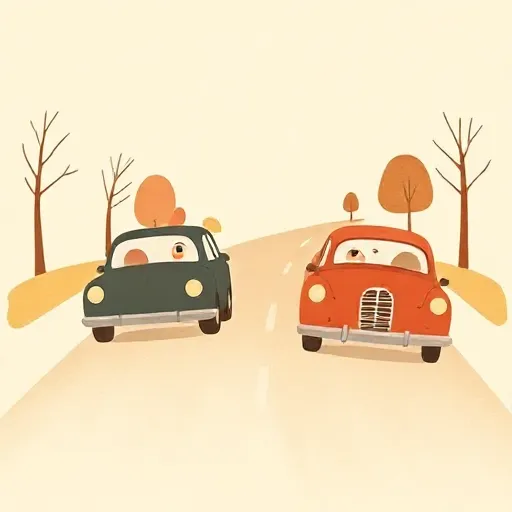
Two centuries later, the American philosopher David Lewis (1941–2001) turned Hume’s insight into a precise theory using game theory, the mathematics of strategic choices. Lewis said a convention arises when a group faces a recurring coordination equilibrium—a situation where several actions would work, but only if almost everyone chooses the same one. Think of driving: you can drive on the right or the left. Both work fine, but you need everybody else to do the same as you. So a convention is an arbitrary solution that nobody wants to deviate from, because doing so would make things worse for you and everyone else.
Lewis added a crucial ingredient: common knowledge. It’s not enough that I know we drive on the right. I must also know that you know, and that you know that I know, and so on. This endless loop of mutual awareness is what glues the convention together. If I think you might not know the rule, I’ll get nervous and might deviate, which could lead to a crash.
This account also explained why conventions feel arbitrary. There must always be at least one genuine alternative that could have served the same purpose. In the United States people drive on the right; in the United Kingdom they drive on the left. Neither side is “more rational.” History, accident, or simply who started first made the difference. Lewis’s definition captured the idea that conventions are choices we make—not dictated by nature or logic—but choices we all need to share.
Why That One? Focal Points

If there are multiple possible conventions, how do we ever settle on one? Lewis borrowed an answer from Thomas Schelling (1921–2016) and his famous experiment. Schelling asked people where and when they would go to meet a friend in New York City if they couldn’t communicate. Overwhelmingly, respondents said “noon at Grand Central Station.” That time and place, for whatever reason, just stood out. Schelling called it a focal point, and Lewis called it salience.
Salience can come from precedent. Once people see a pattern, it sticks out even more. The first time you drove on the right side might have been arbitrary; after that, it’s overwhelmingly obvious which side “everyone” uses. Other times, the properties of the options themselves make one leap out: a round number, a central landmark, a bright color.
Critics point out that salience is a slippery idea. Why should I trust that you’ll recognize the same focal point? And sometimes nothing is salient. Yet in the real world, people consistently converge. Lewis didn’t claim to fully explain how salience works psychologically; he just argued that any theory of conventions had to include something like it, because pure rationality alone can’t break a tie between perfectly symmetrical choices.
Words Are Conventions Too

Perhaps the most intimate convention you use every day is language. The ancient Greek philosopher Hermogenes argued that no word belongs to a thing by nature; a name sticks only because people agree to use it that way. You call a furry pet a “cat” not because the sound “cat” is like a purr, but because you grew up around people who treat that sound as a symbol. This is a linguistic convention.
Lewis tried to explain this too. He said a language is used by a group when there is a convention of truthfulness and trust: speakers mostly try to say sentences that are true in that language, and hearers mostly believe what they hear. Because everyone wants to communicate, each person has a reason to be truthful and trusting, which keeps the convention going.
But this picture runs into trouble. First, do we always trust each other? People lie, joke, and exaggerate all the time. A convention that depends on universal truthfulness seems fragile. Second, and deeper: there are infinitely many possible sentences. You can understand “The purple platypus tap-danced on the ceiling” even though you’ve never heard it before. If meaning were just a convention applied to whole sentences, you’d need to learn a separate convention for each one—an impossible task. Instead, you grasp the meanings of words and rules for combining them. So some philosophers, like Noam Chomsky and Donald Davidson, have argued that convention is at best a crutch, not the foundation of language. The debate remains live.
The Rules We Make Up

Why does all this matter for you? Because your life is full of conventions, and they shape your world invisibly. The “way we do things” in your friend group—the slang you use, the emoji meanings you take for granted, the etiquette of who texts first—are all small-scale conventions. They are arbitrary (another group might use the same emoji differently), self-enforcing (you follow them to fit in), and they solve coordination problems (you understand each other without extra explanation).
Knowing this gives you a kind of superpower. You can step back and ask: Which of these rules genuinely serve us, and which are just hanging around because “we’ve always done it that way”? The conventions of yesterday can feel as unchangeable as gravity. But Hume and Lewis show they are not. They are human creations, kept alive by our expectations of each other—and therefore open to being changed, if enough of us decide to expect something new.
Think about it
- If your whole school started using a new handshake and the old one disappeared, did the old handshake stop “meaning” hello? Does meaning depend on what most people do, or on what you intend?
- Could a convention be totally unfair—like a playground rule that always benefits the biggest kid—yet still keep going because nobody wants to be the first to break it? What would it take to change it?
- Think of a convention in your own life that you follow but never chose (like a certain way of greeting, or a fashion trend). If someone from another culture did the opposite, would they be “wrong” or just following a different, equally good convention?