Can Something Be True and False at the Same Time?
The Rule That Needs No Proof

Imagine a friend looks you in the eye and says, “It is raining and it is not raining, right now, in exactly the same way.” You would probably laugh, or wonder if they were joking. But what if they were serious? Could you prove them wrong without using the very rule they are breaking?
In ancient Athens, Aristotle (384–322 BC) faced thinkers who said things like, “A thing can both be and not be.” He was not amused. Aristotle called the rule they were breaking the Law of Non-Contradiction (LNC), and he considered it the firmest of all principles. It says: the same thing cannot both have and not have the same property at the same time and in the same respect. A cat cannot be entirely black and entirely not-black in the same moment. A door cannot be both fully open and fully shut at once.
Aristotle insisted that the LNC cannot be proved. Any proof would have to rely on the law itself, leading to an endless loop. So it is an indemonstrable first principle, like the axioms of math. If someone demands a demonstration, Aristotle said, they reveal only that they lack education. If they refuse to say anything at all, they are like a vegetable — and “it is ridiculous to seek an argument” with a vegetable. The Persian thinker Avicenna (980–1037) sharpened the point: he said the stubborn person should be thrown into fire, because fire and not-fire are the same, and beaten, because suffering and not-suffering are identical. The LNC is not up for polite negotiation.
True or False? The Excluded Middle Joins the Party

The LNC has a partner. While the LNC says that a statement and its opposite cannot both be true at once, the Law of Excluded Middle (LEM) says that one of them must be true. For any claim, at least one of the pair “She is sitting” and “She is not sitting” is correct. Together, the two laws carve the world sharply: one sentence true, the other false.
Aristotle noticed that not all opposites are the same. Contradictories — like “The dog is brown” and “The dog is not brown” — cannot both be true (LNC) and cannot both be false (LEM). Contraries — like “The dog is black” and “The dog is white” — cannot both be true, but they can both be false if the dog is, say, spotted gray. The LNC applies to both kinds of opposition; the LEM only to contradictories.
This tidy picture wobbles when we talk about the future. Aristotle asked: is the sentence “There will be a sea-battle tomorrow” already true or false today? If it is already true, then the future seems fixed. Yet we feel that tomorrow’s battle is still open. Aristotle’s solution: it is necessary that either a sea-battle will happen or it will not — the disjunction is certain — but it is not necessary that the battle will happen, and not necessary that it will not. So the LEM holds for the full “either-or” statement, even though neither half is yet determined. This puzzle of future contingents has kept philosophers busy ever since.
When Ancient Wisdom Challenged the Rule

Long before Aristotle, Heraclitus (c. 535–475 BC) pointed out that sea water is healthy for a fish but unhealthy for a person. He argued that everything flows and opposites merge. Aristotle accused him of denying the LNC. But careful reading shows Heraclitus was not claiming the same thing is healthy and unhealthy for the same creature in the same respect — exactly the qualifier Aristotle himself built into the law.
A more sophisticated challenge appeared in Indian philosophy. The Buddhist thinker Nāgārjuna (c. 150–250 AD) explored the tetralemma, or four-cornered negation. When monks asked whether an enlightened person is reborn, the Buddha is said to have rejected all four options: that he is reborn, that he is not reborn, that he is both, and that he is neither. This looks like rejecting both the LNC and the LEM. But many scholars argue that the rejection is about what it means to assert something in words when you are talking about ultimate reality — not about ordinary truth and falsehood. In everyday life, Nāgārjuna still used logical arguments. The LNC, it turns out, is hard to escape.
The Cat That Was Both Alive and Dead

Modern science has its own paradoxical story. In Erwin Schrödinger’s famous thought experiment, a cat is sealed in a box with a radioactive atom and a poison vial. Quantum mechanics suggests the atom can be in two states at once — decayed and undecayed — so until someone looks, the cat seems both alive and dead. But most physicists say this does not violate the LNC. The cat is never actually both alive and dead in the same world at the same moment. The strange superposition is about possibilities, not about observable facts.
Everyday language also flirts with contradiction. If you are right on the borderline between “tall” and “not tall” for your age, you might feel comfortable saying, “I’m tall and I’m not tall.” People do say things like, “That shirt is not brown, but it’s not not brown.” These borderline contradictions are puzzling. Some philosophers think they are genuine violations of the LNC; others think judges simply get confused, or that the sentence really means “It’s borderline brown.” The debate is alive and well.
Why It Still Matters Every Time You Speak

You have probably said “Yeah, no” or “I’m not saying, I’m just saying.” We fill our talk with oxymorons like “bittersweet,” “deafening silence,” and “living death.” The poet Walt Whitman wrote, “I am large, I contain multitudes.” These playful contradictions work precisely because we notice the clash — and then we reconstruct a deeper meaning. Grice’s theory of conversational logic says we assume each other is cooperative and rational. When someone says something that seems to break the LNC, we search for a way to make it coherent: maybe “not brown but not not brown” means it falls exactly on the borderline. The LNC is the reason we even see a puzzle to solve.
Without the LNC, all argument would collapse. If “Socrates is wise” and “Socrates is not wise” could both be true at once, words would mean nothing. Every “yes” and every “no” would be interchangeable, and no investigation could even start. That is why Leibniz said the LNC is primitive, built into every mind, even those of “barbarians.” Hard cases — future battles, fuzzy borders, quantum cats — test the law but do not bury it. The oldest rule in philosophy is still the one that keeps all the others standing.
Think about it
- If a friend tells you, “I’m both excited and not excited about the trip,” do you think they are actually breaking a logical rule? Why or why not?
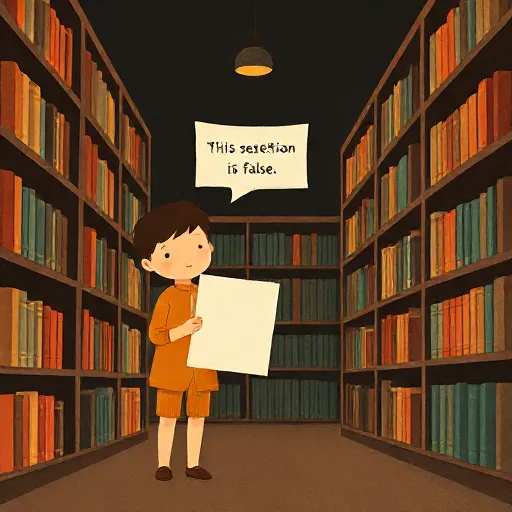
- Imagine someone says, “This sentence is false.” If that sentence is true, it must be false; if it is false, it must be true. Does this show that Aristotle was wrong about the Law of Non-Contradiction, or is something else going on?
- When you are exactly on the borderline between being a child and being a teenager, would you ever say, “I am a child and I am not a child”? How could a defender of the law explain what you really mean?