
Can We Agree on Justice Without Knowing the Whole Truth?
A Fair Recipe for Justice

It’s lunchtime, and you and three friends have one big cookie to share. You all want to be fair, but you disagree. Alina thinks the hungriest should get the biggest piece. Ben says you should draw straws. Chris insists that whoever brought the cookie should decide. You’re stuck. How do you find a rule you can all accept, without a big fight?
John Rawls (1921–2002) thought this sort of standoff hides a deep puzzle about justice itself. His answer was political constructivism, the idea that some facts about what is just or unjust are not discovered like hidden treasure. Instead, they are made—or constructed—by a fair procedure. If you can design a method everyone sees as unbiased, then whatever principles that method picks become the right ones. It’s like inventing a recipe together rather than digging up a fossil.
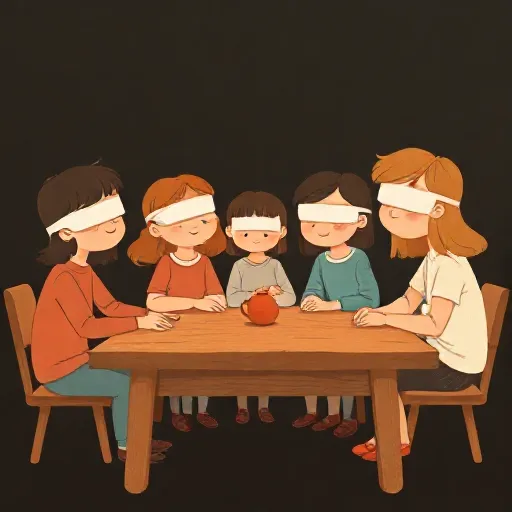
Rawls’s own favored procedure was the original position. Picture a meeting where you must choose the rules for an entire society. But there’s a catch: you stand behind a veil of ignorance. You know nothing about who you will be in that society—not your wealth, health, talents, religion, or even your age. Since you could turn out to be anyone, you won’t favor rules that hurt a particular group. Rawls argued that people in this position would agree on two main principles: one protecting basic freedoms for all, and another making sure that any inequalities actually help the least advantaged.
Political constructivism says those principles are sound precisely because they come out of that well-designed procedure. The principles are like artifacts we build together, not truths that were always hanging in the sky waiting to be spotted.
Why Rawls Avoided the Hardest Questions

If you ask people in a free society about the deepest questions—does God exist, what happens after death, what makes a life truly good—you’ll get very different answers. Rawls called this reasonable pluralism. It’s not that some people are foolish; it’s that free human beings using their reason will naturally come to different conclusions about religion, philosophy, and morality.
This creates a problem. We might want three things all at once: full personal liberty, a society held together by shared political values, and government decisions based on the whole truth. But under reasonable pluralism you cannot have all three. If the government acted on one group’s whole truth, many citizens would feel disrespected and the society would fracture. This is the liberal trilemma.
Rawls’s solution was to make constructivism political, not metaphysical. He stuck to what he called the “method of avoidance.” Political constructivism does not try to settle whether God exists or whether moral truths exist in some independent realm. It only asks: what principles can free and equal citizens accept as fair, even though they differ on everything else? It’s like a family where one member is deeply religious, another is a scientist, and a third cares most about art. They can still agree on house rules—“no shouting after 10 p.m.”—without debating whose worldview is correct.
This is why political constructivism is called non‑comprehensive. It works only for the political domain, where we need to live together peacefully despite our disagreements. It leaves the bigger questions open.
Two Kinds of Rightness: Truth vs. Reasonableness

We all think that some judgments are better than others. But what makes a judgment about justice objectively sound? One traditional answer is rational intuitionism: moral truths, like mathematical truths, exist independently of us. When we get them right, our judgments are true statements about that independent order of values. Rawls associated this view with thinkers like Henry Sidgwick and W. D. Ross.
A very different answer comes from Immanuel Kant’s moral constructivism, which says that moral principles are constituted by the procedures of our own practical reason—they are not read off an external reality. On this view, a correct moral judgment is one that passes the right sort of test.
Rawls’s political constructivism takes a middle path. It says that political judgments are correct when they issue from a reasonable procedure, like the original position. But it refuses to claim that those judgments are true in the deep sense that rational intuitionism requires. Instead, it claims only that they are the most reasonable among the options on the table.
Why be so cagey? Because calling a political principle “true” often starts a new fight. Someone who disagrees with your comprehensive doctrine might reject your idea of truth entirely. But if you only claim that the principle is reasonable and can be accepted by people with many different worldviews, you stand on common ground. The method of avoidance doesn’t say the principle is false; it just leaves the question of truth open. This allows a devout believer and a hard-nosed scientist to both endorse the same public rules of justice without either having to surrender their deepest commitments.
The Big Challenge: G. A. Cohen Says You Can’t Build Justice

Not everyone agreed that building justice like an artifact makes sense. The philosopher G. A. Cohen (1941–2009) started by picking at a famous part of Rawls’s theory: the difference principle, which says inequalities are okay only if they improve the lot of the worst-off. Cohen noticed that in real life, talented people sometimes demand extra pay just to do jobs they ought to do anyway—like holding society ransom. Rawls’s principle, focused on institutions, allowed such incentives. Cohen thought that was a betrayal of true justice. But his criticism soon grew into a full-scale assault on political constructivism itself.
Cohen launched three main objections.
The Fact‑Dependency Objection. Rawls held that even the deepest principles of justice depend on facts about human nature and how societies work. Cohen argued that whenever you base a rule on a fact—like “give the biggest slice to the hungriest because they are hungriest”—you must also accept a deeper, fact‑free principle, such as “need matters.” That deeper principle doesn’t mention hunger at all. So, Cohen concluded, you can’t avoid believing in some fact‑insensitive moral truths. Defenders of constructivism reply that those deeper principles are not themselves principles of justice; they are logical links that guide reasoning. So the constructivist can accept them without giving up the claim that justice‑as‑guides‑to‑action rests on facts.
The Alien Factors Objection. Cohen pointed out that constructivist procedures let “alien” considerations—like whether a rule can be easily publicized or will promote stability—influence what we end up calling “justice.” If you design a chore chart partly by checking how easy it is to verify that everyone did their part, you are mixing fairness with mere practicality. Cohen insisted that pure justice must be unaffected by such concerns. Rawlsians answer that they use a different concept of justice: one that is about how people govern themselves together, not an abstract ideal of distribution. The considerations Cohen calls alien are exactly what matter when you are trying to build a society real people can share. So the disagreement may partly be a verbal one—but it cuts deep.
The Harmless Injustice Objection. Cohen gave a stark example. Suppose two people start with 5 cookies each. You can give one person 7 cookies and the other 6. No one loses a single cookie; both are better off. Yet Cohen thought the increased gap between them is still unjust in some small way. Constructivism, which picks principles to make the worst-off as well off as possible, seems unable to explain why that gap is wrong if no one is harmed. Some constructivists reply that strict equality might not be required in the first place, or that the intuition can be captured by a cleverly revised procedure. The argument remains unsettled.
Why This Ancient Fight Matters to You

Think about the last time you and your friends tried to settle the rules for a game. Some wanted a rule everyone could agree on quickly, even if it wasn’t perfectly fair. Others insisted that only the “truly right” rule should count, even if it meant arguing for an hour. That little huddle replays, in miniature, the enormous debate between Rawls and Cohen.
Political constructivism offers a practical tool: when you cannot persuade everyone to adopt your deepest beliefs, you look for a procedure that gives everyone an equal say behind a veil of ignorance—or some similar fair test. It helps pluralistic groups keep the peace and treat each other as equals. But Cohen’s challenge reminds us that there might be something about justice that no amount of clever process can create. Some wrongs might remain wrong even if a fair procedure permits them.
So next time you’re staring at a blank rule-sheet with your friends, ask yourself: Are we constructing a fair recipe together, or are we searching for a truth that might resist any recipe we invent? Political philosophers are still arguing about it. Now you can too.
Think about it
- If your class votes on a rule that everyone agrees is fair, but you privately believe it’s unjust, should you follow it? Why might you go along anyway?
- Can a rule be truly fair if it was made without knowing certain facts—like not knowing that some kids need more time to finish a test? Is ignorance ever good for fairness?
- Think of a time you reached a compromise on how to share something with friends. Did the compromise feel like “real” fairness, or just a way to avoid a fight? What’s the difference?