
Can You Always Do What’s Best — and Still Keep Your Promises?
The Promise That Utility Forgot
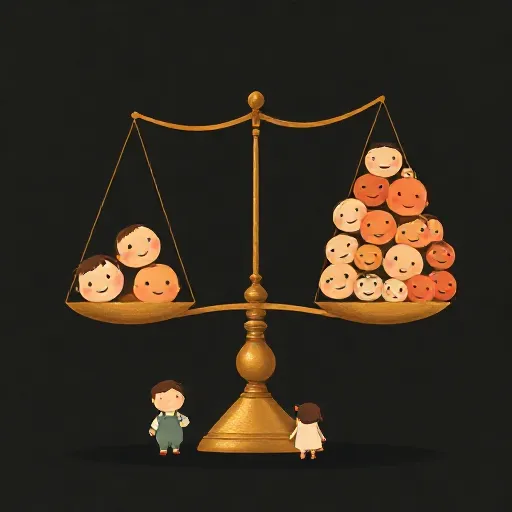
Imagine you promised to help your best friend study after school. On the way there, you see five younger kids who are lost and need someone to walk them home. If you keep your promise, one person gets help. If you break it, five people get home safely. The math seems simple: five is more than one.
Utilitarianism, the moral theory first developed by Jeremy Bentham (1748–1832), says you should always choose the act that produces the most pleasure and the least pain for everyone affected. By that measure, helping the five kids is clearly right — even if your friend feels hurt. But that conclusion can feel wrong. A promise is a promise, not just a number.
Act-consequentialism is the part of utilitarianism that says the rightness of an act depends entirely on how its outcome compares to the outcomes of your other options. Do whatever would bring about the best outcome. Many philosophers find this idea deeply attractive: when you act, you are trying to make the world go a certain way, so surely you should aim to make it go the best way possible. The trouble is that Bentham’s notion of “best outcome” counted only the raw quantity of pleasure and pain. Consequentializing is the project of keeping the structure of act-consequentialism but replacing that thin picture of a good outcome with a much richer one — one that can respect promises, special relationships, and even your own interests.
What If the Outcome Includes the Act Itself?

One of the earliest moves was to notice that pleasure is not the only thing worth having. John Stuart Mill (1806–1873) argued that some pleasures, like reading poetry or solving a puzzle, are qualitatively higher than bodily pleasures. No amount of pig-like comfort, he thought, could outweigh the value of a single intellectual insight.
G. E. Moore (1873–1958) went further. He argued that knowledge, beauty, and virtuous character are also intrinsic goods — things good in themselves, not just because they lead to pleasure. Once you accept that, you can build an outcome that includes far more than pleasure points.
The philosopher A. C. Ewing (1899–1973) then took a crucial step. He said that breaking a promise is intrinsically bad — it makes an outcome worse simply because it contains a broken promise. If you think of an outcome as the whole world that would exist if you acted, then you can include the act itself and its features. So when you weigh whether to break your promise to help the lost kids, the outcome in which you break the promise starts in the hole — it already contains a promise-breaking, which is bad, even before you count the extra happiness for the five kids. Other things being equal, a world with a kept promise is better. That might allow you to stay loyal to your friend without rejecting act-consequentialism.
My Promise, Your Promise: Why It Matters Who Does the Act

Now consider a stickier case. Abe promised to return a library book by Tuesday. He discovers that if he breaks his promise, he will prevent two other people (Bert and Carl) from breaking their own equally serious promises. Keeping his promise means one kept promise and two broken ones. Breaking it means one broken and two kept. If promise-breakings are all equally bad, the outcome with only one broken promise seems better. So should Abe break his promise? Common sense says no — Abe has a special responsibility for his own actions, not for being the world’s promise-police.
To handle this, philosophers like Amartya Sen (b. 1933) introduced evaluator-relative rankings. The idea is that what makes an outcome best can depend on whose point of view you take. Abe, as the agent, ought to prefer the outcome where he keeps his word, even if that means Bert and Carl break theirs. A bystander might prefer the outcome with fewer total broken promises. But morality, on this view, asks the agent to follow her own ranking. Act-consequentialism stays intact: Abe does what brings about the outcome that is best-relative-to-him.
This kind of move leans on a powerful thought: you have a special responsibility for your own agency that you don’t have for others’ choices. That thought appeals even to many non-consequentialists, so it need not be invented purely to save a theory.
When You’re Allowed to Choose Your Own Good

So far, we’ve talked about restrictions: things you must not do, even for a good cause. But common sense also recognizes options — cases where you are permitted to act for the greater good or to look after your own interests. Act-consequentialism can seem to demand that you always make the sacrifice. If you have an extra dose of painkiller that would relieve your mild headache, but could instead relieve two strangers’ moderate pain, the total-pain math says give it away.
One early fix was self/other utilitarianism (a simplified version of ideas from Douglas Portmore and others). It uses two rankings. An act is permissible unless some alternative beats it on both of these: overall goodness and goodness for everyone except the agent. In the aspirin case, taking it yourself wins on overall goodness (your pain is worse), while giving it away wins on goodness-for-others. Since neither act loses on both rankings, both are permissible. That gives you an agent-sacrificing option — you may give up your comfort for others, but you don’t have to.
What if your own need is the smaller one? Imagine you are in moderate pain, but two strangers are also in moderate pain, and you have two tablets. Taking both relieves your pain; giving one each to the strangers relieves twice as much pain overall. The self/other view can’t permit you to keep both, because that act loses on both rankings. So philosophers like Samuel Scheffler (b. 1951) proposed weighting your own utility more heavily — say, ten times as heavily — before summing. Then taking both tablets looks best on the egoistically-adjusted score, while giving them away looks best on the score-for-others. Both acts are permitted, and you now have an agent-favoring option as well.
Three Reasons to Redraw the Scoreboard

Why would anyone go to all this trouble? There are at least three different motivations, which produce three different kinds of consequentializing.
Earnest consequentializers (like Sen and Portmore) genuinely believe that act-consequentialism is the most compelling moral idea and that a sophisticated enough ranking of outcomes can match our deepest moral convictions without cheating. They use a Coherentist Procedure: they start with both our judgments about which acts are better and our judgments about which outcomes an agent should prefer, and they revise both sides until everything fits together. They are willing to lose a few rare verdicts if it means building a theory that feels true overall.
Notational consequentializers (like Jamie Dreier) think the whole debate is a matter of wording. They argue that any plausible non-consequentialist theory can be translated, using a Footian Procedure, into an act-consequentialist theory that gives exactly the same answers in every possible world. If that’s right, the distinction between “consequentialist” and “non-consequentialist” is empty — like measuring temperature in Celsius or Fahrenheit. To them, consequentializing is a way of showing that nothing deep separates the two camps.
Pragmatic consequentializers (like Seth Lazar) don’t care which theory is truer. They translate a non-consequentialist theory into an act-consequentialist form just because that makes it easier to apply tools from decision theory when the facts are uncertain — like in war, medicine, or rescue planning. The resulting theory might be gimmicky, but that’s fine: it’s only a calculating device.
The Big Worry: Are We Still Saying Something Real?

Several objections haunt these projects. The most basic is that the so-called Compelling Idea — the reason act-consequentialism supposedly feels right in the first place — may not be uniquely compelling, or even compelling at all. Philippa Foot (1920–2010) argued that we don’t really have a grip on the idea of “the best outcome” apart from what we already think we ought to do. If the ranking of outcomes is just a shadow of our prior moral beliefs, then nothing is explained.
Earnest consequentializers reply by tying the ranking of outcomes to what the agent has most reason to desire. For example, a parent naturally has stronger reason to desire the safety of their own child than the safety of a stranger’s. That’s not a cheat; it’s part of what makes certain outcomes better from the parent’s perspective. And if we must act from our own perspectives, perhaps that’s the only ranking that matters for action.
Another worry is that some commonsense verdicts simply cannot be fitted into the shape of act-consequentialism. For instance, prohibition dilemmas — situations where every act is wrong — might require a ranking where outcomes cycle (A beats B, B beats C, C beats A), which some argue is incoherent. Earnest consequentializers accept that they might not capture every single verdict, but they just need the overall package to be more believable than the alternatives.
Why This Matters in Your Own Life
Next time you face a choice between keeping a secret and protecting someone, between finishing your homework and helping a sibling, between saving for something you want and giving to a friend in need — you are living inside the very puzzle that consequentializing tries to solve. You feel the pull of a simple rule: “Make things go as well as possible.” But you also feel the weight of the particular, concrete shape of your relationships, your promises, and your own life. The philosophers who work on consequentializing are not just tinkering with formulas. They are trying to build a picture of morality that takes both of those feelings seriously — without pretending the tension doesn’t exist. That project is far from finished, and you are already part of it.
Think about it
- You promised your best friend you would keep a secret, but telling an adult could stop a stranger from being wronged. Should you break your promise? What pushes the balance one way or the other in your mind?
- If a moral theory says you must always do what is best for everyone, should you ever be allowed to care more about your own pain or danger than about a stranger’s — even by a little? Why or why not?
- Can you describe a real situation where doing the “best” thing from a big, bird’s-eye view still felt wrong to you? What made it feel that way?