When You Drive on Autopilot, Is Your Mind Still Watching?
The Driver Who Wasn’t There

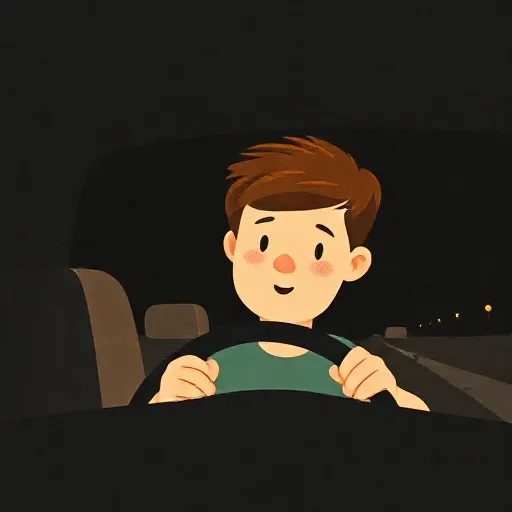
One afternoon, you are riding home from school in the passenger seat. Your mind is on a video game or a joke a friend told you. You blink, and suddenly you realize you haven’t been paying attention to the road for the last five minutes. Yet your parent, who was driving, steered, braked, and changed lanes without a crash. They were on “automatic pilot.” But what was happening inside their head? Were they truly seeing the red light, or was something else doing the seeing for them?
Philosophers who study the mind call this kind of experience phenomenal consciousness: the “what it’s like” quality of a mental state. A toothache, the smell of fresh bread, the color of the sky at dusk — all of these have a distinctive feel. When your parent drifted off mentally while driving, that feel for the road seemed to vanish. And yet, they must have been processing the visual information, or the car would have crashed. So what’s the difference between a mental state that feels like something and one that doesn’t? The answer, some thinkers argue, is a second, silent layer of awareness inside your mind.
Two Kinds of Awareness

Philosophers start by drawing a line between two ways we talk about being conscious. First, there’s creature consciousness — just being awake rather than in a coma or deep sleep. That kind is easy. The hard puzzle is mental-state consciousness: when a single thought, perception, or feeling is conscious in a way that gives it that inner “feel.”
Consider a belief you might have without realizing it, like an unconscious fear of heights that only surfaces when you’re on a tall building. That belief is a mental state, but it’s not conscious. Now think of the sharp, vivid pain of stubbing your toe. That pain screams for attention — it’s a phenomenally conscious state. What makes the difference? The higher-order approach says a conscious state is one that you are aware of in a special way. It’s a mental state that is itself the target of another mental state — a kind of inner witness.
How Can You See Without Knowing It?

A strong argument for the higher-order view comes from cases where people perceive things without any conscious experience of them. One famous example is blindsight. Some individuals have damage to a part of the brain’s visual system, leaving them blind in one section of their field of view. If you ask them what’s there, they’ll tell you they see nothing. But if you then ask them to guess — is the object a circle or a square? Is it moving left or right? — their guesses are surprisingly accurate. They can even reach out and catch a ball thrown from their blind side. Their brain is processing shapes and movements, yet those perceptions never “light up” for the person.
Another clue comes from a patient known as D.F., who suffered brain damage from carbon monoxide poisoning. She could no longer consciously recognize objects or tell a vertical slot from a horizontal one. But when she was asked to mail a letter through a slot, her hand rotated perfectly to match the angle. She was seeing the orientation — her sensorimotor system knew it — yet she, the person, had no awareness of it.
For higher-order theorists, these cases show that a first-order perceptual state (the brain’s raw data from the eyes) can happen in the dark. What turns on the light of phenomenal consciousness is a second-order state that represents the first one. In blindsight, that second state is missing.
The Mind’s Hidden Witness

If consciousness needs a higher-order watcher, what exactly is that watcher? The oldest version, proposed by the philosopher John Locke (1632–1704) and updated by David Armstrong (1926–2014) and William Lycan (a contemporary philosopher), is higher-order perception theory, sometimes called inner-sense theory. The idea is that just as you have eyes and ears to perceive the outside world, you have an inner “sense organ” that scans your own brain states and produces a second, fine-grained perception of them. It’s like a security camera inside your mind, watching your own visual stream.
But many thinkers find that idea clunky. Do we really have a separate inner scanner? And if we did, couldn’t it malfunction and misrepresent what we’re seeing — telling you “that looks orange” when your eyes are sending “red”? That seems to rarely, if ever, happen.
A different approach, defended by David Rosenthal (a contemporary philosopher), is actualist higher-order thought theory. Here, the watcher isn’t a sensory organ but a thought — specifically, a thought that you are having a certain experience. For a perception of red to become conscious, you need to have the thought, “I am seeing red,” even if that thought is itself unconscious. The thought lights up the perception.
A third version, championed by Peter Carruthers (a contemporary philosopher), is dispositionalist higher-order thought theory. The perception doesn’t need an actual thought happening right now; it just needs to be available to higher-order thought — ready to trigger one if needed. Like a video that’s fully loaded and ready to play, the mere readiness makes it conscious.
Finally, some philosophers merge the two layers into one: self-representational theories. Here, a conscious state somehow represents itself in the very act of representing the world. The state is both about the red apple and about itself being an experience of red. Rocco Gennaro (a contemporary philosopher) and Uriah Kriegel (a contemporary philosopher) have developed such views.
Is Your Dog Conscious? And Other Sticky Questions

These theories face a challenge that matters to anyone who loves an animal. If consciousness requires a higher-order thought about your own mental state, then creatures that can’t think about thoughts — which probably includes most animals — wouldn’t be phenomenally conscious. Your dog would be a biological robot, processing smells and movements without any inner feeling. Many people find that hard to swallow. Defenders of the theory reply that the kind of higher-order thought needed might be simpler than we think, perhaps just a dim sense of “this is happening to me,” which dogs might have. But the debate is far from settled.
Another objection is the so-called rock problem. If I think about a rock, the rock doesn’t become conscious. So why would thinking about a perception make the perception conscious? The answer hinges on the fact that a perception is already a mental state — the right kind of thing to be conscious — and the higher-order thought transforms it into a richer, self-aware state. Still, critics press further: if a higher-order thought can happen on its own, with no real perception underneath, can we have a “phantom” conscious experience of, say, pain? Some theorists say yes, creating a puzzle about what, exactly, is hurting.
Why This Matters When You Space Out

You’ll never solve the mystery of consciousness by checking your phone. But the higher-order approach gives you a tool to notice something real: your mind has a remarkable capacity to step back and watch itself. When you feel angry and then realize, “Huh, I’m getting angry,” that second thought can actually change the anger — maybe softening it, maybe making it sharper. That’s your higher-order awareness at work.
This question also lurks behind every conversation about artificial intelligence. If a computer could monitor its own internal states with a higher-order program, would it ever start to feel like something to be that computer? No one knows. But the higher-order theories give a recipe: to build a conscious machine, you’d need to build a machine that can talk about its own experiences.
The next time you find yourself on autopilot — during a walk, in class, or staring out a rainy window — you can ask the same question the philosophers ask: who, exactly, was watching?
Think about it
- If a robot could describe its own “feelings” in perfect detail, would you believe it was conscious? What would convince you?
- You accidentally touch a hot pan, yank your hand back, and only a split second later feel the pain. Was your hand’s movement conscious before the pain arrived?
- Think of a time you suddenly realized you were daydreaming. What exactly changed in that instant, and did the daydream itself feel different once you noticed it?