
What Is Consciousness? The Puzzle of Inner Experience
Imagine you’re a bat. You fly through the dark using echolocation—sending out high-pitched sounds and listening to the echoes that bounce back. You can tell exactly where a moth is, how fast it’s moving, and whether it’s worth catching. Your brain processes all this information instantly, and you act on it.
But what does it feel like to be you? What is it like, from the inside, to experience the world through echolocation? Does it feel like a kind of sound-picture? Like a tingle? Something completely different that humans can’t even imagine?
This is the puzzle of consciousness. It’s the fact that there’s something it’s like to be you—and something it’s like to be a bat, a dog, maybe even a fish. Somewhere in the universe, there are creatures that process information, behave intelligently, and react to their environment. But not all of them are conscious the way we are. Or are they? How would we even tell?
The Basic Problem
Consciousness is the most familiar thing in the world and the most mysterious. You’re having it right now. You’re aware of these words, of the room around you, of your own thoughts. You don’t have to prove this to yourself—you just know it directly. But try to explain what consciousness is, and things get strange fast.
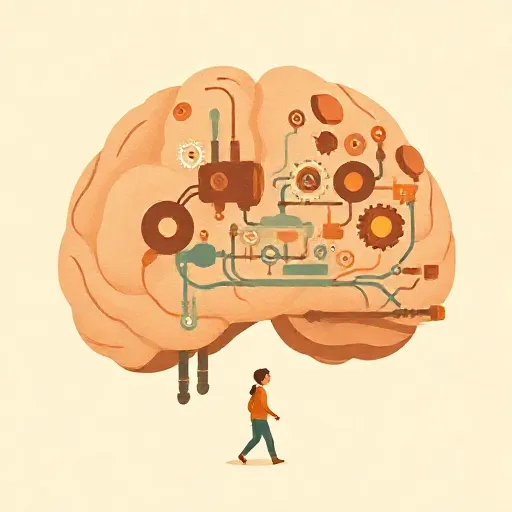
Philosophers have noticed something troubling. We can describe everything that happens in your brain when you see the color red: which neurons fire, what chemicals are released, how the information travels. We could build a robot that processes light input and says “red” at exactly the right moments. But would the robot feel anything when it did that? Would there be something it’s like to be that robot? Or would it just be a very fancy calculator, with all the lights on and nobody home?
This is sometimes called the “hard problem” of consciousness. The “easy problems”—like figuring out how the brain pays attention, remembers things, or controls behavior—are actually very difficult, but they’re the kind of thing science can eventually solve. The hard problem is different: How does any physical thing, like a brain, produce inner experience at all?
What We’re Talking About When We Talk About Consciousness
One complication is that “consciousness” means different things in different situations. Philosophers have noticed at least four distinct ideas that often get mixed together.
Wakefulness. When you’re asleep or knocked out, you’re not conscious in this sense. When you’re awake, you are. Pretty straightforward—but it doesn’t capture everything. Someone in a coma isn’t conscious, but someone dreaming is conscious in a different way, even though they’re not awake.
Sentience. This is the ability to feel things—to have sensations like pain, pleasure, warmth, or cold. A rock isn’t sentient. A dog probably is. What about a fly? This is the sense that’s closest to what most people mean by “conscious.” It’s the capacity to have experiences that feel like something.
Self-awareness. This is consciousness turned inward: being aware that you’re aware. Humans can reflect on their own thoughts and feelings. Can dogs? Maybe, maybe not. This is a more demanding sense of consciousness—some philosophers think it’s the most important one.
“What-it’s-like-ness.” This is the sense Thomas Nagel made famous with his bat example. A creature is conscious if there’s something it’s like to be that creature. This doesn’t require self-awareness. A baby probably has what-it’s-like experiences without reflecting on them. An ant? Nobody knows.
These different senses don’t always line up. You’re awake, sentient, and self-aware right now. But when you’re in a deep dreamless sleep, you’re not sentient—but you’re still alive and your brain is still working. When you’re daydreaming, you might be sentient and self-aware but barely paying attention to the outside world. Consciousness isn’t one thing; it’s a whole family of related phenomena.
The Descriptive Question: What’s It Actually Like?
Before we can explain consciousness, we need to describe it carefully. What are its features? Philosophers have identified several that seem important.
Qualitative character. This is the “raw feel” of experience. The redness of red. The taste of pineapple. The sting of a papercut. These qualities—philosophers call them “qualia” (singular: quale)—seem to be the basic stuff of conscious experience. Some philosophers think qualia are the whole story. Others think they’re just one piece.
Phenomenal structure. Your experience isn’t just a jumble of raw feels. It’s organized. You experience the world in space and time. You experience objects as having causes and effects. You experience yourself as a single point of view. This structure isn’t something you notice directly, but it shapes everything you experience. Immanuel Kant, an 18th-century philosopher, argued that this structure is built into consciousness itself—your mind comes with a kind of basic operating system that organizes experience into space, time, cause, and object.
Subjectivity. This is the weird fact that conscious experiences seem to be private. Nobody else can have your headache. Nobody else knows exactly what it’s like to see blue through your eyes. This seems to create a limit on science: science studies things from the outside, but consciousness is essentially an inside phenomenon. Can you ever fully understand another creature’s consciousness from the outside? Nagel thought the answer was no—at least not completely.
Unity. Your conscious experience at any moment is a single thing. You don’t experience colors separately from shapes, sounds separately from smells. They’re all bound together into one unified experience. Yet your brain processes all this information in different places. How does the binding happen? This is the “unity of consciousness” problem.
The Explanatory Question: How Can Consciousness Exist?
This is where things get really strange. We have physical brains made of atoms and chemicals. We have subjective experiences that feel like something. How do you get from one to the other?
The explanatory gap. Joseph Levine, a contemporary philosopher, named this problem. Even if we knew everything about the brain, would we be able to see how consciousness arises from it? Probably not. There seems to be a gap between our understanding of physical processes and our understanding of experience. We can’t just read consciousness off from brain scans. Something’s missing.
The zombie argument. Some philosophers think the gap is so deep that it shows consciousness isn’t physical at all. Here’s the argument: Can you imagine a creature that’s physically identical to you—same atoms, same brain activity, same behavior—but that has no inner experience? A philosophical zombie? If you can imagine such a thing (and many people think they can), then consciousness must be something extra, something beyond the physical. After all, if consciousness were just a physical thing, then a physically identical creature would have to have it. It wouldn’t be possible to imagine one without it.
This is a controversial argument. Other philosophers deny that we can really imagine such zombies. They say we’re just fooling ourselves—when we try to imagine a zombie, we’re actually imagining a conscious person and just saying they’re not conscious. But the debate shows how slippery the problem is.
The knowledge argument. Frank Jackson, an Australian philosopher, came up with another famous thought experiment. Imagine a scientist named Mary who has spent her whole life in a black-and-white room. She’s never seen any colors. But she knows everything there is to know about the physics and biology of color vision. She knows what wavelengths light has, what neurons do when you see red, everything.
Now she leaves the room and sees a red rose for the first time. Does she learn something new? It certainly seems like she does—she learns what it’s like to see red. But if she already knew all the physical facts, then the fact about what red is like must be a non-physical fact. So consciousness involves facts that aren’t captured by physical science.
Again, not everyone agrees. Some philosophers say Mary doesn’t really learn a new fact—she just gains a new ability (like being able to recognize red) or a new way of knowing something she already knew. But the intuition is powerful.
The Functional Question: What Does Consciousness Do?
Even if we can’t fully explain consciousness, maybe we can ask what it’s for. Does it do anything? Could we get along without it?
Epiphenomenalism. This is the radical idea that consciousness is a kind of side-effect—like the heat from a lightbulb. The light is what does the work; the heat just comes along for the ride. Maybe consciousness doesn’t cause anything; it just accompanies certain brain processes without affecting them. This would mean your feeling of pain doesn’t actually cause you to yank your hand away—the brain does that automatically, and the pain feeling is just along for the ride.
Most people find this deeply unsatisfying. It seems obvious that your conscious decisions cause your actions. But proving this is harder than you’d think. There’s experimental evidence suggesting that your brain starts preparing to act before you consciously decide to do so. The conscious feeling of “deciding” might be a kind of report after the fact, not the cause of the action.
What consciousness might do. Even if we can’t settle the epiphenomenalism question, we can guess at what consciousness is good for. Some possibilities:
Consciousness allows flexible control. When you’re learning something new, you’re conscious of it. Once it becomes automatic (like tying your shoes), it drops out of awareness. Consciousness seems to be for novel, non-routine situations.
Consciousness enables social coordination. Being aware of your own mind lets you understand other people’s minds. You can guess what they’re thinking, cooperate, deceive, and build complex societies.
Consciousness integrates information. Your conscious experience binds together input from all your senses into a single coherent picture of the world. This integrated picture is what makes flexible, intelligent action possible.
Consciousness provides intrinsic motivation. Pleasure and pain aren’t just information—they feel good or bad. That feeling is what motivates you to seek food, avoid danger, and care about things. A purely unconscious system might process information about threats, but would it care? Consciousness might be what makes anything matter.
The Bigger Picture
Nobody has solved the problem of consciousness. Philosophers and scientists are still deeply divided. Some think we just need better neuroscience. Others think we need a completely new way of thinking about reality—maybe consciousness is as fundamental as space, time, and matter. Still others think the problem is unsolvable, that human brains just aren’t built to understand how they themselves work.
What makes the problem so fascinating is that it’s about the one thing you have direct access to: your own experience. Every other fact about the world comes to you through consciousness. But consciousness itself seems to resist being captured by any of our usual ways of understanding things.
So here’s where we are: You’re conscious right now. You know that for certain. But you can’t explain how or why. And neither can anyone else.
Key Terms
| Term | What it does in this debate |
|---|---|
| Consciousness | The general label for the phenomenon of inner experience; what it’s like to be something |
| Qualia (singular: quale) | The raw feels of experience—the redness of red, the sting of pain |
| Explanatory gap | The apparent impossibility of seeing how physical processes could produce subjective experience |
| Zombie | An imaginary being physically identical to a human but lacking all inner experience |
| Epiphenomenalism | The view that consciousness is a byproduct that doesn’t cause anything |
| Hard problem | The problem of explaining why and how physical brain processes give rise to subjective experience |
| Phenomenal structure | The organized way experience presents itself—in space, time, and as a world of objects |
Key People
- Thomas Nagel – A philosopher who wrote the famous 1974 paper “What Is It Like to Be a Bat?” arguing that the subjective character of experience can’t be captured by objective science.
- René Descartes – A 17th-century French philosopher who argued that mind and body are two different kinds of substances, and that consciousness is the essence of mind.
- David Chalmers – A contemporary philosopher who named the “hard problem” of consciousness and argues that consciousness is a fundamental feature of reality, like space and time.
- Frank Jackson – The philosopher who invented the Mary thought experiment to argue that there are non-physical facts about consciousness.
- Joseph Levine – The philosopher who introduced the term “explanatory gap” for the difficulty of linking brain processes to experience.
Things to Think About
-
If you could build a perfect robot that acts just like a human—laughs at jokes, says it feels pain, claims to be conscious—would you ever be sure it actually feels anything? Could you ever prove it doesn’t? How would you decide?
-
Suppose consciousness turns out to be epiphenomenal—a side-effect that doesn’t do anything. Would that change how you live? Would it matter that your decisions are caused by your brain, not your conscious self? Why or why not?
-
Are you the same conscious self you were when you were five years old? You have different memories, different beliefs, a different body. What, if anything, makes you the same person? Does consciousness itself continue uninterrupted, or is it more like a movie—many separate frames that just seem continuous?
-
If a computer program could perfectly simulate your brain, would it be conscious? If not, why not? If so, would turning the computer off be the same as killing a person?
Where This Shows Up
- In debates about animal rights – How conscious are animals? Does it matter whether a fish feels pain or just reacts to damage? Laws and ethical arguments often depend on assumptions about animal consciousness.
- In artificial intelligence – Engineers are building systems that seem increasingly intelligent. But are they conscious? Will we ever build a conscious AI, and how would we know? These questions matter for how we treat AI systems.
- In medicine – When is someone “brain dead”? Do people in persistent vegetative states have any conscious experience? These questions affect real decisions about life support and organ donation.
- In your own life – Every time you wonder what someone else is thinking, every time you try to describe how you feel, every time you ask yourself “am I dreaming?”—you’re engaging with the puzzles of consciousness.