
What Makes a Machine a Computer? From Babbage’s Cogs to Turing’s Brain
The Man Who Wanted a Machine to Do His Sums
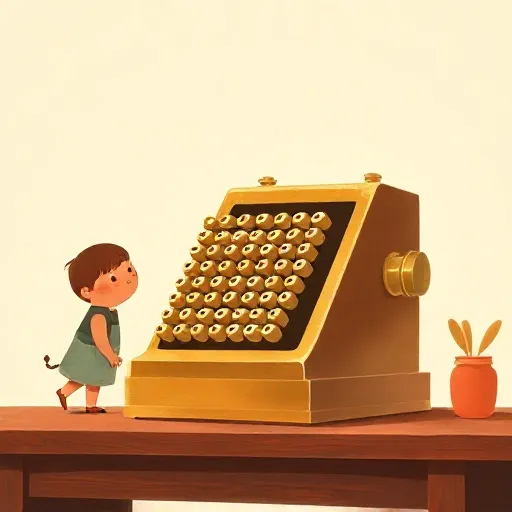
In 1822, a mathematician named Charles Babbage (1791–1871) showed a roomful of London scientists a small brass machine. When someone turned its crank, whirring columns of gear wheels lined up numbers and spat out a printed table. The audience was amazed. The machine never made arithmetic slips, never got tired, and never complained. Babbage called it the Difference Engine.
A Difference Engine is a special-purpose computer — it does one job, and it does that job perfectly. Its job was to produce mathematical tables. In Babbage’s time, ships, surveyors, and bankers relied on huge books of logarithms and tide predictions. But every hand‑copied table contained mistakes, and mistakes could drown a sailor or sink a fortune. Babbage thought: why not let a machine do the work without ever guessing?
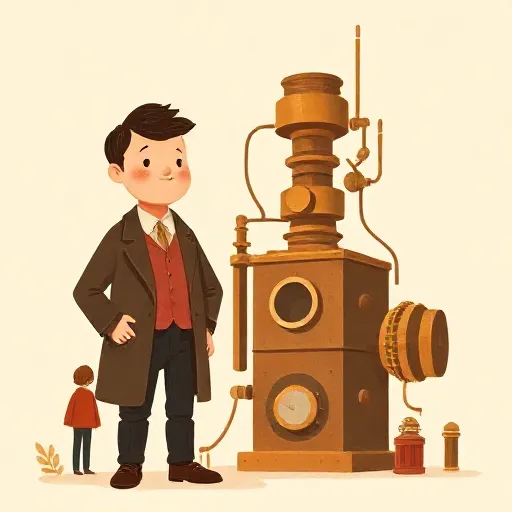
The Difference Engine was all mechanical — brass wheels, rods, ratchets. Numbers were stored by the positions of ten-toothed metal wheels, each wheel standing for a decimal digit. Babbage never finished the full‑size machine, but he did build working fragments. In 1990, using his original drawings, engineers finally constructed a complete Difference Engine No. 2. It worked, exactly as Babbage had planned.
A Machine That Could Follow Any Recipe
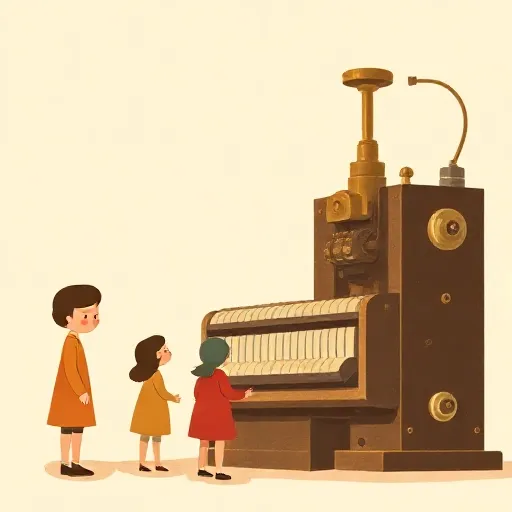
Babbage quickly got a larger idea. Forget a machine that only makes tables. What about a machine that could solve any mathematical problem fed to it? He imagined the Analytical Engine, a general‑purpose mechanical computer.
The Analytical Engine had a memory store — a set of columns that could hold numbers — and a central processing unit, which Babbage called the “mill.” The mill could add, subtract, multiply, and divide. What made the machine truly wild for its time was conditional branching: the ability to look at the result of a step and then choose which instruction to follow next, like a fork in a road.
The instructions were fed in on punched cards tied together with ribbons, an idea Babbage borrowed from the Jacquard weaving loom. A different set of cards could turn the same brass monster into a table‑maker, a polynomial solver, or something nobody had thought of yet. Babbage insisted that the Analytical Engine was not limited to one kind of work — it could do anything that could be written down as a sequence of steps.
Ada Lovelace (1815–1852), a brilliant mathematician and daughter of the poet Lord Byron, worked closely with Babbage. Lovelace saw that the Engine might handle more than numbers. She imagined it could one day compose music, weave patterns, and even process symbols, not just arithmetic. That insight is exactly what a modern computer does: treat words, pictures, and sounds as data.
The Analytical Engine was never fully built during Babbage’s lifetime — the brass and the precision engineering needed were too expensive and too hard. But the concept was clear: a machine guided by a program could be a shape‑shifter.
Turing’s Incredible Idea: The Universal Machine

A century after Babbage, a young English mathematician named Alan Turing (1912–1954) tackled a deep logical problem. He imagined a very simple machine that moved a scanner back and forth along an endless strip of paper, reading symbols and writing new ones according to a handful of rules. That paper, published in 1936, contained the idea of the universal Turing machine.
Turing’s machine was not made of metal — it was a mathematical thought experiment. The memory strip could be as long as needed, and the scanner’s actions were dictated by a table of instructions. Turing realized that you could store those instructions on the strip itself, written as symbols. This is the stored‑program concept: the program lives in the same memory as the data.
Because the instructions are just data, a stored‑program machine can edit its own program. That sounds like science fiction, but it is exactly how your phone learns a new app or a browser switches from a math‑solver to a video player.
Turing proved that such a machine could copy the behavior of any other computing machine — it was universal. From the start, he was thinking bigger than sums. In 1947 he said, “What we want is a machine that can learn from experience.” Changing its own instructions, he argued, was the mechanism for learning.
Turing’s 1936 paper floated the theoretical design that every later computer builder would follow, whether they knew it or not. The universal machine was no longer a dream; it was an engineering target.
From Relays to Lightning: The Race to Build an Electronic Brain
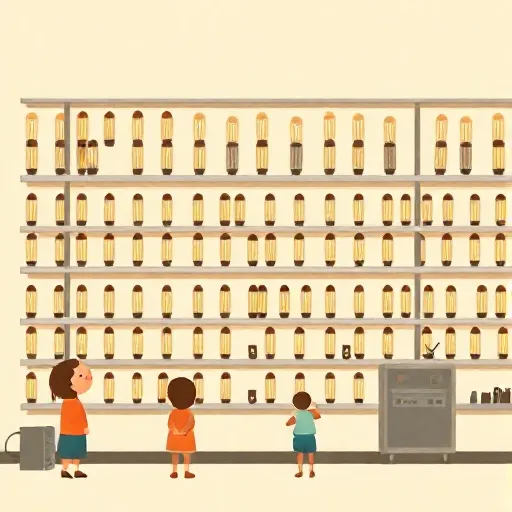
Ideas are one thing; physical stuff is another. The first calculating machines that actually worked were not electronic but electromechanical — they used tiny electric switches called relays. Relays click open and shut with moving metal levers, so they are far slower than thought. During the Second World War, engineers in Germany, the US, and Britain built relay machines, including the Z3, the first working program‑controlled general‑purpose digital computer, in 1941. But relays were too sluggish and unreliable for truly powerful computing.
The breakthrough came when engineers replaced moving metal with pure electronics. The key component was the vacuum tube — a glass bulb in which a stream of electrons can be switched on and off with no moving parts. In Britain, a telephone engineer named Tommy Flowers showed that thousands of tubes could work together reliably. Flowers built Colossus, the world’s first large‑scale electronic digital computer, delivered to the secret code‑breaking centre at Bletchley Park in January 1944. Colossus could test guesses at lightning speed, helping to crack encrypted messages from the German High Command. At least ten were running around the clock by the end of the war.
Colossus was not a stored‑program machine — its instructions were set by plugging wires into sockets. But it proved that a room full of tubes could really compute.
In the United States, ENIAC (completed in 1945) did similar work using tubes, but it too was configured by hand for each job. The next step was clear: combine Turing’s stored‑program idea with electronic speed. In 1945, the mathematician John von Neumann wrote a draft report describing the EDVAC, a design for an electronic stored‑program general‑purpose computer. Meanwhile, at Manchester University, a tiny machine called the Manchester Baby ran its first stored program on 21 June 1948 — a mere seventeen instructions long. It was, in effect, a working universal Turing machine built from cathode ray tube memory and glowing valves.
Turing himself designed the Automatic Computing Engine (ACE), a fast stored‑program computer that used an ingenious scheme to feed instructions to the processor just in time, rather than in tidy order. A pilot model became the fastest computer in the world for a while. By the early 1950s, commercial stored‑program computers like the Ferranti Mark I and UNIVAC began to appear in offices and labs.
Why Every Computer You’ve Used Was Invented in 1936

When you swipe open a calculator, play a game, or stream a video, you are leaning on a chain of ideas that stretches back to Babbage’s brass gears. Your phone is not a special‑purpose gadget that only makes phone calls — it is a universal machine. Its hardware does the same basic trick as Turing’s paper‑and‑scanner: read a symbol, follow a stored instruction, write a new symbol, and move on. The program that runs your music app is just a long list of instructions stored in memory, and the processor carries them out one tiny step at a time, branching and looping when needed.
Turing’s insight that a program could change itself became the engine of everything from spell‑checkers that learn your writing style to video games that adapt to your skill. Babbage’s dream of a machine that could follow any recipe, Lovelace’s vision of a computer handling music and symbols, and the vacuum‑tube beasts that shrank to silicon chips — they all point toward a simple, world‑shaking fact: a mindless machine that obeys a set of rules can be remade into any tool we can describe.
Think about it
- If you could have a pocket‑sized version of the Analytical Engine that could only do exactly the tasks Babbage designed for it, what jobs would you use it for today — and what would you miss about a phone that can become anything?
- Turing said a machine could learn from experience if it changed its own instructions. How is that like or unlike the way you learn a new skill?
- The first computer builders worked in secrecy, often for wartime code‑breaking. If their inventions had been shared freely right away, how might the world look different today?