
Is a Rock Computing Right Now? The Puzzle of Concrete Computation
The Rock That Ran a Program?

You know your smartphone can calculate, run games, and stream video. But could a rock do the same? It sounds silly, but in the 1960s a philosopher named Hilary Putnam pointed out something unsettling: if you look at any physical system the right way, you could claim it is running a computer program.
Putnam asked us to imagine a rock warming under the morning sun. Its temperature climbs from T to T+1, to T+2, and so on. Now think of a very simple computing device: a NOT gate that flips its output back and forth between 0 and 1 each time it receives its own previous output — a two-state finite state automaton (a machine that moves among a fixed set of states). If we simply decide that temperature T and T+2 map onto the computational state ‘0’, and T+1 and T+3 map onto ‘1’, then the rock’s physical changes mirror those of the NOT gate. The rock is behaving exactly like a tiny computer that runs the sequence 0-1-0-1.
This was meant to show that the simple mapping account of concrete computation — the idea that a physical system computes whenever there is a mapping between its states and the steps of a formal procedure — is too loose. It seems to make anything a computer. A rock, a puddle of water, a galaxy — anything with enough physical change could be “running” countless programs. That threatens the very idea of computation. If everything computes trivially, what makes a supercomputer special?
Causal Glue: Does the Sun Count?

Philosophers who reject the simple mapping account say real computation needs more than a clever mapping. One popular upgrade is the causal account, defended by thinkers like David Chalmers and others. According to this view, for a physical system to implement a computation, its state transitions must be linked by causal relationships — one state must genuinely cause the next, not just happen to follow it.
Go back to the rock under the sun. Its temperature rises not because of anything the rock is doing, but because the sun heats it. If the sun went behind a cloud, the temperature would not keep rising. The sequence T → T+1 → T+2 is not a chain of causes inside the rock. A computer, by contrast, has electrical causes linking its states: a current flows, a transistor switches, and that forces the next step in the computation.
A related idea is the counterfactual account. It demands that the physical system support “what if” statements: if the system were put in a certain state, it would necessarily transition to the mapped next state. The rock fails this test. If we tricked the rock into being at T, it would not reliably become T+1 unless the sun was shining at the right moment. So the rock does not truly compute a NOT gate; the mapping is spurious.
Even with these restrictions, some versions of the causal or counterfactual accounts still say that every physical system does compute at least something — because everything has some causal structure. This is called limited pancomputationalism (pan = everything). A rock might not run Minecraft, but it could be said to compute the pattern of its own causal history. Many philosophers still find that too inclusive. They want a steeper wall between genuine computers and ordinary objects.
Meaningful Symbols: The Semantic Stop Sign

Perhaps the difference is that a computer’s states stand for something. Your phone’s memory holds patterns of electricity that represent numbers, words, or pictures. A rock’s temperature does not represent anything — it is just a temperature. This is the core of the semantic account of computation: there is no computation without representation (as philosopher Jerry Fodor put it). For a physical system to compute, it must process states that have semantic content — meaning.
This view is popular among philosophers of mind because it seems to fit what we know about brains and digital machines. Your thoughts are about things; a slide rule represents quantities; a calculator’s display represents numbers. A rock doesn’t have meanings.
But the semantic account runs into its own puzzles. First, what counts as a representation? Must it have a language-like syntax, with symbols that combine according to rules, as words in a sentence do? Some philosophers insist on that, but others note that computability theory — the math that gave us the idea of an algorithm — does not require symbols to be language-like. A Turing machine simply manipulates discrete marks on a tape. Those marks don’t have to represent anything at all.
Second, what gives a physical state its meaning? If representation is just a matter of how an observer interprets the system, then we’re back to the problem of the rock: a scientist could decide that a certain temperature “represents” the number of grains of sand on a beach. Suddenly the rock is computing again, but only because we say so. To avoid triviality, semantic accounts must find a way to make representation a real, objective property — not just a trick of the eye.
A Machine with a Job: The Mechanistic View

An approach that tries to avoid the problems of both mapping and semantics is the mechanistic account, developed in detail by Gualtiero Piccinini. It says a concrete computing system is a functional mechanism — a system of organized components, each with a function, that together perform a special kind of task. That task is to process vehicles according to rules that are sensitive only to differences between vehicle portions. And crucially, the vehicles must be medium-flexible: the same computational pattern (a rule for turning inputs into outputs) could be built out of different physical stuff — gears, electricity, or light — as long as the stuff has enough degrees of freedom and is organized the right way.
A rock has no functional organization. Its molecules aren’t components with jobs; nothing about it is set up to perform a specific task. A laptop, on the other hand, has billions of transistors organized into logic gates, memory cells, and a clock — each part built to do something, and all of them working together so that the machine reliably processes strings of bits.
This view explains something that other accounts struggle with: miscomputation. If a computer glitches and outputs ‘7’ when it should output ‘42’, the causal account might simply say that the device underwent a causal process that can be described as computing something else. The mechanistic account says no — the mechanism failed at its function. It was supposed to compute f, and it didn’t. That matters for any real computer: we want to know when it isn’t working.
The mechanistic account also sorts computation into kinds. Digital computation processes strings of discrete states; analog computation manipulates continuous variables; quantum computation manipulates qubits. In each case, the physical system’s components are organized to meet the specific demands of the rule being implemented.
Why It Matters: Your Brain and the Future
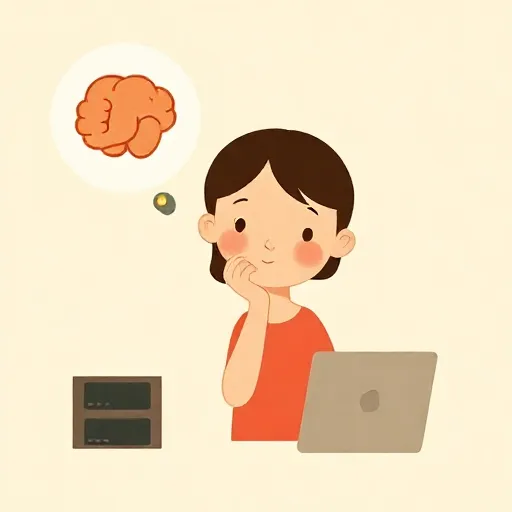
If everything were a computer in the same sense that a smartphone is, the idea that your brain “computes” would be almost empty — it would just be another rock. That would make the computational theory of cognition (the view that thinking is a form of computation) trivial. But most cognitive scientists don’t think it’s trivial. They point to specific ways the brain seems to process information, learn patterns, and flexibly adjust its behavior. To make sense of this, we need an account of concrete computation that distinguishes brains (and genuine computers) from things that merely change over time.
The debate reaches beyond brains. Engineers designing quantum computers, researchers asking whether the universe itself is a giant cellular automaton, and philosophers trying to understand what hypercomputation (computing beyond the limits of ordinary Turing machines) would even mean — all must face the same basic question: what does it take for a physical thing to actually compute?
So the next time you pick up your phone to send a message or calculate a tip, you might wonder: is this sleek slab of glass and silicon doing something fundamentally different from the pebble you kick on the sidewalk? Philosophers haven’t settled the answer yet. But by digging into what “computation” really means, they’re helping us understand not just machines, but maybe our own minds.
Think about it
- Could you program a puddle of water to run a simple video game just by mapping its splashes to game states? What would you need to add to make it a genuine computer?
- If a robot passed every test for having a mind, would it matter whether its inner parts were organized like a computer or just happened to mimic thinking by sheer chance?
- Many scientists describe the brain as a computer. If a rock can also be described as a computer, does that make the brain’s “computing” less special — or does it push us to define what special kind of computer a brain really is?