

How Do You Understand Sentences You’ve Never Heard Before?
A Sentence You’ve Never Seen Before

Imagine you’re reading a book and come across a sentence like “The purple giraffe danced on the invisible trampoline.” You have never seen those exact words in that order, but right away you understand what the sentence is saying. You can even picture it. How do you do that?
Philosophers have puzzled over this for more than a century. The most popular answer is a principle called compositionality — the idea that the meaning of a complex whole depends on two things: the meanings of its constituents (the words or smaller pieces that make it up) and its structure (the way those pieces are arranged). In your mind, the words “purple,” “giraffe,” “danced,” and so on each bring a meaning, and the grammar of the sentence tells you how to combine them. The result is a new, complete meaning you’ve never built before.
The Magic Rule: Compositionality

Compositionality comes in different strengths. The simplest version says: the meaning of any complex expression is determined by its overall structure and the meanings of all its parts. This is global compositionality. A tighter, more intuitive version is local compositionality, which says the meaning is fixed by the immediate structure and the meanings of its immediate pieces. For example, in the sentence “Alia thinks the dog barks,” the meaning of the whole is not just about “Alia,” “thinks,” and “the dog barks” as one chunk; the embedded sentence “the dog barks” has its own internal structure. Local compositionality would demand that the meaning of the whole is determined by the meaning of “Alia,” the meaning of “thinks,” and the meaning of the embedded sentence, together with the way they’re joined. Global compositionality allows some wiggle room, but both hold that meaning is built up from parts.
Philosophers typically care about meaning that speakers grasp — the kind you use to understand new sentences — not merely about what things refer to. So compositionality is usually about meaning, not just reference. (The reference of “the morning star” and “the evening star” is the same planet, but a speaker might not know that, so the meanings differ.) And when we talk about a language being compositional, we usually mean within a single natural language like English, not across all languages.
Why Believe It? Two Big Arguments

Why think language follows this rule? The strongest reason is productivity. We are finite creatures with limited memory, yet we can understand an unlimited number of new sentences — sentences we have never heard before. Gottlob Frege (1848–1925) argued that this would be impossible unless we unconsciously build the meaning of a sentence from the meanings of its words and the way they are arranged. If we had to memorize every sentence separately, we would run out of brain space long before we could handle everyday conversation. So something like compositionality must be at work.
A second argument is systematicity. Anyone who understands “The dog is asleep” and “The cat is awake” can also understand “The dog is awake” and “The cat is asleep” — without any extra training. The meanings of the parts seem to be re‑usable in predictable patterns. This suggests that knowing a complex meaning automatically gives you a grip on its immediate structure and the meanings of its immediate parts. Some philosophers, like Jerry Fodor (1935–2017), see systematicity as evidence not just for compositionality but also for its reverse: the meaning of a whole reveals the meanings of its constituents.
These arguments are powerful, but they don’t rule out isolated special cases. Natural languages are full of idioms — phrases like “kick the bucket” whose overall meaning (to die) can’t be figured out just from the meanings of “kick” and “bucket.” If idioms are truly complex phrases, they are mini‑counterexamples to compositionality. Many linguists respond that idioms are stored in the mind as single words, not as genuine combinations. The debate is not settled.
When the Rule Breaks Down

Some challenges seem harder to explain away. Consider a Japanese maple leaf that has turned brown but is then painted fresh green. If someone points at it and says, “This leaf is green,” the sentence could be true if you’re sorting leaves for a decoration, but false if you’re trying to identify the tree species. The words are the same, the structure is the same, yet what the sentence says in that moment (its occasion meaning) seems to shift with the context. This example, from the philosopher Charles Travis, threatens the idea that meaning obeys a neat compositional rule.
Defenders of compositionality often reply that words like “green” contain hidden indexicals — elements that point to different standards in different contexts, just like “I” points to whoever is speaking. So the word “green” might mean green by such‑and‑such a standard, and that standard is supplied by the situation. The composition of the sentence then proceeds in the usual way, with no violation.
Other tough cases involve conditionals. Look at these two pairs:
- “Everyone will succeed if he works hard.”
- “No one will succeed if he goofs off.”
If “if” always contributes a simple conditional connection, the second sentence should mean something like There is no one such that if he goofs off, he will succeed. But that’s not what we actually understand; we take it to mean Anyone who goofs off will not succeed. The interpretation seems to depend on the quantifier (“no one”) outside the “if”-clause. Some philosophers suggest “if” doesn’t always express a full conditional; sometimes it just restricts the domain of the quantifier. Others argue for more complex pragmatic rules. The right account is still hotly debated.
Propositional attitude sentences add another twist. Suppose “eye doctor” and “ophthalmologist” mean exactly the same thing. Even so, “Carla believes that eye doctors are rich” might be true while “Carla believes that ophthalmologists are rich” is false — if Carla doesn’t know the words are synonyms. This looks like substituting synonyms inside a belief report changes the truth of the whole sentence. If compositionality says meaning is preserved by synonym substitution, we have a problem. Many theorists respond that “believes” secretly brings in an indexical element linked to the believer’s way of thinking about things. Others deny that the two words are ever perfect synonyms in the first place. The disagreement shows how much weight compositionality carries: rather than abandon it, philosophers keep refining their theories of meaning.
Thoughts: Are They Built from Pieces Too?
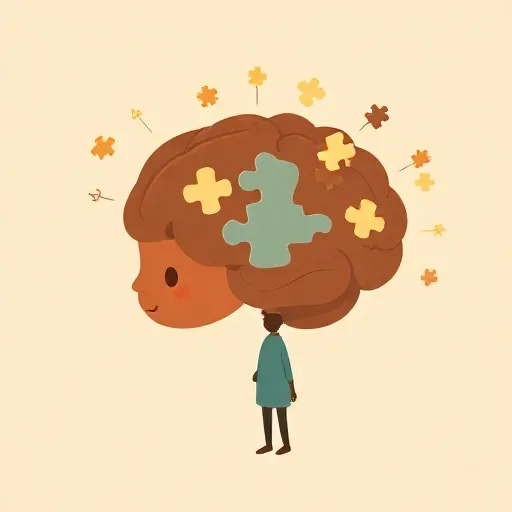
If language works compositionally, does the same go for thinking? The language of thought hypothesis, defended by Jerry Fodor, says that thinking happens in an internal mental language with its own words and grammar. On that view, thoughts have meaningful constituents that can recombine, explaining why our thinking is systematic — if you can think “the squirrel is climbing the tree,” you can also think “the tree is climbing the squirrel,” even if it’s weird. Compositionality would then be a deep fact about the mind, not just about spoken language.
But not everyone agrees. Connectionist models of the mind picture thought as patterns of activation spread across a network, without clear discrete symbols. In such a system, there might be no real “constituents” at all, so the question of compositionality doesn’t even arise. This debate is very much alive. It touches on what it means to have a concept, how children learn meanings, and whether computers could ever think like we do.
Why It Still Matters

Every time you learn a new word and immediately drop it into a sentence you’ve never spoken before, you’re relying on the kind of mental machinery compositionality tries to describe. It’s what makes language creative — not just a list of memorized phrases. You don’t need a teacher to explain “The invisible kangaroo baked a pizza”; your mind builds the meaning on the spot.
Yet the stubborn counterexamples — Travis’s painted leaf, the odd behavior of “if,” the puzzle about beliefs — remind us that the story isn’t simple. Maybe meaning is more context‑sensitive than a pure brick‑building model can handle. Maybe the boundary between what a sentence literally means and what we infer from context is blurrier than we think. Philosophers are still working to find a theory that captures both the astonishing creativity of language and the tricky details.
The question matters because it’s about you. Understanding a brand‑new sentence feels effortless, but hidden beneath that ease is one of the deepest mysteries about how your mind works. Whether the answer turns out to be compositionality, something more flexible, or a mix of both, the search is far from over.
Think about it
- You read “The elephant painted the fence invisible” and immediately understand it — even though you know it’s physically impossible. What does that tell you about how meaning is put together?
- If you stored every idiom like “spill the beans” as a whole, would that count against compositionality? Or is an idiom just a long word?
- Could a computer program that perfectly follows compositional rules ever truly understand a sentence the way you do? Why or why not?