Why Can’t Science Explain Why Brutus Stabbed Caesar?
The Day Caesar Fell: Two Kinds of “Why?”
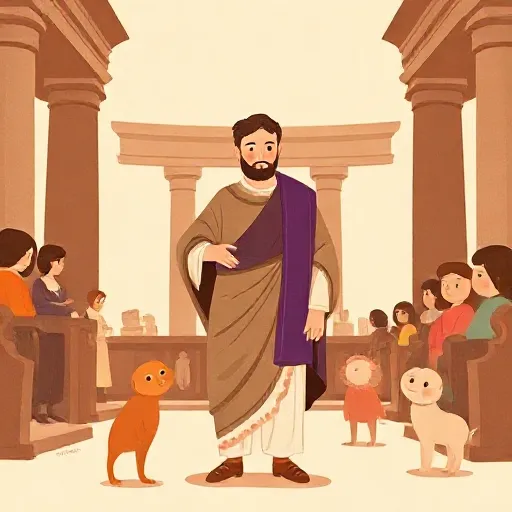
On 15 March 44 BC, a group of Roman senators surrounded Julius Caesar and stabbed him to death. If you asked a natural scientist why Caesar’s blood spilled, they might talk about the force of a blade, the pressure of arteries, or the physics of punctured flesh. But if you ask a historian, they want something completely different: What was Brutus thinking? Why did he believe killing Caesar was the right thing to do?
R.G. Collingwood (1889–1943) was a British philosopher who insisted that those two questions need totally different kinds of answers. He spent his life digging up the difference — literally.
The Philosopher Who Dug Up Roman Forts

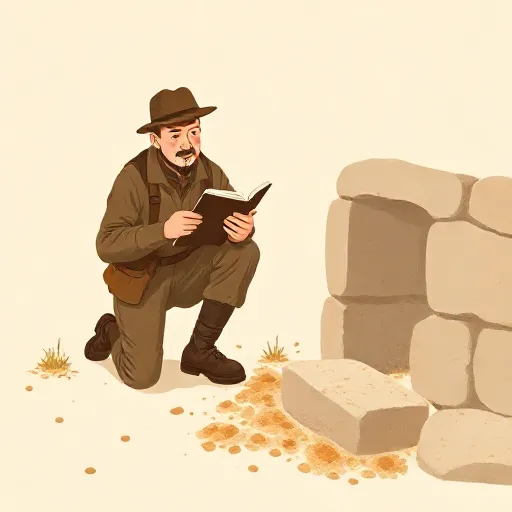
Collingwood wasn’t just a bookish professor. Every summer he directed excavations of Roman ruins in the north of England, becoming a leading expert on the history and archaeology of Roman Britain. He crawled through trenches, recorded inscriptions, and pieced together walls and roads. But he believed that physical remains were never enough. To understand the people who built those forts, you had to do something much stranger: you had to re-enact their thoughts.
He meant this literally. Collingwood argued that the historian’s real job is to re-think the reasoning of past agents — to follow their plans, their fears, and their reasons from the inside. Digging up a Roman fort told you where soldiers stood; re-enacting their thoughts told you why they stood there.
The Inside and Outside of Every Event

Collingwood drew a sharp distinction that became the centre of his philosophy of history. Every event, he said, has an outside and an inside.
The outside is everything you can describe in terms of bodies and movements. When Caesar crossed the river Rubicon, the outside was a man on a horse moving from one bank to another. The inside was something invisible: the thought behind the action. Caesar knew that Roman law forbade a general from bringing his army across that river. By crossing anyway he was not merely moving — he was defying the Republic.
The historian is interested in actions, and an action is the unity of the outside and the inside. A knife plunging is just a physical event; Brutus stabbing Caesar becomes an action only when you grasp the political conviction that drove him. If you only describe the outside — the blood, the motion — you have not understood a single historical thing.
How Can You Think a Roman’s Thought?

This sounds impossible. Brutus lived over 2,000 years ago. How could anyone think his actual thought? Collingwood’s answer is surprising: thoughts aren’t physical objects, so they aren’t locked inside one skull.
Imagine you and a friend both follow the logical steps: “All humans are mortal. Socrates is human. Therefore Socrates is mortal.” Are you thinking two different thoughts, or exactly the same one? Collingwood would say you are thinking the identical thought, because a thought is defined by its content, not by whose brain it happens to be in. There aren’t two copies — there’s just one pattern of reasoning, and both of you are inside it.
The same thing, he claimed, happens when a historian re-enacts Brutus’s political reasoning. By studying the sources — letters, speeches, laws — the historian rebuilds the same logical steps Brutus took. If the reconstruction is correct, the historian isn’t having a similar thought; they are having Brutus’s thought again. Re-enactment is not mind-reading or telepathy. It’s careful logical reconstruction.
Collingwood did admit that feelings and sensations are private. You can’t re-enact the actual sting of the dagger. But the reasoning part — the thought — is shareable, and that’s what makes history possible.
Why Science Can’t Replace History

Collingwood didn’t just claim that history is different from natural science. He offered a whole account of why.
He noticed that the word “cause” does different work depending on what kind of question you’re answering. In the practical sciences — medicine, engineering — a cause is something you can use to produce or prevent an effect. “The cause of your sweating is a dose of aspirin” means: if you want to make someone sweat, give them aspirin. In theoretical natural science, a cause is an unconditional antecedent event: if X happens, Y must happen, like a spark always igniting a particular gas.
But in history, “cause” works more like “reason” or “motive.” When a historian asks, “Why did Brutus stab Caesar?” they aren’t hunting for a preceding physical event that forced his arm to move. They’re asking, “What did Brutus think that made him decide to stab Caesar?” This kind of cause is the inside of the event itself — the thought that made the action make sense.
To show why this matters, Collingwood imagined a car breaking down on a steep hill. A theoretical physicist explains that the uphill slope requires more power. An automobile mechanic holds up a loose cable and says, “You’re running on three cylinders.” Both explanations are correct, but they answer different questions. Neither explanation can replace the other, because each rests on a different absolute presupposition — a fundamental assumption that makes that kind of questioning possible.
An absolute presupposition isn’t something you prove true or false. It’s what you must take for granted before you can even ask your question. The physicist absolutely presupposes that natural events follow universal laws. The mechanic absolutely presupposes that parts can be handled to fix a problem. The historian absolutely presupposes that people act for reasons that can be reconstructed. When someone tries to replace all of these with a single scientific method, they simply fail to notice what kind of question they are actually asking.
This insight led Collingwood to reject the popular view — pushed by thinkers like John Stuart Mill — that history is just an inexact natural science waiting to become more precise. For Collingwood, history is a distinct form of knowledge, complete in its own way, answering questions that science, with all its power, can’t even formulate.
Why It Still Matters: Your Own Thoughts Are Historical
You don’t have to be a professional historian to re-enact thoughts. Whenever you try to understand why a friend didn’t invite you to a party, or why your sibling suddenly acted hurt, you’re doing something very close to what Collingwood described. You’re not running a lab experiment; you’re reconstructing what they might have been thinking — you’re trying to see the world from inside their reasoning.
Collingwood’s big idea is that this kind of understanding is not a second-rate version of science. It’s its own genuine way of knowing. The fight he picked with philosophers who wanted everything reduced to physics or biology is still alive today. Every debate about whether brain scans can fully explain a decision, or whether algorithms can truly understand a poem, echoes his core warning: treat people only as objects obeying laws, and you lose the very thing that makes their actions meaningful.
When you ask “why,” always notice what kind of answer you’re really looking for. Collingwood thought that untangling this question — and distinguishing the different senses hidden in ordinary words — was the true task of philosophy. And once you start seeing it, even a Roman dagger becomes a different kind of fact.
Think about it
- If you and your best friend both understand the same math proof, are you thinking the exact same thought, or is something unique still happening in each mind?
- Could a super-intelligent computer that never felt an emotion ever truly understand why Brutus stabbed Caesar? What would be missing?
- When you explain why you did something, do you feel like you’re giving a scientific cause or just sharing your reasons? Are those ever the same thing?