Does Your Dog Really Think, or Just Act on Instinct?
The Dog, the Cat, and the Wrong Tree
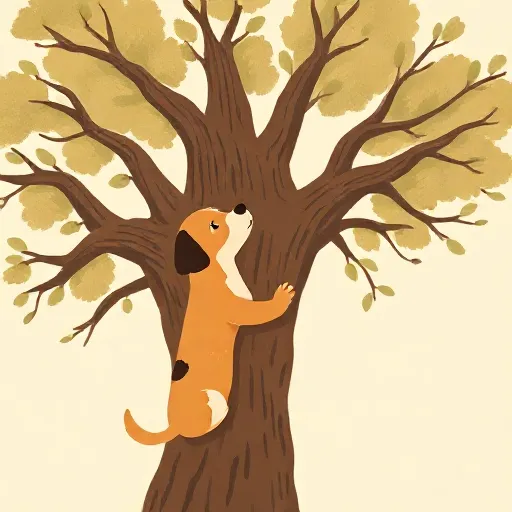
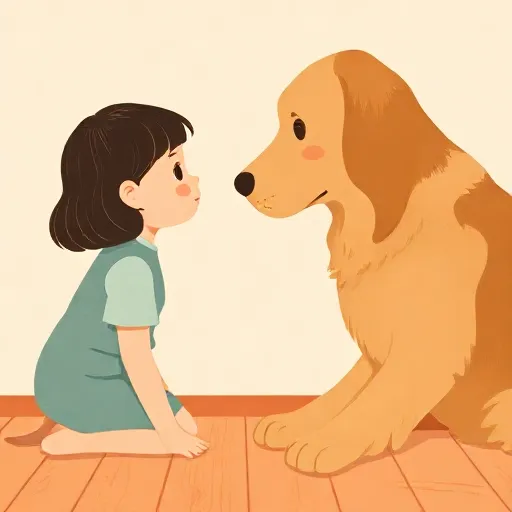
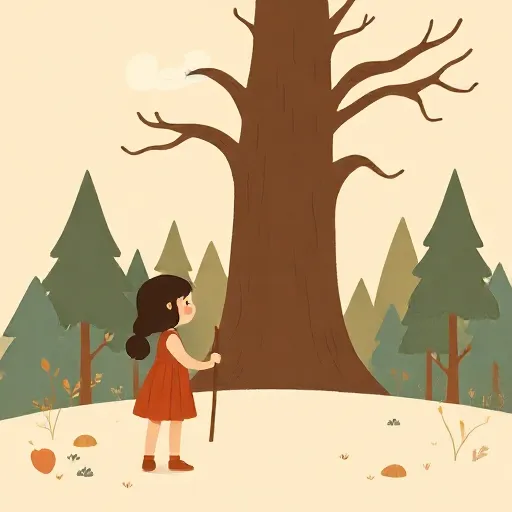
A dog chases the neighbor’s cat across the yard. The cat races straight toward an oak tree, then at the last second swerves and darts up a maple. The dog doesn’t see the swerve. It runs to the oak, puts its paws on the trunk, and barks up at the branches. Anyone watching would say, “That dog thinks the cat is up the oak.” But does it really believe that? And if it does, what kind of thing is a dog’s belief — a picture, a smell-map, a wordless thought?
Those are the sorts of questions that drive the philosophy of animal minds. Comparative cognition is the science that studies what’s going on inside an animal’s head — not by asking them, but by watching what they do. Scientists design puzzles, observe social groups, and even look at what animals pay attention to, hoping to find out whether they have beliefs, plans, memories, or even a sense of fairness. Philosophers take that same evidence and ask what it means for the biggest questions: Who can think? Who can feel? And why does it matter how we answer?
Darwin’s Spectrum of Minds
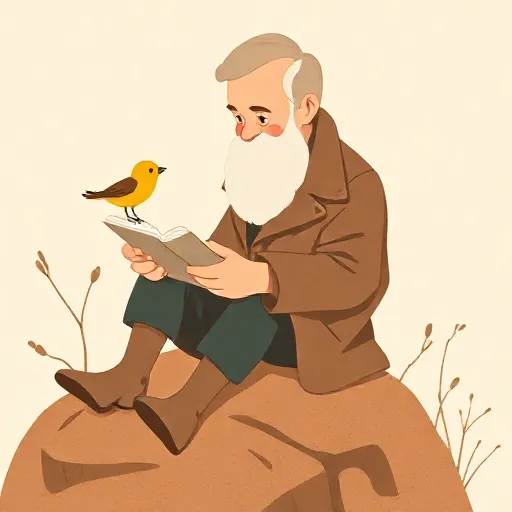
For centuries, many thinkers drew a sharp line between humans and all other animals. René Descartes (1596–1650) argued that because animals can’t speak, they must be like clever machines — no real thoughts, no true feelings. That picture began to crack when Charles Darwin (1809–1882) published The Descent of Man. Darwin insisted that the difference between human and animal minds is “one of degree and not of kind.” We weren’t a separate category; we were part of a long, slow continuum.
He collected stories: horses that sulked, canaries that seemed to dream, a bear that patted the water to pull a floating object closer, a monkey that kept a special stone hidden in its bed to crack nuts. To Darwin, these weren’t just clever tricks. They pointed to real emotions, memory, imagination, and even something like reason. His theory of evolution by natural selection backed him up: if bodies change gradually across species, why wouldn’t minds do the same?
Today’s researchers have moved beyond just collecting anecdotes. They study worms, bees, stickleback fish, and ravens, not to crown the smartest creature, but to see how each mind is shaped by its own environment. A mental ability that helps a cleaner wrasse find parasites on other fish might look nothing like a human skill, yet still be a genuine form of thinking.
Morgan’s Canon: Keep It Simple — but Not Too Simple
Darwin’s sweeping stories made some scientists nervous. C. Lloyd Morgan (1852–1936) worried that we’re too eager to see human-like cleverness everywhere. He proposed a rule, now called Morgan’s Canon: never explain an animal’s action as the result of a fancier mental power if a simpler one will do the job.
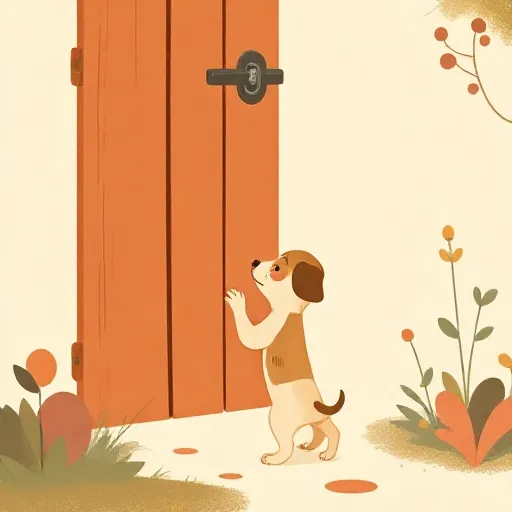
Morgan told the story of Tony, his fox-terrier pup. Tony learned to put his head under the latch of the garden gate, lift it, and wait for the gate to swing open so he could run into the road. It looked brilliantly purposeful. But Morgan asked: did Tony know the gate would open? Maybe he just discovered that shoving his head in that spot was followed by freedom, without ever understanding how the latch worked.
Morgan’s Canon is a weapon against anthropomorphism — the habit of projecting human qualities onto animals. In a famous 1940s study, people watched a silent film of geometric shapes moving around a screen and immediately invented stories about triangles “chasing” circles. If we can’t help but see minds in a wobbly triangle, we probably do the same with dogs and apes. Trying to avoid that mistake makes good scientific sense.
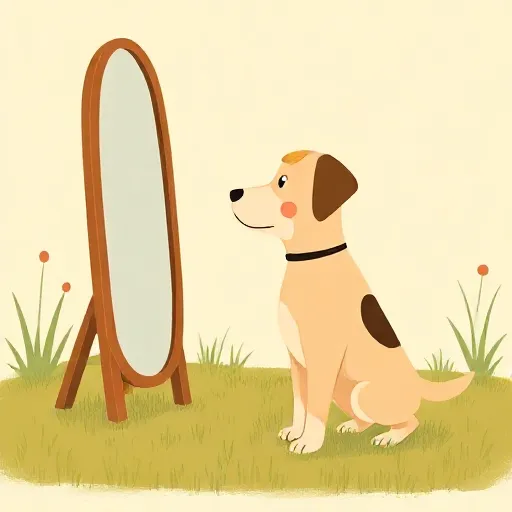
Yet a rigid ban on human-like explanations can create the opposite error. The primatologist Frans de Waal calls it anthropodenial: refusing to see a capacity just because we think it’s uniquely ours. The mirror self-recognition test is a classic example. A mark is put on an animal’s forehead, and researchers check whether the animal uses a mirror to inspect or remove it. Animals that fail are often said to lack self-awareness. But gorillas avoid eye contact because they find it threatening, and dogs — who live by smell — pass an equivalent test using urine samples, recognizing their own scent even though mirrors mean little to them. The test wasn’t measuring self-awareness in general; it was measuring visual self-awareness in a very human way.
Philosophers now argue that both anthropomorphism and anthropodenial are mistakes that distort our picture of animal minds. The goal isn’t to pick one and run with it. It’s to find methods that don’t rely on assuming either that animals are fuzzy humans or that they are hollow shells.
No Language, No Thought? The Descartes-Davidson Challenge
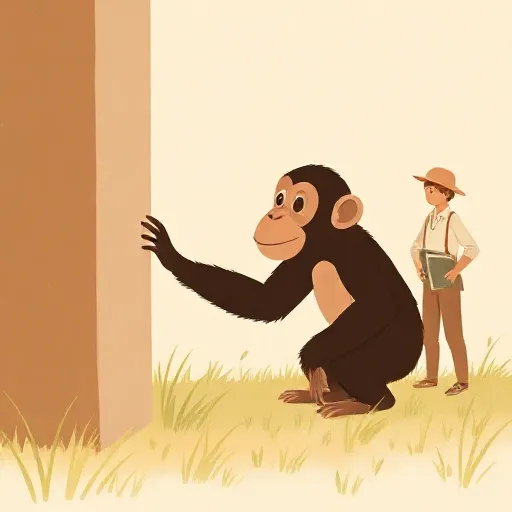
Descartes’ old worry never really went away. In the twentieth century, the philosopher Donald Davidson (1917–2003) gave it a sharper form. He argued that having a belief requires having the concept of belief — understanding that your thoughts might be wrong. And to get that concept, Davidson said, you need language. Only by talking with others can you contrast what you believe with what they believe, and that’s how the idea of a true-or-false world takes shape.
Look at the dog barking at the wrong tree. Can we say which belief it holds? That the cat is in the oldest tree? The smelliest tree? The tree it saw most recently? Without language, Davidson argued, there’s no way to pin down the content of the thought. Worse, a single belief only makes sense in a web of other beliefs. To believe “that’s a tree” you need some idea of what trees are — that they grow, have leaves, stay put. Without that web, the belief dissolves.
Many philosophers push back. Young children think before they speak, and animals might do the same. Experiments can narrow down what an animal expects, what surprises it, what it remembers. Maybe a chimpanzee doesn’t think in sentences like “I can crack this nut with that rock,” but instead holds a flexible mental map of objects and actions — what some call a compositional representational system without being a full language. A dog might think of a cat not as a four-legged meowing mammal, but as a chase-able, eat-able thing, which is still a kind of thought.
Researchers have also found that birdsong can have recursive patterns, and bonobos combine gestures in rule-like ways. These discoveries don’t settle the debate, but they keep the door open. The question isn’t just “can animals think?” It’s “what are the many different shapes a thought can take?”
Why It Matters: Your Plate, Your Pet, and Your Conscience
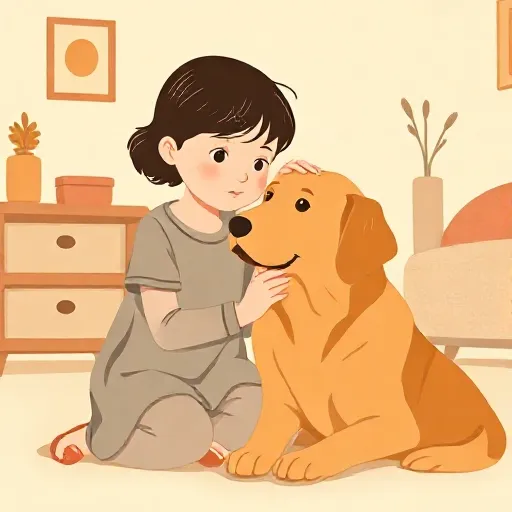
So why does any of this matter for a twelve-year-old deciding what snack to grab or how to treat the family dog? Because what we believe about animal minds shapes the biggest choices we make.
If animals can suffer, then making them suffer starts to look like a moral problem. The most common line philosophers draw is the line of sentience — the ability to feel pleasure and pain. Everyone agrees that sentient beings have interests that count. But how far down does sentience go? Until recently, most people assumed fish, octopuses, and insects didn’t feel pain the way we do. New evidence is challenging that. Some fish show long-term changes in behavior after painful events, and octopuses avoid places where they’ve been hurt. If that’s true, then the circle of creatures we need to consider might grow suddenly very large.
Beyond pain, some animals may enjoy goods like freedom, friendship, or even a kind of meaningful life. Great apes, dolphins, and elephants can recognize themselves, plan ahead, and grieve their dead. A growing number of philosophers and scientists argue that these animals deserve legal personhood — not because they’re human, but because they’re the kind of beings whose lives can go better or worse for them. That doesn’t automatically mean you have to stop eating cheese or quit watching animal shows, but it does mean the answer to “what is it like to be your dog?” isn’t just a curiosity. It’s a question that might quietly shape how you live.
The dog that barked at the wrong tree may not have a fully fleshed-out belief. But the way you answer changes whether you see that dog as a warm, feeling companion — or a complicated machine wearing a wagging tail.
Think about it
- If a parrot learned to say “I want a cracker,” would that prove it actually thinks, or just that it can copy sounds? Where would you draw the line?
- Crows bend wires into hooks, and octopuses unscrew jars. Does watching an animal solve a puzzle you couldn’t solve change how you see its mind? Why or why not?
- Suppose scientists showed that fish feel pain every time they’re hooked. Would it still be fair to go fishing just for fun? What makes an activity fair, anyway?