Are You More Than a Body? Roderick Chisholm’s Bold Answer
The Philosopher Who Loved Puzzles

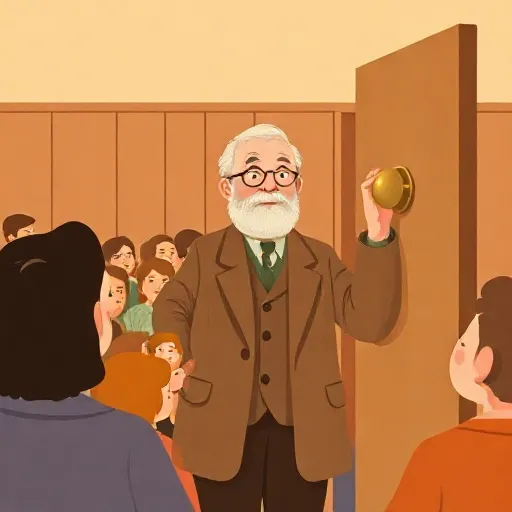
In a Brown University lecture hall during the 1960s, a professor named Roderick Chisholm (1916–1999) picks up an ordinary doorknob. He asks his students, “You think this doorknob is real. But what makes you so sure?” The room falls silent. This is how Chisholm began nearly every philosophical question — not with a grand theory, but with a tiny concrete puzzle.
Chisholm was famous for a method that looked a lot like solving a jigsaw puzzle. He would start by listing a few things we all seem to know — “I seem to see a doorknob,” “I can choose to raise my hand,” “I am the same person who went to bed last night.” He called these pre-analytic data: beliefs we hold before we start philosophizing, innocent until proven guilty. Then, he would build a system of definitions and principles designed to explain how those beliefs could be true. And if someone found a counterexample, he would joyfully revise his definitions again and again — so much so that a joking dictionary entry was invented: chisholm, a verb meaning “to make repeated small alterations in a definition.”
His starting point was always modest. He never claimed he could prove the external world was real, or that we have free will, in a way that would silence every skeptic. Instead, he tried to show how it is possible for us to know the things we take ourselves to know. That willingness to start where we actually stand, and to build carefully outward, is what made his work so distinctive.
How Do You Know the Doorknob Is Real?
Chisholm thought the central job of epistemology — the study of knowledge — was to answer a pair of questions: “What can we know?” and “What are the criteria for knowing?” He noticed something tricky. To answer the first question, you need a criterion to sort genuine knowledge from mere guesswork. But to figure out a good criterion, you need examples of things you already know. This loop is called the problem of the criterion.
Chisholm’s solution was cheerfully simple: start with what you do know. He called this particularism. If a theory says you cannot know there is a doorknob in front of you, and you find that wildly unconvincing, you are allowed to trust the particular belief more than the theory. This was not a proof, he admitted. It was more like saying, “I know I know some things — now let me explain how it works.”
His explanation relied on a chain of epistemic principles — principles about when a belief becomes reasonable, acceptable, or evident. He began with the concept of self-presenting states. A self-presenting state is something going on inside your own mind that you cannot be wrong about right now: the way red looks to you, the feeling of hoping for rain, the sensation of wanting to sneeze. Chisholm held that if you are in such a state, it is evident to you that you are. “It seems to me that I am seeing a doorknob” is directly evident in a way that “There is a doorknob” is not.
From there, he built outward step by step. If you believe you are perceiving something with a sensible characteristic — a shiny brass color, a curved shape — then, Chisholm argued, it is reasonable to believe that something has that characteristic. But reasonable is not enough for knowledge. So he added principles about how beliefs can confirm each other. When a whole web of beliefs hangs together, each supporting the others, the epistemic status of those beliefs can rise. A belief that starts as merely acceptable can become reasonable, and eventually even evident. This allowed him to say that, under the right conditions, your belief that there is a doorknob is not just a hunch — it counts as knowledge.
Crucially, Chisholm was an internalist. He believed you can figure out whether you are justified in believing something just by sitting in an armchair and reflecting on your own state of mind. No brain scans, no psychological experiments — just careful thinking. This put him at odds with philosophers who thought knowledge requires a reliable connection to the outside world. For Chisholm, the story had to be told from the first-person point of view.
Could You Have Chosen Not to Read This Sentence?

If you decide to stop reading right now, was that decision truly free? Or was it already caused by everything that happened in your life up to this moment? Chisholm spent decades wrestling with the free will problem.
He started by asking what we mean when we say, “I could have done otherwise.” It cannot mean merely “It is logically possible,” because that would include performing miracles. It cannot mean “If I had chosen otherwise, I would have done otherwise,” because a person might be so terrified of Boston that she cannot choose to go there, even if nothing physically blocks the road. And it cannot mean simply “there was no sufficient cause at the time,” because someone lying in wait down the highway might freely interfere later, making the trip impossible even though nothing prevented it beforehand.
Chisholm’s alternative introduced two central ideas. The first was agent causation. In everyday life, we talk about events causing other events: one domino knocks over the next. But Chisholm thought that when you act freely, you — the whole person, not just some event inside your brain — directly cause something to happen. You are the source of the action, not just a link in a chain of events.
The second idea was indeterminism: for a choice to be free, there must be no sufficient cause that made you do it. In the moment before you decide, the future must be genuinely open. Chisholm then built a careful account of what it is for something to be “in your power.” An outcome is directly in your power if you are free to try to bring it about, and if you tried, you would succeed. Indirectly, something is in your power if there is a chain of such direct powers leading to it.
This view is a form of libertarianism about free will — the idea that free actions are not determined. Many philosophers find it attractive, while others worry it makes choices look like random events. Chisholm himself kept refining the definitions, true to his method, convinced that the feeling of being an agent was a piece of pre-analytic data worth honoring.
Are You a Ship of Theseus?
One of Chisholm’s boldest claims was about what kind of thing you are. He argued that you are not your body. You are not even a collection of thoughts and feelings stitched together. You are a simple, immaterial substance — a single thing with no parts.
To see why, imagine the Ship of Theseus, an ancient puzzle. Over the years, every plank of a wooden ship is replaced. Is it still the same ship? What if someone collects all the original planks and rebuilds them into a second ship — which one is the real original? Chisholm thought that when we talk about ordinary material objects like ships, our answers depend partly on convention. A ship is an ens per alio — something that exists only because a collection of planks does. It does not keep its strict identity through change of parts.
Your body is like that ship. Your cells are constantly replaced. If you were identical with your body, you would only be “loosely” the same person you were as a baby. In a strict sense, you would have ceased to exist. Chisholm found that absurd. He told a story, inspired by C. S. Peirce, about a man about to undergo a painful surgery. His friends offer to save money by declaring a convention: “We will say the man on the table is not you, but Smith.” The man would still ask, “But won’t that person be me?” No convention can change the fact, Chisholm thought, that the person suffering the pain will be me or won’t be. That suggests you are the sort of thing that persists in a strict, real way — an ens per se, something that exists in its own right.
Chisholm also pointed out that you can survive the loss of a hand, but the particular collection of parts that makes up your body at this moment cannot survive losing that hand. Using Leibniz’s Law — if two things are identical, they must have all the same properties — he concluded you cannot be that collection of parts. He even argued that we know we have qualitative properties (like hoping for rain) that we never know any composite object to have. So for all we know, we must be simple, immaterial monads — indivisible units of conscious reality.
This radical view challenged materialist theories of the mind that were gaining popularity. Chisholm did not insist he had proven the soul’s simplicity beyond all doubt. But he thought the pre-analytic data — your deep sense that you are one thing, that you persist, that your thoughts really belong to you — were best explained by his view.
Why Your Feeling of Being “You” Still Matters

You have never had a moment when you felt like a disconnected heap of nerve cells and memories. You feel like one person, one self, making choices and looking out at the world through your own eyes. Chisholm’s entire career was a long, patient attempt to take that ordinary feeling seriously, without simply waving away the puzzles it creates.
He did not think philosophy could hand you a neat final answer and walk away. Instead, he modeled a way of thinking: start with what seems undeniable, define your terms as clearly as you can, build a system that explains it, and then invite everyone to find the cracks. When they do, you fix the cracks and try again. That method — precise, humble, and endlessly self-correcting — is just as useful today when teenagers debate whether they have free will, whether a perfect God could allow suffering, or whether you can know anything at all beyond your own mind.
The questions he grappled with are not dusty museum pieces. Every time you wonder whether a video game character “really” chooses, or whether the person who wakes up tomorrow will still be you, you are stepping into territory Chisholm mapped. He gave us a vocabulary — agent causation, self-presenting states, mereological essentialism — to turn those uneasy feelings into arguments we can examine, criticize, and improve. And he showed that taking common sense seriously does not mean thinking shallowly; it means digging down to the deep, strange principles that make ordinary life possible.
Think about it
- If a friend told you the “you” who started reading this article no longer exists because all your cells have been gradually replaced, what would you say to convince them you are still the same person?
- Imagine a scientist could perfectly predict every choice you will make tomorrow. Would it still be fair to praise or blame you for those choices? Why or why not?
- You are sure you see a phone in your hand right now. But you have been wrong about similar things in dreams. What, if anything, makes this moment different from a dream? How could you ever check?