What Is Real? A Journey Through Chinese Metaphysics
The Lost Bow
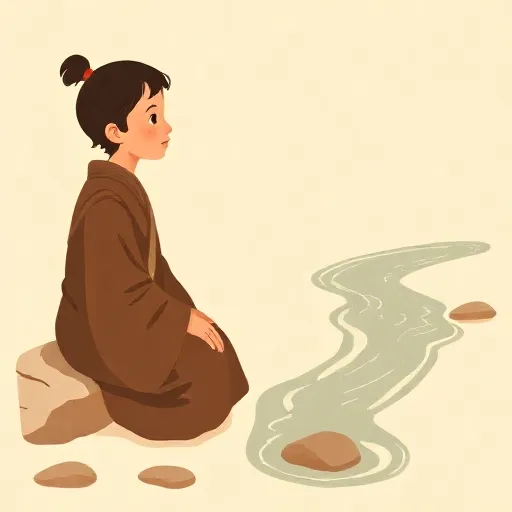
Imagine you lose something valuable—say, a really good backpack. You’re upset. Then someone says, “Don’t worry. Someone in this town will find it. It stays in the community.” That helps a little.
But then someone else says: “Actually, don’t even say ‘in this town.’ Just say: a person lost it, a person will find it.” That’s even more calming. Now it’s not really your loss. It’s just something that happened among people.
Then a third person goes further: “Don’t even say ‘person.’ Just say: something was lost, something will be found.”
At that point, what does “loss” even mean anymore? If you’re not attached to “mine,” and not even attached to “human,” then the whole idea of losing something disappears. You’re just watching the world move.
This story appears in an ancient Chinese text called the Lüshi chunqiu, compiled around 239 BCE. The three speakers in the story represent different levels of philosophical clarity. The third speaker is Laozi, the legendary author of the Daodejing (also called the Laozi). And his radical calm points to something strange: maybe the way we normally divide up the world—into me and you, mine and yours, human and non-human—isn’t the deepest truth about reality.
For more than two thousand years, Chinese philosophers have argued about what’s really real. Their answers are often surprising. They didn’t worry much about whether God exists or whether we have free will—questions that dominated European philosophy. Instead, they asked: How do things arise from a single source? What makes one thing different from another? And if everything is connected, how should we live?
Where Things Come From
Around the 4th century BCE, Chinese thinkers started asking a new kind of question. Before that, most philosophers had focused on ethics and politics: How should rulers behave? What makes a good person? But suddenly, texts like the Laozi and the Zhuangzi began asking: Where do all the different things in the world come from?
Their answer was: from a single source. They called it the dao (道), which means “path” or “way.” The dao isn’t a thing. It’s more like the tendency that makes things happen. The Laozi says: “The dao generates one, one generates two, two generates three, and three generates the ten thousand things.” That phrase “ten thousand things” means everything—all the diverse stuff of the world.
But here’s the tricky part. If the dao generates everything, what is the dao itself? Some early thinkers said it was a kind of being—a very subtle, invisible stuff. Others said no: the dao can’t be a thing, because it’s what makes things possible. The Zhuangzi puts it as a principle: “What things things is not itself a thing.”
This is a genuinely strange idea. Imagine trying to describe the color red without using any words for colors. Or trying to point at your own finger. The dao is like that—it’s what makes everything what it is, but it can’t be pinned down as one more thing among others.
The early texts use two key terms: you (有) and wu (無). They’re often translated “being” and “non-being,” but that’s misleading. Wu doesn’t mean nothingness. It means the absence of particular, definite things. Think of it this way: before a sculptor carves a block of marble, the marble is “without form”—it isn’t yet a statue, a column, or anything specific. Wu is like that: the undetermined potential from which specific things emerge.
Spontaneity: Why Things Happen Without a Plan
So if the dao generates the world, how does it do it? Does it plan everything out like an architect? Does it command things to happen?
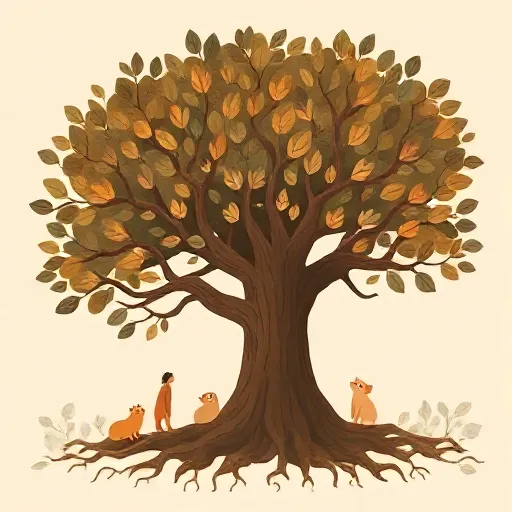
No, say the Chinese philosophers. Things arise ziran (自然)—a word that literally means “self-so.” Things happen the way they do because that’s just how they are. There’s no designer, no purpose, no external force pushing them.
Ziran is one of the most important ideas in Chinese metaphysics. It explains why the sun rises, why water flows downhill, why trees grow toward light. None of these things happen because something tells them to. They just do what they do by their own nature.
This might sound like a cop-out. If someone asks “Why does water flow downhill?” and you answer “It just does,” that’s not much of an explanation. But the Chinese philosophers thought this was exactly right—because at some point, explanations have to stop. You can’t keep asking “why” forever. Eventually you reach something that just is the way it is. The difference from European philosophy is this: Europeans tended to locate that “self-caused” thing in a transcendent God, outside the world. Chinese philosophers located it in the world itself. Everything is self-so. The whole universe runs on spontaneity.
Two important consequences follow from this.
First, existence isn’t thought of as static “being.” It’s thought of as sheng (生)—life, growth, birth, vitality. The oldest commentary on the Classic of Changes says the foundation of everything is shengsheng: “generating and generating, never ceasing.” The universe isn’t a collection of fixed objects. It’s an endless process of coming-to-be.
Second, if everything is self-so, then human beings are part of nature, not above it. You don’t need to conquer your spontaneity or rise above your natural impulses. You need to get in sync with them—to stop forcing things and let your own nature express itself. This is the famous idea of wuwei (無為): “non-action” or “effortless action.” It doesn’t mean doing nothing. It means acting without strain, without trying to control everything.
Yin and Yang: The Dance of Opposites
Between the single source and the ten thousand things, Chinese philosophers said there were intermediate stages. The most famous of these is the interaction of yin (陰) and yang (陽).
You’ve probably seen the symbol: a circle divided into a black swirl and a white swirl, each containing a dot of the other color. Yin originally meant the shaded side of a mountain; yang meant the sunny side. Over time, they came to stand for all sorts of paired opposites: dark and light, cold and hot, receptive and active, feminine and masculine, yielding and forceful.
But here’s what’s crucial: yin and yang aren’t two separate forces fighting each other. They’re two aspects of a single process. They need each other. Neither one can exist without the other. And they’re constantly turning into each other—night becomes day, winter becomes summer, rest becomes activity.
This way of thinking about opposites is very different from the way many European philosophers thought. In Europe, it was common to see the world as made of fundamentally different kinds of stuff: mind and matter, God and creation, spirit and flesh. These were often seen as in conflict, or at least as separate realms. Chinese philosophers saw everything as continuous. Differences are real, but they’re differences within a single system.
This is why the symbol has a dot of white in the black and a dot of black in the white. Nothing is purely yin or purely yang. Everything contains the seed of its opposite.
The Problem of Difference
If everything comes from one source, and everything is connected, then what makes one thing different from another? Why is a tree not a rock? Why are you not me?
This question—the problem of individuation—is central to Chinese metaphysics. European philosophers often worried about how separate things could interact (if mind and matter are completely different, how does my thought move my arm?). Chinese philosophers had the opposite worry: if everything is one, how do we explain the obvious differences we see?
One answer came from the concept of xing (性), usually translated “nature” or “characteristic disposition.” Xing means the way a particular kind of thing tends to respond to its environment. Human beings have a human xing; dogs have a canine xing; trees have an arboreal xing. These differences are real, but they’re not eternal or fixed. They’re patterns of behavior that emerge from the ongoing process of the world.
The philosopher Mengzi (often called Mencius in English, 4th century BCE) argued that human xing includes natural tendencies toward care, shame, and respect. That’s why he thought human nature is good—not because people never do bad things, but because our spontaneous responses point us in the right direction. When you see a child about to fall into a well, your first impulse is alarm and concern. That’s your xing expressing itself.
A rival philosopher named Gaozi disagreed. He said xing is just whatever you’re born with—like the wood a cup is carved from. The wood doesn’t determine whether the cup will be good or bad; that depends on how you carve it. Similarly, human nature is morally neutral; ethics is something we add later.
This debate—is our basic nature good, neutral, or bad?—ran through Chinese philosophy for centuries. But notice what both sides assumed: that there is such a thing as human nature, and that understanding it matters for how we should live.
Resonance: How Things Influence Each Other
If everything is made of the same stuff (called qi 氣—vital energy), and everything is connected, then how does one thing affect another?
Chinese philosophers developed a model of causality based on ganying (感應): stimulus and response. Think of it like resonance. If you pluck a guitar string, another string tuned to the same note will vibrate too—even if they’re not touching. That’s ganying. Causality isn’t about one billiard ball hitting another. It’s about patterns of energy that resonate with each other.
This might sound mystical, but it was based on careful observation. Spring stimulates growth; music moves emotions; a teacher’s presence influences students. These are real causal relationships, but they don’t work by pushing and shoving. They work by correspondence—things of the same kind respond to each other.
During the Han dynasty (206 BCE–220 CE), philosophers developed elaborate systems of correspondence. Everything was classified into categories: yin and yang, the five phases (wood, fire, earth, metal, water), the seasons, directions, colors, tastes, musical notes, organs in the body. The idea was that if you understood these correspondences, you could predict and control things. Treat an illness that’s “hot” and “expansive” with “cool” and “contracting” foods. Align your government with the seasons to keep society in harmony.
This way of thinking had a dark side. Some philosophers used these categories to justify social hierarchies. The Chunqiu fanlu, a text from the 2nd century BCE, argued that the ruler is yang and the minister is yin; the husband is yang and the wife is yin; the father is yang and the son is yin. Since yang is superior to yin, these relationships are natural and right. The universe itself supposedly supported the power of men over women, rulers over subjects.
Other philosophers pushed back. Wang Chong (27–100 CE) argued that the universe runs on ziran—pure spontaneity—and doesn’t care about human hierarchies. Things happen because they happen, not because they’re “supposed to” uphold anyone’s social order.
Emptiness and Interconnection
When Buddhism arrived in China (starting around the 1st century CE), it brought new metaphysical ideas that transformed Chinese thought. The most important was emptiness (kong 空).
Buddhists argued that nothing has an independent, fixed essence. Everything depends on everything else. A chair is “empty” of chair-ness—it’s just wood and nails and fabric arranged a certain way, and those materials came from trees and mines, which grew from seeds and rock formations, which formed through geological processes going back billions of years. There’s no “chair” that exists separately from all these causes and conditions. The chair is empty of any permanent self-nature.
This doesn’t mean the chair doesn’t exist. It means the chair exists as a process, not as a fixed thing. Buddhists called this dependent co-arising: everything arises together with everything else. Nothing stands alone.
Some Chinese Buddhist schools took this even further. The Huayan school (華嚴) argued that not only does everything depend on everything else, but everything contains everything else. Think about why you’re reading this article. One cause is that your parents met. Another cause is that paper was invented. Another is that gravity holds the earth together. Another is that the Big Bang happened. If you trace the causes far enough, the whole universe is involved in making this single moment happen.
Brook Ziporyn, a contemporary philosopher, calls this “omnicentric holism.” Every point in the universe is the center of the universe, because every point contains (in some sense) all the others. This is what the Huayan school meant by “the mutual interpenetration of all phenomena.”
Patterns and Vital Energy
Confucian philosophers in the Song dynasty (960–1279) were unhappy with Buddhist metaphysics. They felt it denied the reality of everyday things—parents, children, grief, joy. They wanted to affirm that the world we live in is genuinely real and that human relationships matter.
So they developed their own metaphysics. Their key terms were li (理) and qi (氣).
Qi is the energetic stuff of the universe—the same term we saw earlier. It’s the material that everything is made of, and it’s constantly in motion, condensing and dispersing, forming things and then letting them dissolve.
Li is harder to translate. It means pattern, principle, coherence. Stephen Angle, a contemporary philosopher, defines it as “the valuable, intelligible way that things fit together.” Imagine a well-designed machine: all the parts work together smoothly, each one doing its job, contributing to the whole. That’s li. It’s not a law imposed from outside. It’s the inherent organization that emerges when things work as they should.
The Neo-Confucians said that li and qi always go together. You can’t have one without the other. Li is the pattern; qi is the stuff that has the pattern. A famous slogan was: “Li is one but distinguished as many.” The same basic coherence runs through everything, but it takes different forms in different things.
This gave the Neo-Confucians a way to talk about ethics. They said that human beings have li in their hearts—the same pattern that organizes the universe. If you clear away selfish desires and distractions, you’ll naturally respond to situations in the right way. You’ll feel the right emotions, make the right choices, treat others with care. Self-cultivation isn’t about adding something you don’t have. It’s about removing obstacles so your true nature can shine through.
Still Arguing
After more than two thousand years, Chinese philosophers are still debating these questions. Is the ultimate source of things a kind of energy (qi), a pattern of coherence (li), or something beyond both? Is the world one thing or many things? Does unity wipe out difference, or does it make difference possible?
These aren’t just abstract puzzles. They affect how people live. If everything is connected, then harming another person is harming yourself. If the world runs on spontaneity, then forcing things—including forcing yourself to be a certain way—is fighting reality. If reality is empty of fixed essences, then you don’t have to be stuck with the identity you were given.
The Chinese tradition offers a set of tools for thinking about these questions. It doesn’t give final answers. But it suggests that reality is more fluid, more interconnected, and more alive than we usually imagine. And that the point of understanding reality isn’t just to know things—it’s to live well.
Appendices
Key Terms
| Term | What it does in the debate |
|---|---|
| Dao (道) | Names the single source from which everything arises, but it’s not itself a thing |
| Ziran (自然) | Captures the idea that things happen spontaneously, without design or external cause |
| You and Wu (有/無) | Distinguish between definite, formed things and the undetermined potential from which they emerge |
| Yin and Yang (陰/陽) | Describe the polar forces whose interaction generates and sustains the world |
| Qi (氣) | The vital energy or stuff that makes up everything and is constantly in motion |
| Xing (性) | The characteristic disposition or nature of a kind of thing |
| Li (理) | The patterns of coherence that organize the world and make it intelligible |
| Ganying (感應) | A model of causality based on resonance and correspondence between things of the same kind |
| Kong (空) | The Buddhist idea that nothing has an independent, fixed essence—everything is empty of self-nature |
Key People
- Laozi (legendary figure, probably 4th century BCE): Supposed author of the Daodejing, the foundational text of Daoism, who argued that the dao is the source of everything and that acting spontaneously (ziran) is the key to wisdom.
- Zhuangzi (4th century BCE): A Daoist philosopher who used wild stories and paradoxes to challenge fixed categories; he argued that dao is in everything, even piss and dung.
- Mengzi (also Mencius, 4th century BCE): A Confucian who argued that human nature is good and that we all have natural tendencies toward care, respect, and shame.
- Huishi (c. 380–305 BCE): A philosopher remembered for the radical claim that “heaven and earth form one body” and that we should care for all things equally.
- Wang Chong (27–100 CE): A critic of correlative cosmology who argued that the universe runs on pure spontaneity and doesn’t care about human values.
- Zhang Zai (1020–1077): A Neo-Confucian who argued that the ultimate reality is qi and that the universe is one body, making all people our siblings.
- Zhu Xi (1130–1200): The most influential Neo-Confucian, who argued that li (pattern) is the ultimate reality and that self-cultivation involves study and learning.
- Wang Yangming (1472–1529): A Neo-Confucian who argued that li is already in the heart and that we just need to remove selfish desires to see it.
Things to Think About
-
If everything is connected, does that mean nothing is really your fault? If a criminal’s actions depend on causes going back before they were born, can we hold them responsible?
-
The story of the lost bow suggests that the more inclusive your perspective, the less you suffer from loss. But does this come at a cost? If you stop caring about “your” things, do you also stop caring about anything?
-
The Neo-Confucians used li and qi to explain why people need self-cultivation: we have good natures (li), but our energy (qi) can be turbid and block it. Does this make sense? What would it mean to “purify” your energy?
-
Correlative cosmology—matching seasons, directions, colors, and emotions—seems arbitrary in many cases. Is there a way to tell which correspondences are real and which are just made up?
Where This Shows Up
- Traditional Chinese medicine still uses yin-yang theory and the five phases to diagnose and treat illness. An acupuncturist might say your condition is “yang excess” and need “yin tonification.”
- Feng shui (literally “wind and water”) arranges buildings and objects according to principles of qi flow and resonance—though many practitioners today treat it more as tradition than science.
- East Asian martial arts like taiji (tai chi) explicitly draw on Daoist ideas of wuwei and ziran: the goal is to move without strain, responding to your opponent’s energy rather than forcing your own.
- Ecological thinking overlaps significantly with Chinese metaphysics. The idea that everything is interconnected, that systems are self-organizing, and that human beings are part of nature rather than above it—these are claims made by both ancient Chinese philosophers and modern environmental scientists.
- Modern physics (especially theories of complex systems) sometimes sounds like Chinese philosophy. The physicist David Bohm, for example, argued for an “implicate order” where everything is enfolded in everything else—a concept very close to Huayan Buddhism.