
What Is a Chemical Element, Anyway?
You’ve probably seen the periodic table. It hangs on classroom walls, printed on posters, built into phone apps. 118 squares, each with a symbol and a number. Hydrogen. Helium. Lithium. Oxygen. Gold. The whole universe, supposedly, made from combinations of these basic building blocks.
But here’s a weird question: What is an element, exactly?
If you said “a basic substance that can’t be broken down into anything simpler,” you’d be giving an answer that philosophers and chemists have been arguing about for over two thousand years. And they’re still not entirely sure they’ve got it right.
The Ancient Puzzle: Are Elements Really in Things?
Let’s start with a problem that Aristotle noticed around 350 BCE. Take some salt and dissolve it in water. You now have saltwater. The salt is still in the water — you can taste it, and if you boil the water away, the salt comes back. So salt and water are both present, mixed together.
But what about when you combine two substances to make something new? When hydrogen and oxygen combine to make water, is the hydrogen still there inside the water? Or has it been transformed into something else?
Aristotle thought the answer was complicated. He believed everything was made from four elements — earth, air, fire, and water — combined in different proportions. But he also thought that once you mixed elements together to make a new substance (like turning fire and water into something with middling warmth and wetness), the original elements weren’t actually present anymore. They were only potentially there, meaning you could get them back by breaking the substance down, but they didn’t exist inside it right now.
This is what philosophers call the “problem of mixture.” If elements are the building blocks of everything, are they actually sitting inside compounds like bricks in a wall? Or do they get destroyed and remade every time a chemical reaction happens?
Aristotle went with the second option. But that created a puzzle: if elements get destroyed when they combine, how do you ever get them back? It’s like saying you can un-bake a cake into flour and eggs.
Lavoisier: Let’s Weigh Everything
Fast forward to the 1780s. A French chemist named Antoine Lavoisier is changing how people think about chemistry. Lavoisier didn’t much care for the ancient four-element system. Instead, he made a list of what he thought were actual elements — substances that couldn’t be broken down any further by the techniques available at the time.
His list looks weird to modern eyes. It includes oxygen and hydrogen (which we still consider elements) but also “caloric” (a substance he thought was the stuff of heat itself) and several kinds of “earth” like lime and magnesia. He was wrong about some things, but his method was revolutionary.
Lavoisier’s key insight: weigh everything. If you burn something and it gains weight, something must have been added. If it loses weight, something must have left. Mass is conserved — it doesn’t appear or disappear. This gave chemists a tool for figuring out what was really happening in reactions.
He also basically gave up on trying to figure out what elements really were, deep down. In his own words: “if, by the term elements, we mean to express those simple and indivisible atoms of which matter is composed, it is extremely probable we know nothing at all about them.” Instead, he said, an element is just whatever substance we can’t break down any further — the “last point which analysis is capable of reaching.”
This is a move from a grand theory about what elements are to a practical rule about what we can do. It worked, but it left a philosophical question hanging: is an element just a tool for chemists, or does it actually exist as a real component inside compounds?
Mendeleev’s Table: Prediction and Power
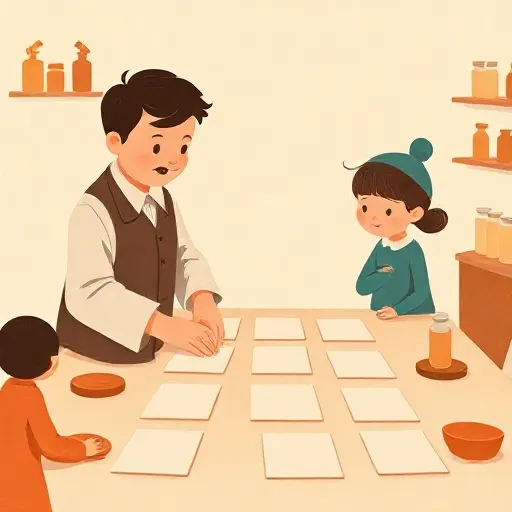
In 1869, a Russian chemist named Dmitri Mendeleev did something that changed everything. He wrote all the known elements on cards and arranged them by atomic weight, looking for patterns. What he found was that when you order them this way, elements with similar chemical properties appear at regular intervals — periodically.
Mendeleev’s periodic table was more than a filing system. When there were gaps in his table, he predicted that new elements would be discovered to fill them. He even predicted their properties — how dense they would be, what compounds they would form. And he was right. When gallium was discovered in 1875, its properties matched Mendeleev’s prediction for an element he called “eka-aluminium” almost exactly.
Here’s what’s philosophically interesting: Mendeleev thought of elements as actual components of compounds, not just as end-points of analysis. He assumed that the weights of compounds are the sums of the weights of their component atoms. The atoms of each element survive chemical change — they’re really there inside the compounds. This is the opposite of what Aristotle believed.
This debate is still alive. The International Union of Pure and Applied Chemistry (IUPAC), which sets chemical standards, officially agrees with Mendeleev. They define elements by atomic number — the number of protons in the nucleus. If it has 79 protons, it’s gold, period. But some philosophers have pointed out that different isotopes (atoms of the same element with different numbers of neutrons) can behave quite differently. Heavy water, made from a hydrogen isotope called deuterium, is poisonous. Regular water isn’t. So are they the same substance or different ones? Nobody has a completely satisfying answer.
The Strange Case of Mixtures and Compounds
You might think chemists have a clear way to tell whether something is a pure compound or just a mixture. They do — but it turns out the boundary is surprisingly fuzzy.
In the early 1800s, a chemist named Joseph Proust proposed the “law of constant proportions”: any pure compound always contains the same elements in the same proportions by weight. Water is always 8 grams of oxygen for every 1 gram of hydrogen. Salt is always roughly equal parts sodium and chlorine by weight.
This law became a powerful tool. Is air a compound or a mixture? Well, if it were a compound, it would always have the same ratio of oxygen to nitrogen everywhere on Earth. But it doesn’t — it varies a bit. So air must be a mixture, not a compound.
But another chemist named Claude Berthollet disagreed. He thought that compounds could vary in their proportions, just like you can dissolve different amounts of sugar in water depending on temperature. Proust won the argument at the time, but here’s the kicker: over a hundred years later, chemists discovered substances they now call “Berthollides” that behave exactly the way Berthollet predicted. They’re genuine compounds, but their elemental proportions vary with temperature and pressure.
This complicates the neat picture. If even the basic rule for what counts as a compound has exceptions, then the whole question of what elements are and how they combine turns out to be more tangled than a high school textbook suggests.
Are Atoms Even Real?
Here’s something surprising: until about 1905, many serious scientists didn’t believe atoms existed.
The trouble started with Aristotle, who attacked ancient Greek atomism on several fronts. What are atoms made of, he asked? If they’re made of the same stuff as everything else, why are they indivisible? What makes them special? And if atoms can’t change their properties — if they’re just little billiard balls that move around — how do they explain the fact that substances change fundamentally when they combine? A white solid salt and a clear liquid water produce salty water, which has properties neither of them had separately. How do unchanging atoms produce genuinely new substances?
Robert Boyle, the 17th-century chemist, tried to revive atomism. But even Lavoisier — often called the father of modern chemistry — thought atomic theory was useless for actual chemistry. He knew nothing about the atoms he was supposedly studying, and he was honest about it.
The skepticism continued into the 1800s. John Dalton proposed that each element has its own kind of atom with a characteristic weight, and that atoms combine in fixed ratios. This explained the law of constant proportions nicely. But critics pointed out that Dalton couldn’t explain how atoms stuck together. Without a theory of chemical bonding, atomism was just a speculation.
Ernst Mach, Wilhelm Ostwald, and Pierre Duhem — some of the most respected scientists of the late 1800s — all rejected atomism. They argued that chemistry should be based on what you can actually measure: temperature, pressure, weight, energy. Atoms were invisible specks that nobody had ever seen, and they seemed to cause more philosophical problems than they solved.
What finally convinced everyone? Brownian motion — the random jiggling of tiny particles in water. In 1905, Albert Einstein showed that this jiggling could be explained by invisible molecules bumping into the visible particles. A few years later, Jean Perrin’s experiments confirmed Einstein’s predictions and gave a reliable estimate of how many molecules were in a given amount of gas. When multiple independent methods gave the same number, even the skeptics gave in.
But here’s the thing: even after atoms were accepted, many of the old philosophical questions remained. How do atoms actually form bonds? Do chemical bonds really exist as physical things between atoms, or are they just useful fictions? Some chemists and philosophers still argue about this today.
Is Water Really H₂O?
You’ve probably heard that “water is H₂O.” Philosophers have used this as an example for decades. It seems obvious. But it’s not quite right.
H₂O is a compositional formula — it tells you the ratio of hydrogen to oxygen in water. But liquid water isn’t just a bunch of separate H₂O molecules floating around. Water molecules associate into larger clusters. They spontaneously split apart and re-form. Water contains hydrogen ions and hydroxide ions mixed in with the H₂O molecules. The microstructure is complicated and dynamic.
Those complications matter. They’re why water has such strange properties — why it expands when it freezes, why it has a high boiling point for such a small molecule, why it conducts electricity. If water were just “a collection of H₂O molecules,” none of these properties would make sense.
So is water H₂O? It depends on what you mean. As a shorthand, sure. As a complete description of what water is? Definitely not. And this matters for a bigger philosophical question: can you reduce a substance entirely to its microscopic structure? Most philosophers of chemistry say no. Macroscopic properties — boiling points, densities, heats of fusion — are part of what makes a substance what it is. You can’t replace them entirely with a molecular formula.
The Big Picture
So after two thousand years of thinking about elements, here’s where we are:
- Elements might be “actual components” of compounds (Mendeleev’s view) or just “end points of analysis” (Lavoisier’s pragmatic view). The official answer favors Mendeleev, but the question keeps coming back.
- The boundary between compounds and mixtures is fuzzier than you might think. Some genuine compounds don’t even obey the law of constant proportions.
- Atoms were controversial until surprisingly recently. Even after everyone agreed they existed, the philosophical problems about how they combine and what bonds really are haven’t gone away.
- The simple statement “water is H₂O” is much more complicated than it looks.
What makes this all fascinating is that it’s not settled. These aren’t questions from ancient history that science has answered. They’re live debates happening right now in philosophy of chemistry journals. The periodic table on your wall is a fantastic tool, but it hides deep puzzles about what it actually means to call something an “element.”
Maybe that’s the most honest conclusion: we’ve learned an enormous amount about how substances behave, how they combine, and how to predict their properties. But the simplest questions — What is an element? Is it really in there? — turn out to be the hardest to answer.
Key Terms
| Term | What it does in this debate |
|---|---|
| Element | The basic substances everything else is made of, but nobody agrees whether they’re real components inside compounds or just the simplest things we can isolate |
| Compound | A substance made from two or more elements combined, but the line between compound and mixture is surprisingly hard to draw |
| Law of constant proportions | The rule that any pure compound always has the same elements in the same weight ratios — except for Berthollides, which break the rule |
| Atomism | The view that matter is made of tiny indivisible particles — controversial until about 1905, still philosophically tricky today |
| Chemical bond | What holds atoms together in molecules, but philosophers disagree about whether bonds are real physical things or just useful ideas |
| Compositional formula | Something like H₂O — it tells you the ratio of elements in a compound, not the complete microscopic structure |
Key People
- Aristotle (384–322 BCE) — Ancient Greek philosopher who thought elements were only potentially present in compounds, and who attacked atomism so effectively that it took over 2000 years to recover.
- Antoine Lavoisier (1743–1794) — French chemist who introduced mass-based reasoning into chemistry and defined elements pragmatically as whatever you can’t break down further. He also kept “caloric” on his list of elements, which turned out to be wrong.
- Dmitri Mendeleev (1834–1907) — Russian chemist who created the periodic table and believed elements are actual components of compounds. He successfully predicted properties of undiscovered elements.
- John Dalton (1766–1844) — English chemist who proposed that each element has its own kind of atom with a characteristic weight, reviving atomism but without a good theory of how atoms bond.
Things to Think About
-
If you could somehow look at a single molecule of water, would you expect to find hydrogen and oxygen inside it, or would the hydrogen and oxygen have been transformed into something new? What would it even mean for them to be “inside” the molecule?
-
Suppose a chemist in 1850 and a chemist today both agree that gold is an element. Do they mean the same thing? If not, has the meaning of the word changed, or have we just learned more about what gold really is?
-
Mendeleev predicted the existence and properties of undiscovered elements based on gaps in his table. Does that mean his theory about elements being actual components of compounds was “true”? What would it take to prove him wrong?
-
If heavy water (made from deuterium) is poisonous but regular water isn’t, should we consider them different substances? If yes, what does that do to the definition of elements by atomic number?
Where This Shows Up
- Every time you see a “gluten-free” or “organic” label, you’re dealing with questions about what counts as a pure substance and how we should classify it.
- Debates about whether “natural kinds” (like gold or water) have fixed essences show up in law courts, where judges have to decide whether a substance counts as “gold” for purposes of contracts or patents.
- The question of whether atoms are real isn’t ancient history — it connects to current debates in quantum mechanics about whether unobservable entities exist.
- Arguments about reduction (can chemistry be reduced to physics?) mirror arguments about whether psychology can be reduced to biology, or biology to chemistry. The same philosophical moves appear in every science.