

Can a Butterfly Flapping Its Wings Really Cause a Tornado?
The Weather Machine That Changed Everything

In 1961, meteorologist Edward Lorenz (1917–2008) was running a weather model on his clunky computer. He wanted to re-create a forecast he had already seen, so he typed in a number from the earlier run: 0.506 instead of the full 0.506127. That rounding should have made almost no difference. But when he came back, the new forecast looked nothing like the first. A change less than a tenth of a percent had turned sunshine into storms.
Lorenz had stumbled onto a strange secret: some systems are so sensitive that a tiny nudge can blow up into a completely different future. A butterfly flapping its wings in Brazil could, in theory, set off a tornado in Texas weeks later.
This is chaos. Not confusion or mess, but a special kind of order that looks unpredictable. To understand it, we need a dynamical system—any set of rules that tells you how something changes with time. A swinging pendulum, the number of rabbits in a forest, even the rhythm of a beating heart can be modeled as dynamical systems. Usually, we think that if we know the starting state perfectly, we can calculate exactly what comes next. That’s determinism: the same starting point always leads to the same future, like dominoes falling one by one.
But chaos reveals that determinism and predictability are two different things. Chaotic systems are fully deterministic, yet their futures are so sensitive to the tiniest details that they might as well be random. If one domino is a hair’s breadth off, the whole chain falls differently.
The Recipe for Chaos

Not every system is chaotic. For chaos to appear, you need three ingredients: nonlinearity, stretching and folding, and aperiodicity.
Nonlinearity means the effect isn’t proportional to the cause. If you turn up the volume on a speaker a little, the sound gets a little louder—that’s linear. But if you turn it up too far, the sound distorts and screeches uncontrollably. That’s nonlinear. In chaotic systems, a small nudge can change everything, not just make a louder nudge.
Stretching and folding is the geometric trick that mixes things up. Imagine kneading dough: you roll it out, fold it over, roll it again. Two raisins that started side by side quickly end up far apart. Chaotic dynamics stretch tiny differences apart, then fold them back so that what was originally close becomes wildly separated and tangled. This is why small uncertainties explode.
Aperiodicity means the system never repeats exactly. A clock pendulum swings with a regular beat; that’s periodic. Chaotic motion never settles into a simple loop. Instead it wanders forever around a strange attractor—a twisted, infinitely detailed shape in the space of all possible states. Even though the system follows strict rules, it never revisits the same state.
These three features combine to create the butterfly effect. A tiny difference becomes a completely different future. Yet the equations underneath are still deterministic. Chaos is in the behavior, not in the laws themselves. And it only appears for certain values of the system’s controls; change a parameter a little, and the chaos can suddenly vanish.
Why Defining Chaos Is So Hard

You’d think such a striking phenomenon would have one clear definition. But mathematicians and scientists have argued for decades about what exactly counts as chaos. Different definitions pick out different features.
Some say chaos is just sensitive dependence on initial conditions (SDIC), often measured by a Lyapunov exponent. If that exponent is positive, tiny differences grow exponentially fast. Others add that you need dense periodic orbits (repeating patterns packed tightly together) and topological transitivity (you can get from any point to any other region over time). This was Robert Devaney’s famous definition. Still others insist on a horseshoe map—a construction that literally stretches, compresses, and folds a square.
The trouble is, every definition has counterexamples. Some systems are sensitive but don’t have the rich mixing of chaos. Some with positive Lyapunov exponents can still be predictable if uncertainty shrinks at certain moments. And some linear systems—which are never considered truly chaotic—can show sensitivity too.
Why does this matter? Because if we want to say whether real things like the weather or a dripping faucet are chaotic, we need to know what we are looking for. Maybe chaos isn’t one crisp property. Philosophers sometimes call such a collection of related traits a cluster concept—like “game” or “intelligence.” In practice, scientists look for a mix of signs: sensitivity, aperiodicity, and stretching and folding.
Does Chaos Mean the Universe Is Random?
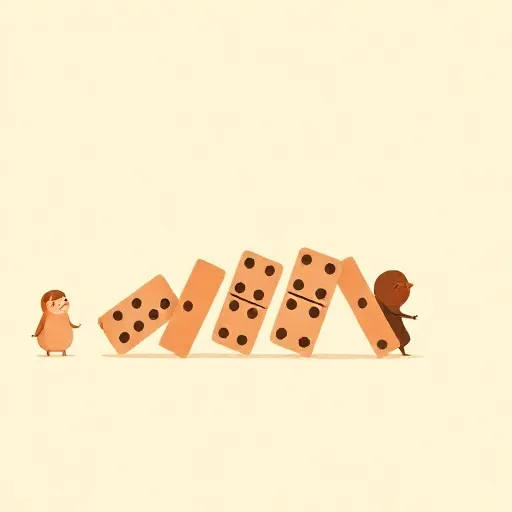
When Lorenz reported his work, some people thought chaos had killed determinism. If we can’t predict the weather beyond a week, doesn’t that mean nature itself is unpredictable? Not so fast. The equations are still deterministic: the same starting point always yields the same path. The trouble is that we can never measure the starting point with infinite precision.
But some philosophers and scientists have argued that chaos might open a door to genuine randomness. The idea goes like this: In a chaotic system, even a tiny push—say, a single photon hitting a molecule—gets amplified into a large-scale effect. Quantum mechanics is famously indeterministic (or at least seems to be). So perhaps quantum randomness is amplified by chaos, making the everyday world undetermined too. Physicist and priest John Polkinghorne (1930–2021) and others defended this view.
Most philosophers of science are skeptical. For one thing, chaotic systems often have regions where uncertainty shrinks, not grows. A quantum nudge might be damped out rather than take over the system. Also, quantum indeterminism itself is deeply debated; some interpretations preserve determinism. And even if quantum events are random, it’s not clear they can reliably steer a chaotic system. So chaos alone doesn’t settle the determinism debate. It just shows that determinism does not guarantee predictability.
Are We Just Seeing Mathematical Shadows?

When scientists analyze chaotic systems, they find fantastic shapes: fractal attractors with self-similar patterns at every scale, infinite folding, and finer detail no matter how much you zoom in. The Lorenz attractor has a dimension that is a fraction—somewhere between a line and a plane. These structures are mathematically elegant and help explain chaotic behavior.
But do these infinite structures exist in the real world? A real weather system doesn’t have an actual Lorenz attractor floating inside it. The attractor is a model, a simplified picture in an abstract space of temperature, pressure, and wind. Because real measurements are always finite, we can never see an infinitely detailed fractal; we only see a prefractal, repeating at most a few scales before the pattern blurs.
This raises a big question: how faithful are our models to reality? The faithful model assumption says our mathematical models correspond closely to the real systems they represent. But chaos makes that assumption shaky. Tiny omissions or simplifications can blow up into enormous errors. Even a “perfect” model would amplify the smallest measurement uncertainty. And because of nonlinearity, trying to improve a model by adding a little more detail can sometimes make its predictions worse, not better.
Some philosophers, like Peter Smith, argue that the infinite fractal detail is just mathematical baggage—the key features, stretching and folding, are real enough. Others worry that if our best explanations rely on structures that don’t actually exist, something is missing. This is the challenge of scientific realism in chaos theory.
Why Chaos Still Matters to You
Next time you check the weather forecast and it’s wrong, remember Lorenz. The atmosphere is a chaotic system, so even with giant supercomputers, predictions have a limit—about two weeks. But chaos isn’t just about weather. Your own brain might be a chaotic system: billions of neurons influence one another in ways so intricate that small thoughts can cascade into big decisions. Some thinkers suggest this unpredictable yet patterned activity is what makes flexible thinking possible and makes free will feel real.
Chaos also teaches something deep about knowledge. It shows that even in a world of strict cause and effect, perfect prediction is impossible for limited minds. You can’t know exactly where a leaf will land on a windy day, but you can know the rules that shape its path. That blend of order and surprise is what makes our world endlessly interesting.
Think about it
- If a super-powerful computer could predict the weather perfectly for a day, but never for more than two weeks, what does that tell us about the limits of what we can ever know?
- Could a chaotic system be so sensitive that it’s impossible to capture with any model? Or can we always find a way to describe its patterns?
- If chaos makes the future unpredictable even though it’s determined, does that change how you think about making choices right now?