Can a Machine That Never Wavers Make Something Truly Random?
The Coin Toss and the Strange Sequence

Imagine you have a brand new shiny coin. You flip it ten times. The results are: heads, tails, heads, heads, tails, tails, tails, heads, tails, heads. That looks pretty messy and normal, right? Now imagine the results are: heads, heads, heads, heads, heads, heads, heads, heads, heads, heads. Did both results happen by chance? The second one looks deeply suspicious, even though mathematically, getting ten heads in a row is just as likely as any other specific sequence.
Philosophers call this gut feeling the Commonplace Thesis. It is the unspoken assumption that chancy events produce messy, patternless results, and that messy results must come from a chancy process. Most of the time, this intuition works fine. But when philosophers looked closer, they found that the connection between chance and randomness is full of cracks. They are actually measuring two very different things.
Chance: The Dicey Process

So what is chance, exactly? It is not just saying, “I don’t know what will happen.” Philosophers call that epistemic probability—a fancy term for an educated guess based on your lack of information. True, objective chance is different. The philosopher Rudolf Carnap (1891–1970) argued that real chance is a feature of the world itself, not just your state of mind.
David Lewis (1941–2001) gave us a brilliant rule for working with it, called the Principal Principle. It says that if you know the objective chance of something is 50%, your rational belief should be exactly 50%. Think of chance as the expert you must listen to. If a weather model says there is a 30% chance of rain, it would be irrational to be 90% certain it will be sunny. Most importantly, chance is about the process. It is a “single-case” property. A fair coin has a 50% chance of landing heads on its next toss, even if it is the very last coin in the universe and no one ever tosses it again.
Randomness: The Orderly Product
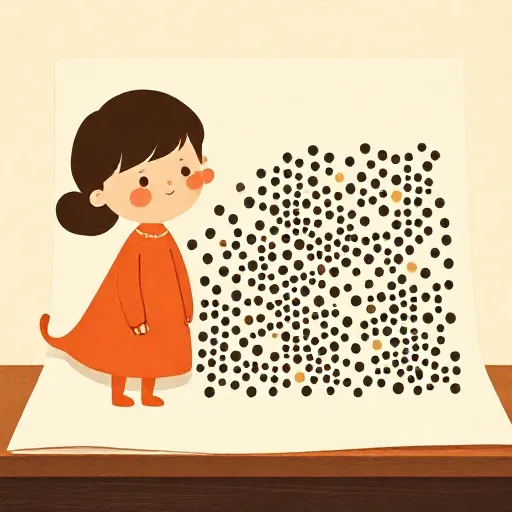
While chance is about the process, randomness is about the product. It is a property of the sequence of outcomes, not the coin that produced them. To see this, imagine trying to text the results of a thousand coin flips to a friend. If you had an unfair coin that always landed heads, you could just text “1000 heads.” One short message! But if the sequence is truly patternless, the shortest possible message is just listing all one-thousand letters.
This is the insight of Kolmogorov complexity, developed by Andrey Kolmogorov (1903–1987). A sequence is Kolmogorov random if the shortest computer program that can spit it out is basically as long as the sequence itself. There are no shortcuts, no hidden patterns.
Decades earlier, the physicist Richard von Mises (1883–1953) approached randomness through a gambler’s eyes. He argued that a sequence is truly random only if absolutely no betting system—no clever scheme based on past results—can give you an edge. A generation later, Per Martin-Löf (born 1940) refined this mathematically. He defined random sequences as those that pass every effective test for disorder. If no pattern-detecting machine in the universe can spot a bias or a repetition in the string of numbers, it earns the title of being “ML-random.”
When Chance Doesn’t Look Random
Here is where the Commonplace Thesis breaks down. It is surprisingly easy to have chance without randomness. Think of a loaded die that rolls a six about 90% of the time. Is it chancy? Absolutely. You genuinely have no control over whether a specific toss will fail. But look at the string of results: they are incredibly predictable and compressible. You can summarize them as “mostly sixes,” which is a short message. The process is chancy, but the product is not mathematically random.
Weather models suffer from the same disconnect. Meteorologists rely on sophisticated chancy models to predict a “70% chance of rain.” But weather is a Markov process—a system where the past influences the immediate future. If it is sunny today, it is likely sunny tomorrow. Over a long period, the sequence of sunny and rainy days forms distinct patterns. It might be a chancy process, but the output is highly ordered. The sequence fails the test of Borel normality, which requires that every small block of digits in a random string appears just as often as any other small block.
When Randomness Isn’t Chance

Now for the truly mind-bending opposite. Can you get perfect randomness without any chance at all? Yes. Imagine a baker stretching and folding striped dough. This is the Baker’s Transformation, a famous concept in chaos theory. If you pick a specific crumb in the dough, exactly where it ends up is strictly deterministic. Newton’s laws of motion control its fate perfectly. There is zero wiggle room.
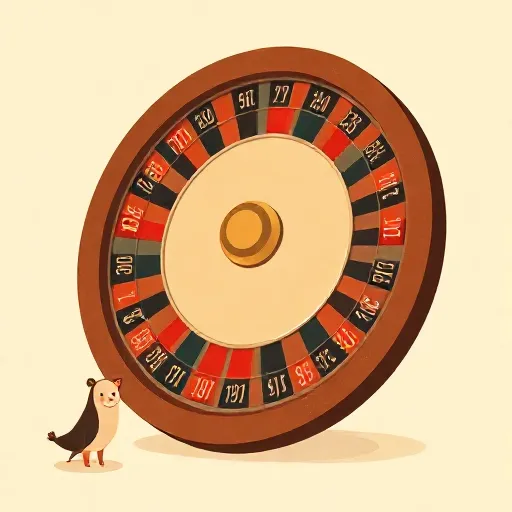
Yet, if you track whether that crumb is in the left or right half of the dough after every fold, the sequence of “L” and “R” is a mathematical nightmare. It passes all the strictest tests for patternlessness. It is Kolmogorov random! Because the system is chaotic, a tiny difference in the starting position rapidly explodes into a massive difference in the final sequence. This is called sensitive dependence on initial conditions. The system is a clockwork machine that is totally non-chancy, but it produces a sequence that looks like it came from a perfect roulette wheel. This proves that a deterministic, non-chancy universe could still look wildly unpredictable.
Why Should You Care About the Difference?

Why does this ancient-sounding debate matter when you are streaming a video or playing an online game? Because “randomness” is the very foundation of modern cybersecurity. When you log into a website, your traffic is encrypted using keys that are supposed to be random. If a programmer uses a pseudorandom number generator—a deterministic algorithm that just feels random—a smart hacker finding that deterministic pattern could break the lock and steal your data.
We rely on chance to be fair (like in a lottery) and on randomness to be safe (like in a password). Figuring out if the universe itself is deeply random—with true objective chance as some quantum physicists argue—or if it is an unimaginably complex deterministic machine (like the baker’s dough folded on a cosmic scale) changes how we view our own place in it. Are your choices like the deterministic chaos of a leaf falling through a breeze, or is there a quantum flip of a coin inside your decisions? The line between luck, skill, and security hangs in the balance.
Think about it
- If a computer programmer writes a code that generates perfectly random-looking passwords, but the code itself is completely predictable, would it be rational for you to trust those passwords with your deepest secrets?
- Imagine a scientist discovers that the long-term weather in a certain valley follows a perfectly alternating pattern: a decade of storms, then a decade of sun. Would it be fair to say the weather in that valley is still “chancy,” or has it stopped being chance?
- A chaotic double pendulum swings with jerks that look totally random, but a physicist says it is 100% deterministic. If you were betting money on where it would be in ten seconds, would you feel like you were gambling, or taking a predictable risk?