Why Can’t Science Give Us Perfect, Unbreakable Rules?
A Spring That Doesn’t Always Spring Back
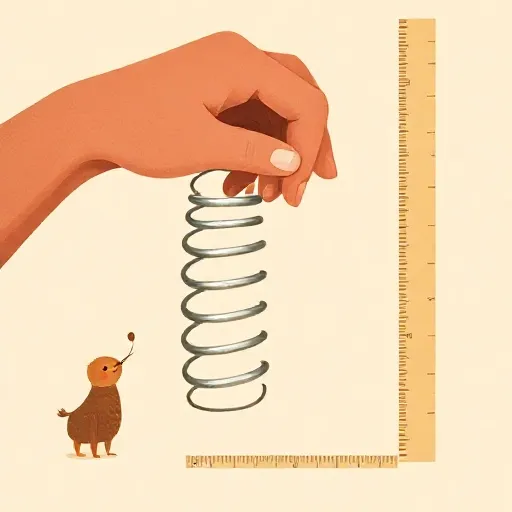
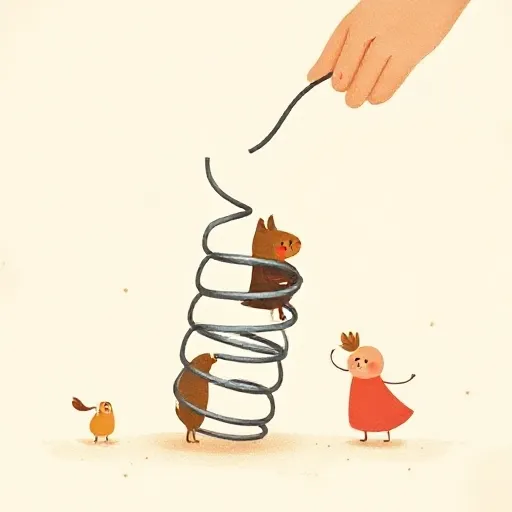
Imagine you’re in a physics lab, stretching a spring. You add one weight, then another. Each time, the spring lengthens the same amount. You write down a tidy rule: “If I double the force, the stretch doubles.” That’s Hooke’s law — a classic law of nature.
But then you hang a really heavy weight. The spring doesn’t just stretch more; it bends, twists, or snaps altogether. The tidy rule just broke. Does that mean Hooke’s law was never a real law? Not exactly. Scientists knew all along that the law works only if nothing else interferes — if the spring isn’t weakened by rust, if you don’t pull too hard, if the metal stays perfectly elastic.
This hidden condition is called ceteris paribus (say it: kay-teris pa-ri-bus), Latin for “other things being equal.” It’s the little voice that whispers, “This rule holds provided nothing weird gets in the way.” And it keeps popping up everywhere — not just in physics, but in biology, psychology, economics, even the rules you use to understand your friends.
That raises a huge puzzle. If all those scientific “laws” carry a built-in unless, can we still trust them? Are they genuine laws, or just approximate guesses? This puzzle has kept philosophers busy for decades.
The Two-Horned Dilemma

Take a simple ceteris paribus law from biology: “cp, birds can fly.” If you read it as a strict, universal claim — all birds, everywhere, always can fly — it’s clearly false. Penguins can’t fly. A baby bird can’t fly. A bird with a broken wing can’t fly. So the law, if meant to be exceptionless, crumbles.
But if you instead say “birds can fly unless something interferes,” you risk making the statement trivial. “Birds can fly unless they can’t” tells you nothing new. It can’t be tested, because any bird that doesn’t fly gets explained away as an “interference.” This is the dilemma of falsity versus triviality: either the law is false (if you take it literally) or it’s empty (if you hide behind the ceteris paribus clause). Philosopher Marc Lange called this the central challenge for any theory of non-strict laws.
So how can a scientific rule have real teeth if it’s full of holes? Over the years, philosophers have offered four big strategies.
Idea One: List All the Exceptions (Completers)

In the 1980s, Jerry Fodor (1935–2017) argued that ceteris paribus laws in psychology (like “if someone wants something and believes a certain action will get it, they’ll try to do it”) aren’t hopelessly vague. The “hidden” exceptions, he said, could in principle be filled in — not by psychology itself, but by a more fundamental science, like neuroscience. If someone fails to act, a neurologist might find a brain injury that blocks the normal process. Fodor called these missing factors completers.
A similar idea came from Paul Pietroski and Georges Rey (1995): accepting a cp-law is like writing a promissory note. You promise that whenever the law fails, you can find an independent explanation for the failure — you don’t have to list all exceptions in advance.
But critics quickly showed a big problem. Using this approach, almost any silly rule can be turned into a “true” ceteris paribus law. “Cp, all spherical bodies conduct electricity” could be “completed” by citing molecular structure every time a sphere doesn’t conduct. “Cp, if a person looks to the right, they’ll see a kangaroo” would count as a true law too, because every failure could be explained by a missing kangaroo or faulty eyesight. That makes the completer approach far too generous — it can’t separate real laws from accidental nonsense.
Idea Two: The Law Holds Steady (Invariance)
Instead of treating cp-laws as broken universals, another group of philosophers changed the question. They asked not “is it true in every possible case?” but “under what range of changes does it keep working?” This is the idea of invariance or stability.
For James Woodward and Christopher Hitchcock, a generalization is a law if it remains invariant under a range of interventions — deliberate changes to one variable while holding background conditions fixed. The law of demand in economics (“cp, if demand rises, price rises”) is reliable as long as you don’t let supply shift at the same time, and as long as truly wild events (like a comet destroying the economy) don’t happen. Those wild events are, for the purposes of economics, non-negligible — too rare to worry about.
Similarly, Marc Lange argues that special-science laws are stable only under the counterfactual suppositions that matter to that science. An island biogeography law about species numbers doesn’t have to hold if birds evolve organs that weaken gravity — that’s a possibility the science simply ignores. So the law isn’t universal, but it’s stable enough for its job.
This avoids the dilemma neatly: we never claimed the law holds in every imaginable scenario. It holds only within the range that scientists actually care about. The trade-off? Lawhood now depends partly on human interests — on what a discipline considers “negligible.” Some philosophers think that’s exactly how science works; others worry it makes laws too subjective.
Idea Three: It’s All About Hidden Tendencies
Long before the modern debate, John Stuart Mill (1806–1873) suggested another escape. Laws of nature, he said, don’t describe what actually happens in the messy world. They describe tendencies or dispositions. A heavy body has a tendency to fall; gravity is always tugging on it. But other forces — like air resistance — may cancel that tendency. So the law “heavy bodies fall” is strictly true as a statement about a capacity, not about the final outcome.
Nancy Cartwright, a contemporary philosopher of science, revived this idea. Laws like Snell’s law for the refraction of light hold perfectly only in ideal, undisturbed situations. But that ideal behaviour reveals a stable capacity of light itself, which scientists can then use to explain what happens in complex, real-world situations by adding up capacities.
This dispositional account has a neat advantage: the law itself is turned into a strict truth (about a tendency), so the dilemma seems to dissolve. However, critics note that you still need to say exactly when the tendency will manifest — that is, you still need to spell out the ceteris paribus conditions for the disposition to show itself. The puzzle merely shifts to another level, and a similar regress can appear.
Idea Four: The “Normally” Approach
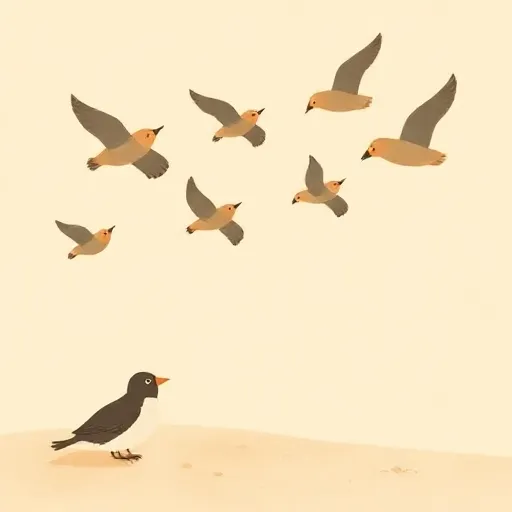
Maybe the simplest reading of a cp-law is that it tells you what normally happens. “Cp, birds can fly” means “normally, birds can fly” — and that’s a factual claim about the world.
Gerhard Schurz developed this into a full theory. For life sciences and social sciences, he argued, cp-laws are normic laws. Because of evolution, biological organisms and social systems have surviving norm states — a bird that can normally fly is a real, selected pattern. So the statement “birds normally can fly” links the antecedent to a high objective probability; it’s testable by checking how often the consequent holds given the antecedent.
Wolfgang Spohn took a different angle, tying “normally” to our beliefs. A cp-law holds if, under normal conditions (conditions an ideal reasoner would not rule out), the generalization is true. So the normality is about epistemic expectations, not just frequencies.
This approach makes cp-laws empirically respectable: they give strong statistical claims rather than empty excuses. But it also changes the nature of a law from a necessary truth to a description of what usually happens, which some think weakens the idea of “law” too much.
The Rules You Live By
Back to that spring. Even if Hooke’s law breaks under extreme weight, we still use it to build bridges and weigh groceries. The law is ceteris paribus true — and that’s enough.
You live by cp-rules all the time without calling them that. “If I water the plant, it will grow” (cp, unless the soil is bad or a pest attacks). “If I’m kind, people will like me” (cp, unless they misinterpret my actions). These aren’t iron laws; they’re ceteris paribus generalizations that guide your expectations and help you navigate the world.
So the debate about scientific laws isn’t just a dusty puzzle for professors. It’s about how we ever manage to say anything helpful about a messy, complicated universe. Whether you lean toward completers, invariance, dispositions, or normality, one thing is clear: our best rules come with a quiet unless. And learning to live with that — to know when a rule is good enough — is a skill that matters as much in the lab as it does in your friendships.
Think about it
- Can you think of a “law” about people that has exceptions — like “if someone wants something, they’ll try to get it”? How do you decide when an exception is important enough to throw out the whole rule?
- If a scientific rule works 95% of the time but fails 5% of the time, would you still call it a “law of nature”? What would make it more than just a lucky guess?
- Why do you think scientists and ordinary people keep using rules that aren’t strictly true? When might it be better to treat a rule as an unbreakable promise, and when is it smarter to expect it to bend?