Could a Simple Rule Create a Strange New World?
The Classroom That Wore Hats

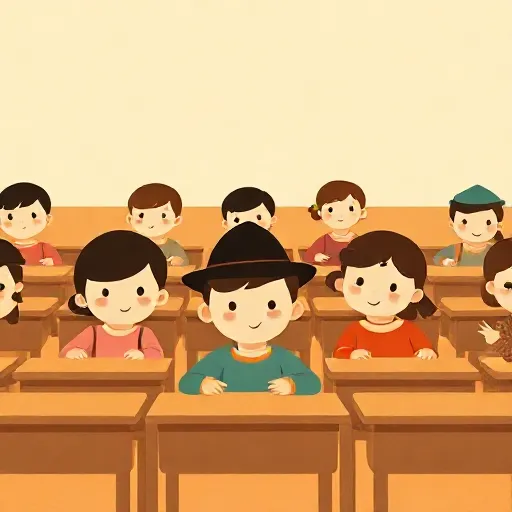
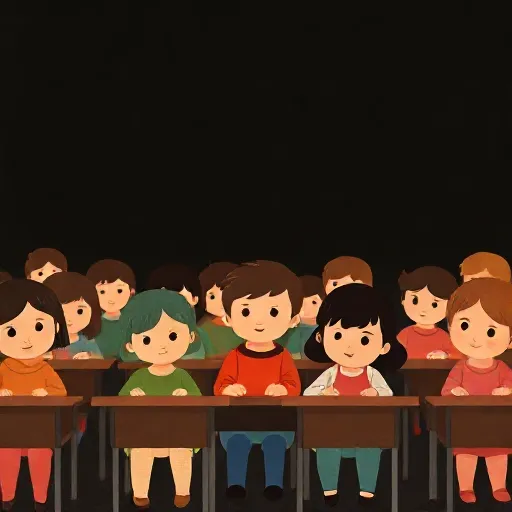
Picture your classroom. The teacher makes a strange announcement: “Each morning, look at the two classmates immediately on your left and right. If exactly one of them wore a hat yesterday, you wear a hat today. If both wore hats, or neither did, you do not.” Nobody else in the school follows this rule—only your row.
The first day, only the student right in the middle shows up with a hat. The next day, the two kids on either side of the center are wearing hats, while the center kid is bare‑headed. Soon, the pattern spreads like ripples. After a few days, the classroom looks like a strange triangle‑within‑triangles shape that nobody could have guessed from that tiny rule alone.
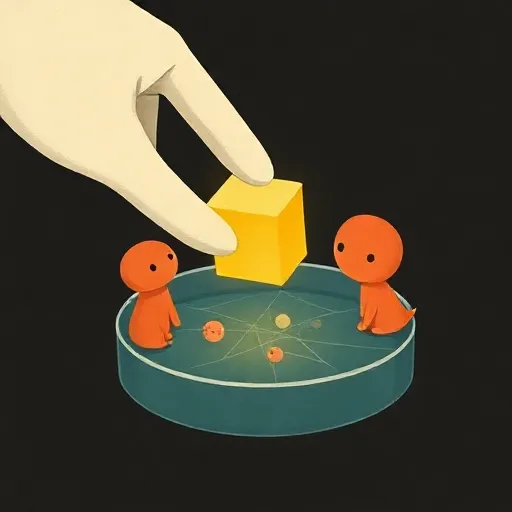
You have just met a cellular automaton (CA). A CA is a grid of tiny identical parts called cells. Each cell can be in one of a few simple states—in this story, “hat on” or “hat off.” At every tick of a clock, each cell updates its state by looking only at its immediate neighbors, following the same fixed transition rule for everyone. No single cell knows what the whole pattern looks like; it just follows its local orders. Yet together, the cells can produce shapes that astonish even the person who invented the rule.
Four Families of Rules: From Boring to Chaotic
The computer scientist Stephen Wolfram (born 1959) wondered: how many different behaviors can you get from the simplest possible CA? He studied one‑dimensional lines of cells with only two states and a neighborhood of two neighbors. There are exactly 256 possible rules for such a setup. By running each one from random starting patterns, Wolfram sorted them into four remarkable classes.
Class 1 rules quickly freeze into a boring uniform color—all cells black or all white. Class 2 rules settle into a repeating cycle, like a striped shirt that never changes. Class 3 rules generate what looks like noisy static: unpredictable, swirling, never settling. Then there is Class 4, which lives between order and chaos. Class 4 rules produce stable structures, traveling bits, and sudden bursts of complexity that seem to have a mind of their own.
The most famous Class 4 rule is Rule 110. Its pattern contains moving “particles” that can carry information from one place to another. In fact, Matthew Cook proved in 2004 that Rule 110 is a universal computer—it can simulate a Turing machine, a simple abstract device that, in principle, can compute anything any modern computer can. And because a universal computer cannot always predict when it will halt (the Halting Problem), you cannot short‑cut Rule 110. To know what it does, you have to run it, step by step. Wolfram called this computational irreducibility: there is no shortcut formula that tells you the future. The only way to see the pattern is to let the rule play out.
A Universe in a Grid: Conway’s Game of Life
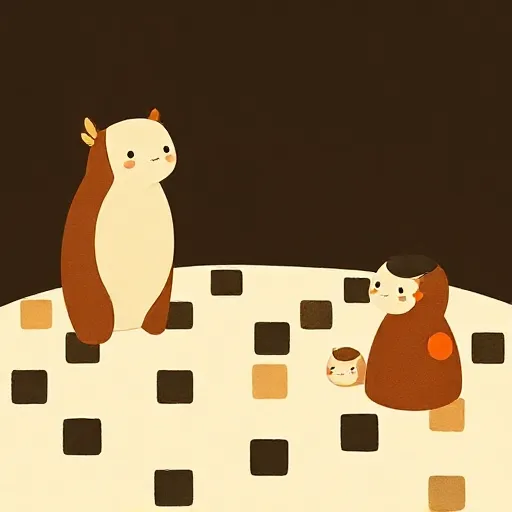
If one dimension can surprise you, two dimensions are a universe. The mathematician John Conway (1937–2020) invented the Game of Life in 1970. Life uses a grid of square cells, each either alive (black) or dead (white). Every cell looks at its eight closest neighbors and follows three simple laws: a dead cell with exactly three live neighbors becomes alive (birth); a living cell with two or three live neighbors stays alive (survival); otherwise, the cell dies or stays dead. That is it.
From these three rules, entire worlds sprout. A tiny pattern of five cells called a glider crawls diagonally across the screen in four ticks, endlessly moving without changing shape. An eater destroys anything that touches it but remains still. Other patterns blink, grow huge, or dissolve. Conway and his fans discovered that Life, too, is a universal computer. By gluing gliders together and smashing them into walls, you can build logic gates. A gigantic Life grid could, in theory, run any program, including one that draws its own future.
Like Rule 110, Life is computationally irreducible. Nobody can glance at a random Life starting pattern and tell you whether it will eventually die out, explode into chaos, or build a virtual copy of your brain. You must watch the grid tick.
Does a Glider Have Free Will?
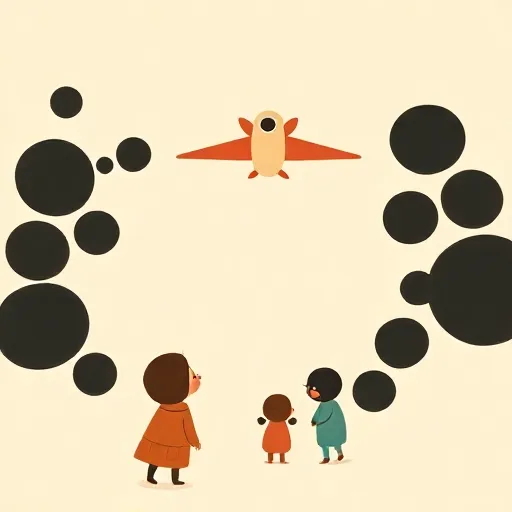
The philosopher Daniel Dennett (1942–2024) saw Life as a window into an ancient puzzle: if everything is determined by laws, can anyone have free will? In Life, every cell obeys rigid, deterministic rules. There is no ghost tipping a cell off, no random dice. Yet when we watch a glider approach an eater, we naturally say things like, “The glider avoids the eater.”
Dennett argues that this “avoidance” is not an illusion. At the design level—where we talk about gliders and eaters instead of individual cells—it makes perfect sense to say the glider really does avoid the eater. If you were a tiny observer inside the Life universe, you could predict the glider’s path far faster by thinking “gliders avoid eaters” than by calculating every cell. Determinism at the bottom level does not force you to describe everything as inevitable at the higher level. What looks like a choice can emerge, Dennett says, even when the micro‑rules leave no wiggle room.
Wolfram adds another piece: because a universal CA is computationally irreducible, no being, however smart, can predict its entire future without just living through it. Even if every one of your own neurons followed CA‑style rules, your next thought might be exactly as unforeseeable to an outside calculator as the next shape in Rule 110. For Wolfram, that unpredictability helps explain why deterministic systems—including us—can feel genuinely free.
Is Our World a Giant Cellular Automaton?
The boldest idea of all comes from the physicist Edward Fredkin (1934–2023). He proposed the Finite Nature hypothesis: the universe, right down to space and time, is made of a finite number of discrete cells. At the tiniest scale, every event is a digital update on a giant CA grid. If Fredkin is right, then electrons, gravity, and the chair you are sitting on are all just long‑lasting, complex patterns—like gliders in Life, but vastly bigger.
Why would anyone believe this? For starters, it sidesteps the puzzling idea that space is continuously smooth. In a CA universe, there is no need for an infinite number of points between here and there. And if the universe really is a CA, it must be computationally universal (because it contains computers like the one you are using). That means its own evolution is computationally irreducible. Even if you knew the universe’s transition rule and its starting state, you could not outrun the clock: you would have to wait for time to tick to discover what will actually happen.
Most physicists remain skeptical. Nobody has yet rewritten Einstein’s laws purely in CA terms. But the question is wide open: reality might be built from the same logical bricks as the Game of Life.
Why Simple Rules Still Surprise Us
Think about the weather. A butterfly flaps its wings in Brazil, and a storm brews in Texas. Weather, traffic, a flock of birds swirling without a leader—all of them are like cellular automata. Each piece follows simple, local rules, yet the whole looks designed.
That same logic might apply to you. Your brain is a network of billions of neurons, each one firing or staying quiet based on what its neighbors are doing. No single neuron knows you are hungry or daydreaming, but together they produce your stream of thoughts. If your mind arises from rule‑following cells, then the lesson of CA matters personally: being governed by simple local rules does not make you simple, and being part of a deterministic universe does not make your next idea inevitable in a way you could ever fully calculate in advance.
You are living in a world where complex things grow from basic ingredients. The hat‑wearing classroom, Conway’s gliders, and the grandest theories of physics all whisper the same secret: sometimes you cannot predict the future—you can only watch it unfold.
Think about it
- If a scientist could program every atom of your brain into a giant Game of Life, would the glider‑like pattern that results be really you? What would you need to see to say yes?
- A completely determined universe can still feel surprising because its future cannot be predicted without living through it. Does that make a difference for whether your choices matter?
- Imagine you find a new cellular automaton rule that creates patterns nobody has ever seen. Would you call the patterns “alive” if they started eating each other, running away, and making copies of themselves? Where would you draw the line?