Can Nothing Make Something Happen?
The Spinning Ball Puzzle
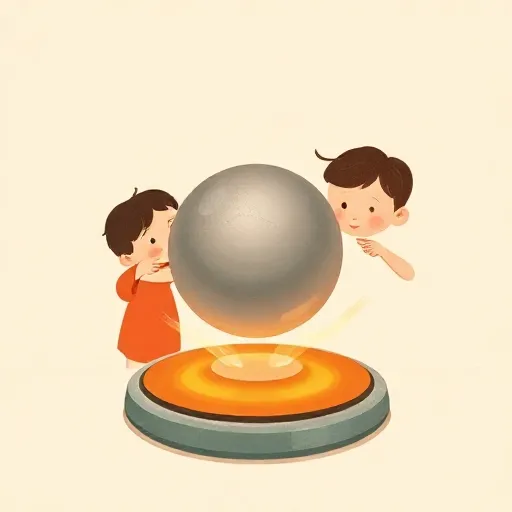
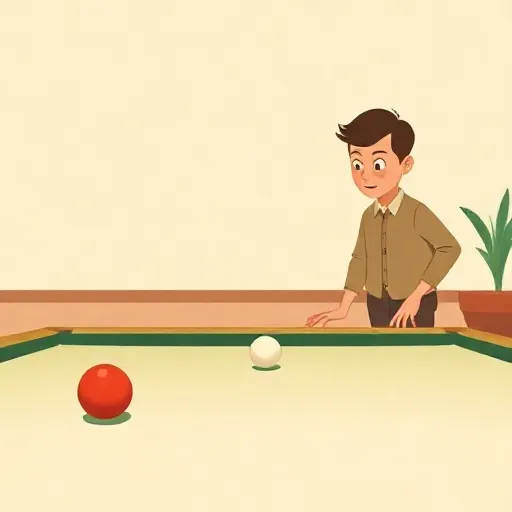
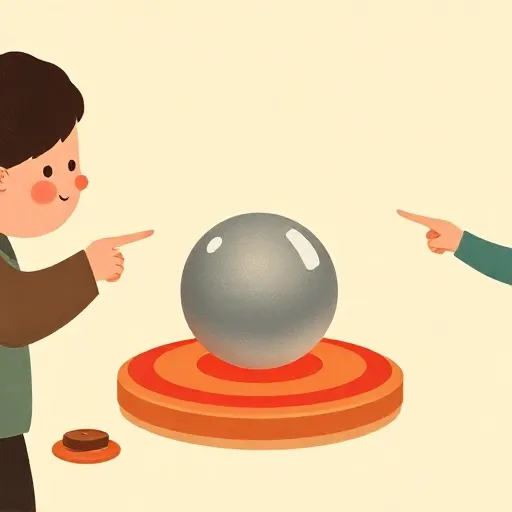
A metal ball sits on a hotplate. The hotplate heats it up while the ball also spins. The ball’s rotation and its heating happen in exactly the same region of space at exactly the same time. If you saw it, you might say, “One thing — a hot spinning ball.” But philosophers ask a tricky question: are the heating and the rotation the very same event, or are they two different events? If they are the same, then anything caused by the heating must also be caused by the rotation. But that doesn’t seem right. The heating made the surrounding air warm; the rotation did not. The hotplate caused the heating but not the rotation. So maybe the heating and the rotation are distinct events.
This puzzle opens a deep debate about token causation — what specific causes and effects really are. A “token” cause is a particular happening in the world, like one ball heating up, not a general type like “heating in general.” Philosophers disagree about what kind of thing token causes and effects are, and what the relationship between them is like.
What Exactly Is an Event?
Donald Davidson (1917–2003) argued that if two happenings have exactly the same causes and effects, they are the same event. Conversely, if they differ causally, they must be different events. So, because the ball’s heating caused the air to warm while the rotation did not, they are distinct events. This view doesn’t tell us what events are, only how to tell them apart: by their causal powers.
Jaegwon Kim (1934–2019) gave a more detailed picture. He said an event is a triple: an object (the ball), a property (heating), and a time interval (the minutes it lasted). On Kim’s view, the heating is the triple ⟨heating property, the ball, t1–t2⟩, and the rotation is ⟨rotation property, the ball, t1–t2⟩. Since the properties differ, they are different events.
David Lewis (1941–2001) took a different approach. He thought events are collections of possible spacetime regions — ways things could have been in any possible world. The ball’s rotation is the set of all possible spacetime regions where that very ball rotates; its heating is the set where it heats. Because a ball can heat without rotating and rotate without heating, these collections are different. That lets Lewis say the heating and the rotation are two events, even though they happen at the same time and place in the actual world.
All three philosophers agree on one thing: coarse-grained views — the idea that events are nothing but chunks of spacetime with no further internal structure — are too blunt. They can’t handle the spinning ball.
Facts: When Nothing Happens but Something Still Causes

What about absences or omissions — things that don’t happen? Suppose Anna goes on vacation and fails to water her plant. The plant dies. It’s natural to say Anna’s failure caused the death. But there’s no “event” of failing — it’s a non-occurrence, a lack. Many philosophers think absences aren’t real events. Yet causal talk about absences is everywhere: “The missing safety bolt caused the bridge to collapse.”
To solve this, some philosophers, like Jonathan Bennett (1930–2024) and D. H. Mellor (1938–2020), proposed that token causes and effects are facts, not events. A fact is a true proposition, like “Anna didn’t water the plant.” Even if no positive event exists, that fact is real.
Others resist. David Armstrong (1926–2014) insisted that omissions aren’t part of the “real driving force in nature” — only positive factors cause things. On this view, we can still say absence talk is useful shorthand, but strictly speaking, causation only connects real events. Some try to translate absence talk into positive-event talk: for example, “Anna’s failure to water the plant” might just be a contrastive description of what Anna actually did — she strolled instead. So the event of her stroll caused the plant’s death, if we think of it differently.
The debate isn’t settled. It shows that what you count as a cause depends on what you think the world is made of.
The Backup Plan: Preemption and Necessary Causes
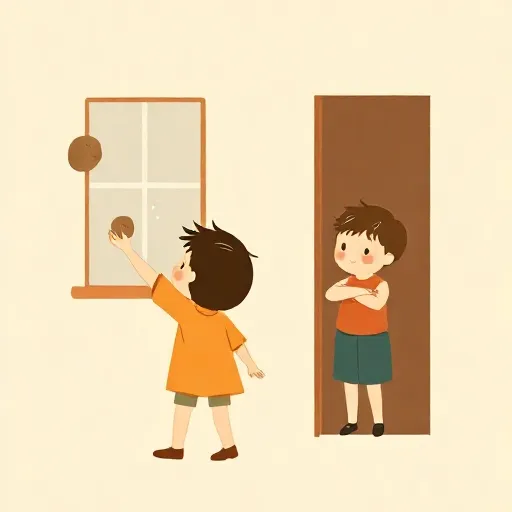
Imagine two neighbors, Billy and Suzy, both want to break the same window. Billy tells Suzy he’ll do it, so she stays home. Billy throws a rock; the window shatters. Had Billy not thrown, Suzy would have. In this story, Suzy’s desire to break the window is a backup cause that was preempted — Billy’s action got there first and blocked her from being a cause. Most people say Billy’s throw caused the shattering, not Suzy’s plan. But notice: the window’s shattering did not depend on Billy — if Billy had been absent, Suzy would have caused it anyway. So a cause need not be necessary for its effect.
Now consider Patricia, who is terminally ill. Doctors give her morphine to ease pain, but a mistake causes an overdose, and she dies immediately. Had she not gotten the overdose, the disease would have killed her a few days later. Here, too, the actual cause (the overdose) wasn’t necessary, because the backup would have produced a death anyway — just later. This is late preemption: the backup causal chain isn’t cut short until after the effect happens.
Cases like these challenge theories that define causation as “if the cause hadn’t occurred, the effect wouldn’t have.” Many counterfactual theories struggle with preemption, while process theories do better: they say there must be a specific physical process linking cause to effect. But then we run into trouble with…
Switches: Making a Difference

A lamp has two bulbs, left and right. A switch sends power to one of them. Filipa flips the switch to the right, then Phoebe turns on the power. The right bulb glows, and the room lights up. Did Filipa’s flipping cause the room to be illuminated? It seems not — because if the switch had been left, the left bulb would have lit the room. But now suppose the left bulb is dead. Then, if Filipa hadn’t flipped right, the room would have stayed dark. In that case, her flipping definitely caused the room to light. Yet the physical process from her hand to the right bulb is exactly the same in both scenarios. So causation depends partly on what would have happened otherwise — not just on the actual stitch of events.
Switches also threaten the idea that causation is transitive. Transitivity says: if A caused B and B caused C, then A caused C. In the first version (both bulbs work), Filipa’s flip caused the right bulb to turn on, and the right bulb caused the room to light. But we already decided the flip didn’t cause the room to light. So we seem to have a violation of transitivity. Many philosophers take this as a clue that causation isn’t a simple two-place relation but maybe a four-place relation with built-in contrasts (like “flipping to the right, rather than leaving it left, caused the room to light, rather than stay dark”).
Why It Matters: Normality and Responsibility

Everyday talk about causes often tracks what’s normal or expected. Abigail asks her neighbor Byron to water her plant while she’s away; he promises but forgets, and the plant dies. Another neighbor, Chris, never promised and didn’t water it either. Most people say Byron’s inaction caused the death, but not Chris’s. The only difference is that Byron broke a promise — his behavior was abnormal. Philosophers call this the role of defaults and norms in picking out causes.
Ned Hall (born 1971) presented a puzzle that deepens this. Imagine a boulder comes loose, rolls toward a hiker, and the hiker sees it and jumps out of the way just in time. Did the boulder’s falling cause the hiker to survive? Intuitively, no — it threatened the hiker but didn’t bring about survival. If we construct a neuron-diagram model where “the boulder falls” is coded as a firing neuron that both initiates a death threat and then neutralizes it, the formal structure is identical to the early preemption case with Billy and Suzy, where we do say the cause (Billy’s throw) was a cause. The only thing that differs is our sense of what the default state is. In the early preemption case, the default is that the window remains intact; the throw changes that. In the boulder case, the default is that the hiker stays safe; the falling boulder disrupts that, and the hiker’s jump restores it.
This suggests that our very concept of token causation can’t be separated from what we treat as normal. It’s not just about what physically touches what; it’s about how we expect things to go. And that matters a lot when we assign blame, credit, or responsibility — at school, in law, and in friendships.
Understanding what a cause really is isn’t just a game for philosophers. It shapes how we answer concrete questions: Did your forgetting to lock the door cause the theft, or was the thief the only cause? If a friend would have done the same hurtful thing even if you hadn’t spoken up, does your silence count as a cause? These puzzles don’t have easy answers, but noticing them makes you a sharper thinker about the world.
Think about it
-
If a scientist could perfectly predict every choice you’ll ever make, would it still make sense to say one person “caused” a bad outcome and another didn’t? Why or why not?
-
Imagine you promise to feed your neighbor’s cat but forget, and the cat goes hungry. Another neighbor also didn’t feed the cat, but never promised. Is your failure more of a cause than theirs? What if you both promised?
-
In the boulder case, the hiker survived because the boulder fell. Does it feel right to say “the falling boulder caused the hiker to survive”? If not, what makes it different from Billy’s throw causing the window to shatter?