
Do We Live in One World, or in Many?
The Mapmaker, the Storyteller, and the Scientist

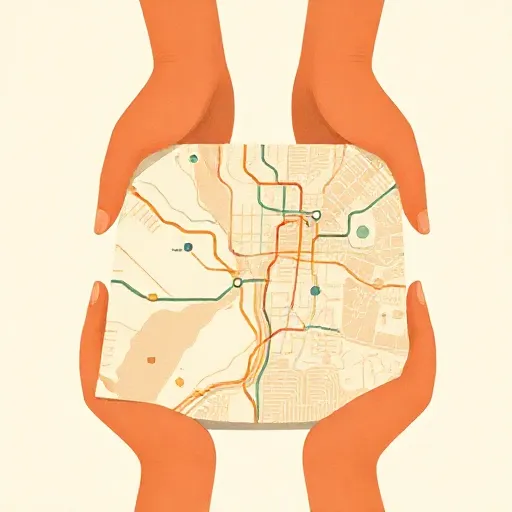
Imagine three friends on a rainy afternoon. Leah draws a map to a hidden fort, complete with a dotted trail and a big red X. Jonah tells a story about a thunder‑giant in the sky whose footsteps are the booming rain. Ravi studies a diagram of water droplets and electrical charges that explains the same thunder with numbers and arrows. One thunderstorm — and three completely different ways of making sense of it. Which one is right?
A German philosopher named Ernst Cassirer (1874–1945) would have said the question is a trick. All three are real — they are just doing different jobs. He spent his career trying to prove that human beings are not simply animals who think logically. We are “symbolic animals”: creatures who make sense of the world by inventing systems of signs, from treasure maps and myths to equations and symphonies. Cassirer called these systems symbolic forms.
For him, the big mistake in philosophy had been to crown one symbolic form — usually scientific reasoning — as the only one that tells the truth, and to treat everything else as fuzzy make‑believe. Cassirer argued that myth, everyday language, art, religion, and science are all genuine ways of giving meaning to our experience. They are different, but equally necessary, ladders for climbing out of confusion.
The Symbol Animal

Cassirer was born into a wealthy Jewish family in what is now Poland and studied at Berlin and Marburg. At first he followed the Marburg School of neo‑Kantianism, a group of thinkers who believed that philosophy should start from the “fact of science” and ask: what must the mind be like for mathematical physics to be possible? In his early work Cassirer explored how modern science grew out of a long, slow process of building better and better mathematical models — a series of successive maps, each a little closer to the territory.
Then something shifted. He moved to Hamburg in 1919 and discovered the Warburg Library of the Cultural Sciences, a treasure‑house of materials on art, ritual, myth, and magic. Suddenly the “fact of science” looked too narrow. The real starting point for philosophy, Cassirer decided, was the much larger fact of culture. Human beings everywhere sing, tell stories, worship, paint, measure, and calculate. All these activities are efforts to give shape to the blooming, buzzing confusion of life. They are symbolic forms.
Cassirer’s masterwork, The Philosophy of Symbolic Forms (1923–1929), sets out to see how each form works from the inside, and how they build on one another. He did not want to collapse all forms into one. Instead he wanted to show that they are like different languages — each has its own grammar, and you miss the whole human story if you judge myth by the standards of science, or poetry by the standards of logic.
Feeling, Naming, Calculating
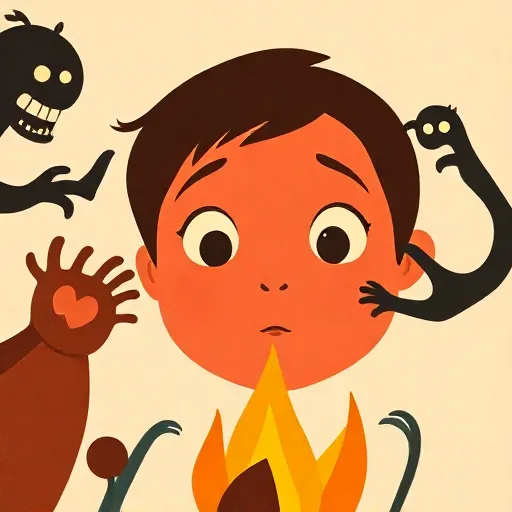
Cassirer argued that there are three deep levels, or “functions,” by which symbols do their work. The most primitive and powerful is the expressive function. This is the layer where the world hits you emotionally — where a thunderclap feels angry, a cliff feels threatening, and a face feels kind. In expressive experience, nothing is neutral; everything carries a mood. Myth lives in this realm. In a myth, there is no sharp split between appearance and reality: a dream can be just as real as waking, a name can have magic force, and a part (a lock of hair) can contain the whole person.
From this emotional soup, the representative function pulls a more stable picture. Ordinary language does this job. Words like “tree,” “over there,” and “yesterday” carve the world into things that stay put and can be pointed to again and again. We start to build a shared world of objects with a real‑versus‑illusion distinction — something is “really” a chair, even if from one angle it looks like a blob. This makes practical life possible and gives us the idea of propositional truth: “The cup is on the table” can be checked and agreed upon.
The third and most abstract layer is the significative function. Here the symbols cut loose from everyday seeing, touching, and pointing. Pure mathematics is the clearest example. Numbers, matrices, and geometric relations no longer refer to any particular thing you can hold in your hand; they form a self‑contained system of relationships. Modern physics lives here too — think of Einstein describing gravity not with concrete pushes and pulls but with the warping of a four‑dimensional geometry. Cassirer saw this as the pinnacle of one particular symbolic form, but only one among many equally valid ways of world‑making.
A Standoff in the Swiss Alps

In the spring of 1929 Cassirer traveled to the resort town of Davos, Switzerland, for a celebrated public debate with Martin Heidegger (1889–1976). Heidegger was the rising star of a new movement that insisted philosophy had forgotten the most basic fact of all — that we are finite beings who will one day die. He argued that Kant’s grand system of reason had to be re‑read through the lens of human finitude: we can never reach an absolute, eternal standpoint.
Cassirer disagreed sharply. He pointed to moral experience and mathematical physics. The moral law, he thought, commands us unconditionally, not just “if you feel like it.” And mathematical truths, such as the fact that 2 + 2 = 4, are not made true by what any single person happens to feel or by the fact that we are mortal. They seem to stand outside time. In Cassirer’s eyes, symbolic forms like mathematics and ethics open a window onto something genuinely objective and universally valid, not just a projection of our limited minds.
The two men never reconciled. But the debate marks a crossroads: one path leads toward a view that all meaning is ultimately human‑shaped and bounded by death; the other, Cassirer’s path, insists that through symbols we can reach truths that are bigger than our own skulls — yet still be humble enough not to claim that only our culture’s form is the right one.
When Old Myths Become New Weapons

As the 1930s darkened, Cassirer watched something deeply alarming. He saw the rise of National Socialism in Germany not just as a political crisis but as a philosophical one. The Nazis employed the most modern tools — radio, film, mass rallies, microphone‑amplified speeches — to awaken the oldest layer of the human mind: the expressive, mythical layer. In that layer, a leader can be experienced as a semi‑divine figure, a nation can be fused into a single “blood and soil” body, and the difference between “we say so” and “it is true” dissolves.
Cassirer explored this in one of his last books, The Myth of the State (published after his death in 1945). He argued that certain earlier thinkers had, often unintentionally, supplied material for this modern political myth. He pointed to Georg Wilhelm Friedrich Hegel (1770–1831) , whose philosophy of history could be twisted into celebrating the state as an all‑powerful “absolute” reason, and more directly to Oswald Spengler (1880–1936) , whose book The Decline of the West treated cultures like living organisms destined to struggle for supremacy. Cassirer believed that once mythical thinking is deliberately turned into a technology — once you design rallies to bypass rational argument and hit the expressive center straight — the result can be catastrophic. A population can be made to act on a shared story that treats facts as irrelevant, and the future becomes closed.
Critically, Cassirer did not think myth was evil in itself. It is one of the fundamental ways humans have always made sense of the world. The danger lies in letting it run unchecked, especially when it is harnessed by the machinery of a modern state.
Why It Still Matters

Cassirer’s warning sounds eerily familiar today. Social media feeds flood us with emotionally charged snippets, memes that feel like ancient tribal signs, and stories about leaders that blur wish and fact. The expressive function — that pre‑logical gut level where something just feels true — is constantly being activated. Cassirer would likely say that we are living through a period when the balance among symbolic forms has tilted heavily toward myth, while the slower, careful work of representational and significative thinking — checking sources, reasoning with data, building models that can be tested — struggles to be heard.
He did not leave us a simple rule for the right mix. His philosophy of symbolic forms is not a list of instructions but a set of rich descriptions. It tries to show that being human means inhabiting multiple worlds at once: the world of feeling, the world of everyday things, and the world of abstract relations. No single one can be permanently crowned without losing something essential. And when we forget that, we become vulnerable to anyone who promises to make all the messiness vanish with a powerful, simple story.
Cassirer himself, a German Jew forced into exile, lived the cost of that forgetting. Yet even in exile he continued to argue that our cultural future remains open — a never completed task that depends on the choices we make together.
Think about it
- Can you think of a modern story — about a leader, a nation, or even a product — that makes people feel something so strongly that they stop asking whether it is factually true? When might that be fun or harmless, and when might it become dangerous?
- Cassirer believed that science, art, and myth are different symbolic forms, each with its own kind of truth. What does a lyric poem give you that a science textbook cannot? And what can a science class give you that a poem cannot?
- Suppose someone says, “My culture’s way of seeing reality is the only correct one.” How might Cassirer respond? Would you agree with him?