Why Keep Living If Nothing Matters? Camus's Reply
The Question That Won’t Go Away
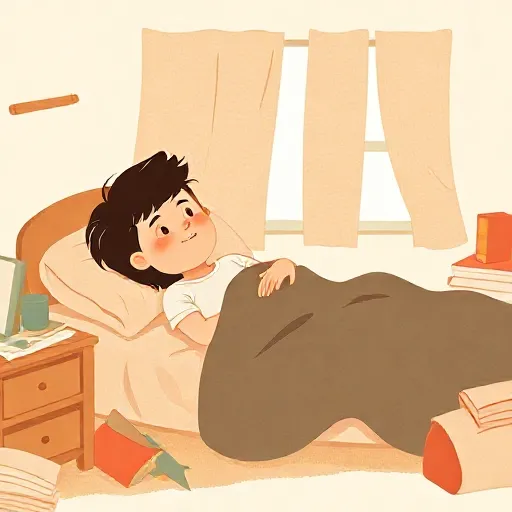
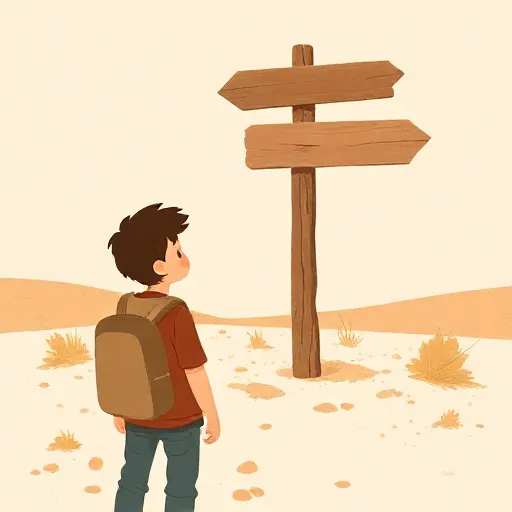
It is 7 a.m. on a Monday. You lie in bed, staring at the ceiling. The alarm went off, but you don’t want to move. School, lunch, homework, sleep — every day the same cycle. A strange thought creeps in: Why bother? What is the point of any of it?
The French writer Albert Camus (1913–1960) thought this was not a silly question at all. He called it the most serious question a human being can ask. In his book The Myth of Sisyphus, Camus wrote, “There is only one really serious philosophical problem, and that is suicide.” He did not mean that everyone should consider ending their life. He meant that once you really think about whether life has a meaning, you are forced to ask: Is my life even worth living?
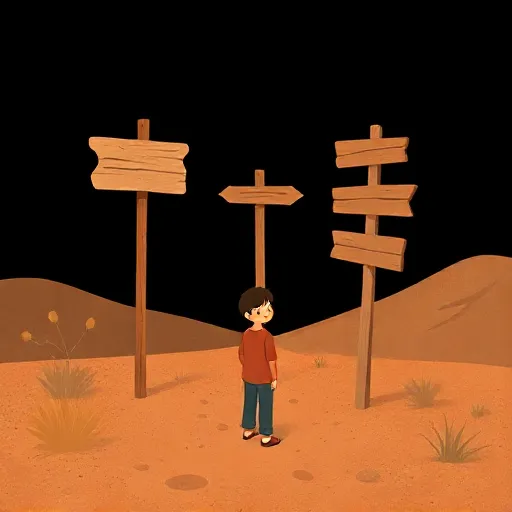
Camus believed that our situation is something he named the absurd. The absurd is not a thing you can touch; it is a clash between two facts. First, humans desperately want the world to have a purpose. We hunger for a reason why we are here. Second, the universe is silent. It does not give us any answer. The sky, the stars, the earth — none of them tell us what our lives are for. So we keep searching for a meaning that we will never find. That impossible situation is the absurd.
Camus noticed that people usually try to escape the absurd in one of two ways. Some choose suicide, which ends the search forever. Others take refuge in hope — for example, the religious hope that a perfect life waits after death, or the political hope that a flawless society is coming in the future. Camus rejected both. Suicide and hope, he said, are ways of pretending the problem does not exist. He wanted a third path: to stare the absurd in the face and keep living anyway.
A Man, a Mountain, and a Rock
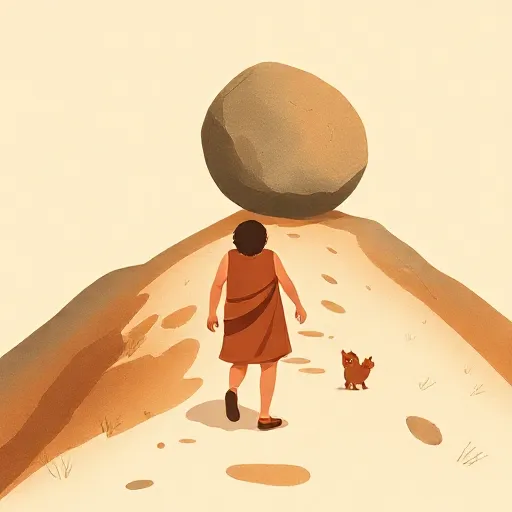
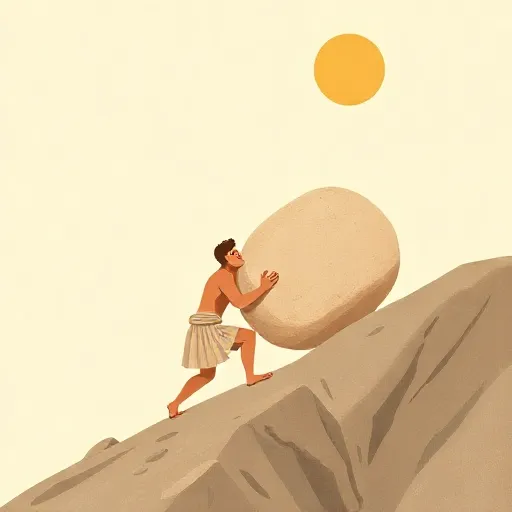
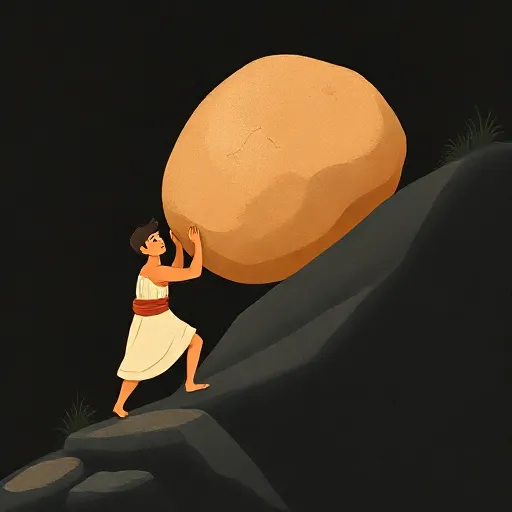
To explain his answer, Camus reached for an ancient Greek myth. Sisyphus was a king who angered the gods. As punishment, he was doomed to push a massive boulder up a mountain. Every time he reached the top, the rock would roll all the way back down. Sisyphus had to trudge back down and start again. Forever.
Camus said this is a perfect picture of human life. We strive to understand the world and give it meaning; our efforts seem to lead nowhere; and we must keep trying anyway. But Camus added a surprising ending. He wrote, “One must imagine Sisyphus happy.” How can anyone be happy in an endless, pointless task?
Camus’s answer: Sisyphus knows his fate completely. He is not fooled by false hopes. During the walk back down the mountain — after the rock has crashed to the bottom and before he begins again — he is fully conscious. He sees the futility and still chooses to go on. That makes him stronger than his punishment. His fate belongs to him because he accepts and owns it.
For Camus, the same is possible for us. We can live with full awareness that the universe has no ultimate meaning, yet still find the world beautiful. We can love friends, taste fruit, and feel the sun on our faces — not in spite of the absurd, but because we have accepted it. Happiness and the absurd, Camus said, are two sons of the same earth. If you stop demanding that life hand you a cosmic purpose, you might begin to notice the warmth of the morning and simply get up.
From Myself to Everyone: When Rebellion Turns Deadly
Camus thought suicide was not the right answer to the absurd. But after World War II, he grew just as worried about the opposite extreme: killing other people. In another book, The Rebel, he asked: if life has no built-in meaning and there is no God, what stops anyone from committing murder?
He saw that many modern revolutions started from an honest feeling of revolt — a furious protest against injustice and suffering. That feeling, he believed, was healthy. Revolt says, “I matter, and others matter too.” It creates solidarity: “I revolt, therefore we are.” But Camus watched how often revolutionaries turned into mass murderers. Convinced that they could build a perfect, meaningful society, they decided that any violence was justified to get there. This, Camus argued, was just a new kind of religion — a hope for a paradise on earth, which betrayed the original spirit of rebellion.
True revolt, Camus insisted, must respect limits. If you rebel against death and suffering, you cannot logically pile up more death. He criticized intellectuals, even his former friend Jean-Paul Sartre (1905–1980), for backing violent political movements in the name of history. Camus did admit that sometimes a tyrant might have to be killed, but he set strict conditions: civilians must never be targeted, and the one who killed must be willing to sacrifice their own life for breaking the moral order. He could not fully solve the puzzle — rebellion seemed both necessary and impossible without contradiction — but he wanted people to never take murder lightly, to never treat it as a simple tool.
Why Camus Still Speaks to Us

In our own time, Camus’s ideas keep finding new voices. During the early months of the Covid-19 pandemic, his novel The Plague became a sudden bestseller. The story follows a city sealed off by a deadly disease. Ordinary people form cleanup crews and medical teams — not as heroes, but because it is the decent thing to do. The narrator, Dr. Rieux, says fighting the plague is simply a matter of “common decency.”
Camus believed that when the world feels chaotic and meaningless, the best response is not despair, and it is not a desperate search for a grand solution. It is to do what you can, right where you are, together with others.
Whether you face a personal crisis or a global one, Camus leaves you with a strangely hopeful message. You can live fully even when you know there is no ultimate meaning. You can push your rock and be happy — not because you will ever finish the task, but because the pushing itself, the living, the loving, the feeling of the sun, is its own reward. The absurd never vanishes, but neither does your power to rebel against it by choosing to live, wide awake.
Think about it
- Would a life be worth living if you knew for certain that nothing you ever do will be remembered in a hundred years?
- Camus said revolt gives our lives dignity. Can you think of a time you stood up for something even though you knew you might fail?
- If someone believes the world is completely meaningless, does that make it easier or harder to treat other people kindly? Why?