Can You Think Too Hard About God? A Byzantine Story
A Philosopher on Trial

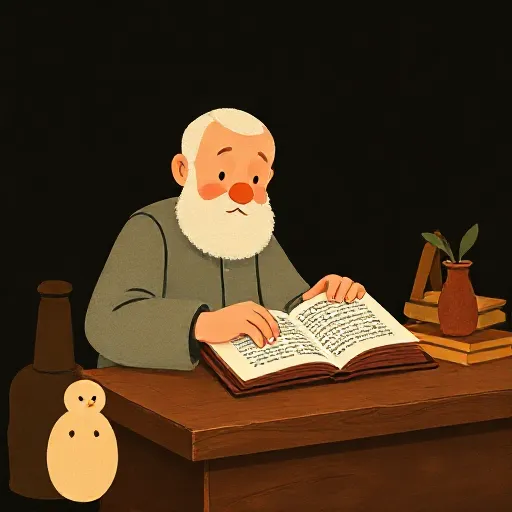
The year is 1082, inside the great city of Constantinople. A man named John Italos (c. 1025–after 1082) stands before a church court. He is the empire’s top philosopher, the Consul of the Philosophers, a teacher who has trained emperors and debated the brightest minds. But now he is accused of something dangerous: thinking too much.
The charge is that Italos used logic — the careful, step‑by‑step reasoning invented by the ancient Greeks — to ask hard questions about God. Could God’s nature be explained by human reason? Could divine truths be proved like a geometry problem? The church leaders were alarmed. They said some mysteries should simply be accepted on faith. In their eyes, Italos crossed a line. The court condemned him, and to this day, in some Orthodox churches, his name is listed among heretics during a special Sunday service.
This trial was not just about one man. It was the sharpest flash in a long, slow struggle inside the Byzantine Empire: how much can you use philosophy to understand your own religion? To see why that question mattered so much, you have to look at the world that produced John Italos.
The Empire That Never Forgot the Greeks

Byzantium was what remained of the Roman Empire in the east. It lasted for over a thousand years after Rome itself fell. While Western Europe lost track of most ancient Greek texts, the Byzantines never did. For them, Homer’s Iliad was still the main school textbook. They copied the works of Plato and Aristotle by hand, century after century.
Yet there were no universities like those that would later spring up in Italy or France. Higher education in Byzantium was meant to train government officials and church leaders, not independent scholars. The ideal was encyclopedic: a well‑rounded person should know a bit of everything, but especially how to write and speak well. Rhetoric — the art of persuasive speaking — was prized above deep philosophy. Philosophy was mostly basic Aristotelian logic and a little natural science, enough to think clearly and not embarrass yourself in a debate.
The standard curriculum included the first few books of Aristotle’s Organon (his works on logic), along with some textbooks on physics and mathematics. Students often used short, easy summaries called compendia instead of the real texts. For gifted pupils, there were private tutors or, in certain golden periods, an Imperial School of Philosophy in Constantinople. A few rulers even appointed a Consul of the Philosophers, giving a star teacher the empire’s stamp of approval.
This system kept ancient ideas alive. But it also meant that philosophy was rarely free. If your job was to train church officials, you had to be careful that your teaching did not contradict the doctrines of Orthodox Christianity. And that is where things got complicated.
Psellos and the Forbidden Plato

About a generation before Italos, the most famous thinker in Constantinople was Michael Psellos (1018–1078). He was a Consul of the Philosophers, a brilliant speaker, a tireless writer, and a man who knew everything from medicine to law to music. Psellos taught all branches of philosophy and wrote hundreds of letters and essays.
What made Psellos daring was his love for Plato and, even more, for the Neoplatonists — philosophers like Plotinus, Porphyry, and Proclus who had taken Plato’s ideas and built huge, intricate systems out of them hundreds of years after Plato died. These Neoplatonists described reality as a great chain flowing down from a single divine source, through pure intellect, to the soul, to the physical world. Psellos found that this picture could, with adjustments, fit pretty well with Christian ideas about God, angels, and creation. He saw the pagan philosopher Proclus as an authority, not an enemy.
But Proclus had been a polytheist, not a Christian. So Psellos walked a tightrope. He spent years building a Christian version of Neoplatonism, but whenever he got too close to teachings that sounded heretical, he had to back off. In his writings, he often carefully distanced himself from dangerous doctrines. He remained a celebrated figure, but he could never say everything he thought aloud. The church was watching.
Italos Crosses the Line

John Italos was Psellos’s student and later his successor. He was known as a superb logician. Anna Komnene, a Byzantine princess and historian, wrote that Italos understood Aristotle’s logic better than anyone else of his time. But Italos took a step his teacher had avoided.
In his classroom, Italos encouraged students to ask philosophical questions about all topics — including the Trinity, the nature of Christ, and the origin of the world. He then answered them in a collection called the Quaestiones quodlibetales (roughly, “Questions on Whatever You Like”). The answers were tightly reasoned, using the tools of Aristotle’s logic. For Italos, theology — the study of God — was not above philosophy. It was the highest part of philosophy. If you could understand everything through reason, then you should be able to understand God that way too.
This was big trouble. The Orthodox Church taught that some truths about God are beyond human comprehension. You cannot prove them; you accept them through faith, guided by the Church. When Italos treated Christian mysteries as if they were puzzles to be solved with syllogisms, it looked to many like prideful overconfidence. In 1082, the church condemned him in eleven articles, officially cursing his rationalist approach.
Still, Italos was not the only one to think logic belonged in theology. His own student, Eustratios of Nicaea (early 12th century), later argued that even Christ himself had used Aristotelian syllogisms when he spoke. Eustratios was also condemned for heresy, in 1117. The pattern was clear: the more you insisted that reason could stand on its own in matters of faith, the more likely you were to end up in chains.
The Great Soul Debate

If you could not always reason about God, could you at least reason about the human soul? This was a safer but still thrilling question. Byzantine philosophers were devoted to Aristotle, who had defined the soul as “the first actuality of a natural body which potentially has life.” That sounds like the soul is just the body’s way of being alive — and if the body dies, the soul seems to disappear. Did Aristotle really believe the soul was mortal?
Theodore Metochites (1270–1332), a later Byzantine statesman and thinker, wrote a famous set of essays called Sententious Notes. In them, he laid out the battle lines. On one side were those who said Aristotle denied any life after death. They pointed to his definition and to texts where he says the soul depends on the body. On the other side were those who, like Metochites himself, insisted that Aristotle secretly agreed with Plato: the rational part of the soul is immortal.
To make their case, these philosophers turned to a passage in Aristotle’s De anima where he talks about a special kind of intellect — the “productive intellect” — that is “alone immortal and eternal.” The task was to show that this intellect is not some remote cosmic mind, but a part of every individual human being. The great 6th‑century commentator John Philoponus, whose works were very influential in Byzantium, offered a helpful scheme. He said there are three kinds of soul: the vegetative soul (which handles growth and nutrition) dies with the body; the irrational soul (feelings, imagination) is connected to a breath‑like substance called pneuma and also perishes; but the rational soul, the thinking part, is wholly separable and can survive forever. He compared it to a pilot leaving a ship.
Later Byzantine teachers like Nikephoros Blemmydes (1197–c. 1269) used the same pilot image to argue that Aristotle really did believe the rational soul is immortal. Metochites went further. He tried to build a logical argument for immortality right out of Aristotle’s own books on physics. He argued that something that moves itself (as the soul does in Plato’s view) would never stop moving, so the soul must be eternal. The problem is that Aristotle himself denied that anything truly moves itself — so Metochites may have been twisting Aristotle to get the answer he wanted. Even so, his clever attempt shows how badly Byzantine thinkers wanted to prove the soul’s survival without relying only on scripture, by using nothing but ancient philosophy and logic.
Why a Thousand‑Year Tug‑of‑War Matters Today

The Byzantines never fully resolved the tension between reason and faith. Some, like Italos, pushed too hard and were silenced. Others, like Psellos, nudged the boundaries while staying safe. Still others, like Metochites, retreated into the safer territory of defending the soul’s immortality with clever argument. And by the final years of the empire, some philosophers abandoned Christianity altogether, trying to revive the old pagan religion of Plato’s gods — a step too far for almost everyone.
This long struggle matters because it is not just ancient history. It is a version of a question you might face yourself: when should you accept something because your family, your community, or your sacred texts tell you it is true, and when should you use your own mind to question it? Is there any belief you hold that you would not be willing to test with logic? If a friend argued that your most important belief was unreasonable, would you listen?
The trial of John Italos was a harsh answer to those questions. But the very fact that Byzantine philosophy survived for a millennium — that we still have their arguments about the soul, about Plato and Aristotle, about reason and revelation — tells you that the urge to think for yourself is very hard to stamp out. And that may be the most important lesson their story has to offer.
Think about it
- If you could prove logically that something you currently believe by faith is wrong, would you change your mind? Why or why not?
- Should a religious community ever be allowed to punish someone for asking philosophical questions about its teachings?
- Does the idea that part of you — your mind or soul — could survive your body make sense to you? What kind of evidence could convince you one way or the other?