Can One Word Name a Million Things? Walter Burley’s Unseen World
The Most Famous Disputation in Bologna
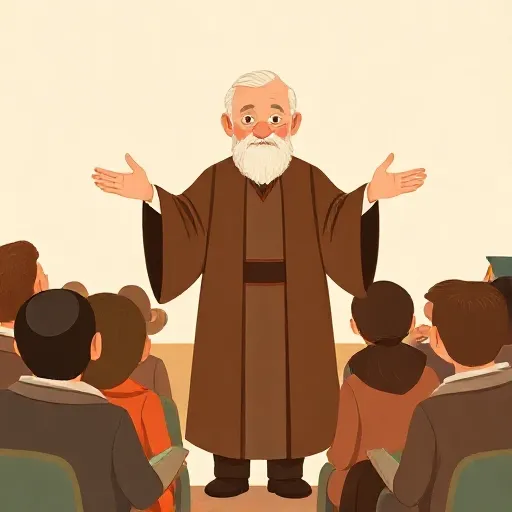
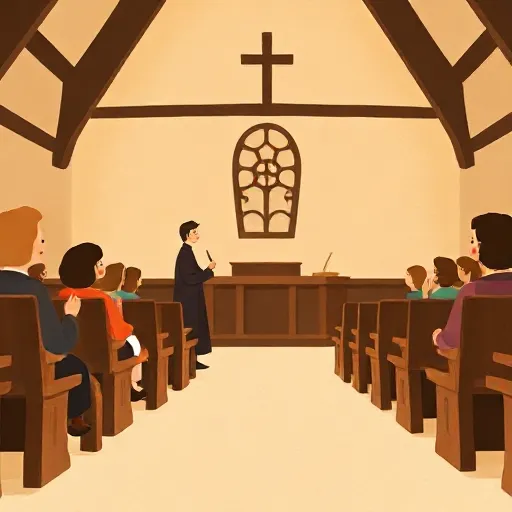
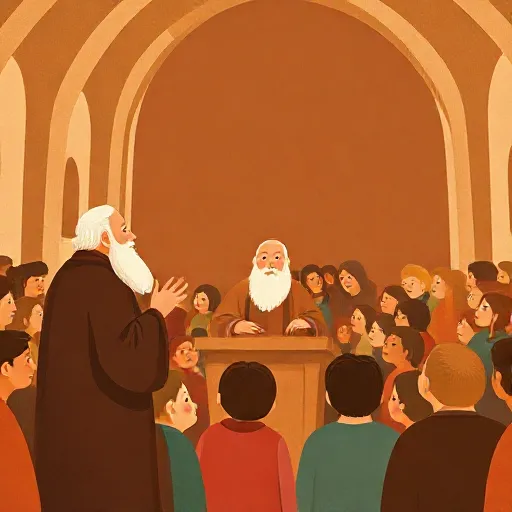
In 1341, a scholar named Walter Burley (1275–1344) stood up in a packed hall in Bologna, Italy. He was old now, with a white beard and the deep-set eyes of someone who had spent a lifetime thinking. The room was full of students and masters who had come to hear him defend a startling claim: the words we use every day — “human,” “dog,” “white” — name real, invisible things that exist outside our minds. Not just sounds or ideas. Actual parts of the world.
Burley had not always believed this. As a young man, he had held a more modest view. But a fierce younger thinker, William of Ockham (c.1287–1347), had attacked the older theories and forced Burley to rebuild his whole picture of reality. The debate that followed would ripple through philosophy for centuries, and it asks the same question we still ask today: when you say a word, what are you really pointing at?
What Makes a Dog a Dog?

Imagine you see a Great Dane, a Chihuahua, and a shaggy stray. You call all of them “dog.” What makes that possible? Is there one thing — a universal — that all dogs share? And if there is, where does it live?
A universal is a form, or nature, that can be common to many particular things at once. For example, you and your best friend are both human. Medieval philosophers asked: is there a real, extra-mental “humanity” that exists in both of you, making you human? Or is “human” just a label your mind invents after seeing a bunch of similar individuals?
When Burley first taught at Oxford and Paris, he gave a middle-of-the-road answer. Real universals do exist, he said, but they exist only in the individual things — as parts of their essence. The universal “humanity” is a metaphysical component of every person, just like your particular soul and your particular body are parts of you. The universal has no separate existence; its whole being is the being of the individuals that instantiate it.
This view is called moderate realism. Burley also insisted that only three of Aristotle’s ten categories — substance, quantity, and quality — are full-blown things. The other seven categories, like relation or time, are just real aspects of those three. A father, for instance, is an aggregate: a human substance plus the accidental form “fatherhood.” The word “father” does not name a simple object; it names a substance-with-an-accident.
So far, so tidy. But then Ockham came along.
The Rebel Friar Who Attacked Universals
William of Ockham was a Franciscan friar with a razor-sharp mind. He thought moderate realism collapsed under its own weight. His argument went like this.
Suppose the universal humanity is really identical with Socrates and also really identical with Plato. Then whatever is true of Socrates must be true of humanity, and whatever is true of Plato must also be true of humanity. But Socrates is snub-nosed and Plato is not. That would mean humanity is both snub-nosed and not snub-nosed at the same time — a contradiction. To avoid this mess, moderate realists had to say that the universal is the same as the individual in one respect but different in another respect. Ockham shot back: that breaks the basic rule of identity. If two things are truly identical, you cannot say they are different “in a certain way” without talking nonsense.
He added another problem. If universals exist only inside individuals, then if God annihilated Socrates, the universal humanity would be destroyed along with him — and with it, the entire category of substance. But that seems absurd: one person’s death should not wipe out the very idea of being human.
Ockham concluded that the only way out was to deny that universals exist outside the mind at all. General words like “man” are just mental signs — concepts — that we use to think about many similar individuals. In the world, there are only particulars. No invisible dogness, just Fido and Rover.
Burley took Ockham’s criticisms seriously. He agreed that the old moderate realism was inconsistent. But instead of giving up on universals, he turned in the opposite direction.
Burley’s Radical Turn: A World of Real Forms
After 1324, Burley defended what we can call radical realism. He now claimed that universals exist fully outside the mind and are really distinct from the individuals they live in. The universal humanity is not made of the same stuff as Socrates; it is a separate kind of thing — a secondary substance — that is present in Socrates without being a part of his essence. The same universal can be wholly in Socrates in Athens and wholly in Plato in Rome at the same time, because its kind of unity is not the kind you can count (not “one in number”). It is a unity of species, not of quantity.
A single human being, like you, is a macro-object: a bundle of a primary substance (your core “this-ness”), a singular substantial form (what makes you this human rather than any other), and a host of universal forms that reveal what you are — humanity, animality, and so on — plus many accidental forms (your height, your hair color). The universal forms are not pieces that build you; they are forms that disclose your nature.
Burley also filled the world with real propositions. A true sentence, like “Socrates is a man,” does not just match a fact in your head. It corresponds to a real, extra-mental complex object — a proposition in re — made up of the things the subject and predicate stand for, joined by an identity relation. If there is no such complex object in the world, the sentence is false.
To make sense of all this, Burley gave words a richer semantic structure. A general term like “human” has both a significatum (what it points to) and a sense (how we grasp it). The significatum includes both the universal form (the intension) and the individual people who instantiate it (the extension). The sense is a special kind of mental universal — a concept that exists in the mind purely as an object of thought. This mental object is what lets you think about “human” even if you have never met every human on Earth.
Ockham thought positing all these extra things was like filling the world with invisible ghosts. Burley replied that without them, language would be meaningless. A general word must name something real and common, or else how could it apply to millions of different things?
Flipping How We Know: From Universal to Singular
The change in Burley’s ontology forced him to rethink human knowledge, too.
In his earlier years, Burley had followed the standard view: our intellect knows universals first. Sense perception gives us individual dogs and trees, but real understanding — intellectual knowledge — is always of the universal “dogness” or “treeness.” We can know a particular dog only indirectly, by turning the universal species back toward the sense image.
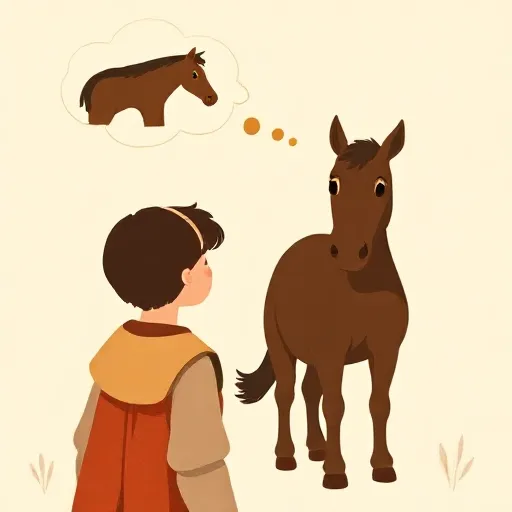
But if universals are now really distinct from individuals, that old story breaks. A universal is no longer the inner blueprint of the individual. So Burley boldly reversed himself. In his final commentary on Aristotle’s Physics, he argued that the human intellect knows singulars — this dog, that person — primarily and directly. The singular is not a blurry, second-hand reflection; it is the first thing our mind grasps in its confused, everyday awareness. Then, by a second movement of the mind — reflection — we can abstract and build the universal concepts that let us define and categorize.
Burley did not deny that we also know universals. He described two movements of knowing. The first goes upward: from the singular to the most general genus, through confused knowledge. The second goes downward: from the most general forms to the richest definitions, through clear, appropriate knowledge. Both are intellectual, and both are necessary. What changed is that the starting point is now the concrete individual you see with your own eyes, not a universal hidden inside it.
This put Burley in surprising company. Many fourteenth-century thinkers were also trying to give singular things a bigger role in knowledge, often as a reaction against earlier theories that made the individual seem unknowable. Burley’s version was unique because he kept his universe fully stocked with real universals while still insisting that your mind first lights on this person, this tree.
Why It Still Matters: Words, Reality, and You
You have never learned Latin or worn a medieval scholar’s robe, but Burley’s problem is yours. Every time you call something “fair” or “unfair,” you are using a general word. Are you naming a real, invisible standard of justice? Or are you just projecting a feeling onto a bunch of situations that happen to look similar to you?
If you think there really is a universal “justice” that exists outside human minds — even if you can’t touch it — you are leaning toward Burley’s radical realism. If you think “justice” is only a convenient name we give to many different acts, you are closer to Ockham. Scientists face the same question: does the biological species “dog” carve nature at its joints, or is it just a filing system humans invented because we like to sort things?
Burley’s story matters because he was willing to follow a problem wherever it led. When his first theory cracked under Ockham’s logic, he didn’t abandon the idea that words touch real features of the world. Instead, he built a richer, stranger picture — a world where every general term has a real form to match, where true sentences mirror complex objects that exist as solidly as rocks. You may not believe in his invisible forms. But the next time you argue about what is fair, notice that you are treating a word as if it reaches beyond your own head. That is the same instinct Burley spent a lifetime trying to explain.
Think about it
- If you say “Socrates is a human,” do you think there is a real, invisible “human-ness” that exists beyond all individual people, or is the word just a useful shortcut your mind creates?
- How could anyone ever prove that a universal — like “redness” — exists independently of every single red apple, fire truck, and rose?
- If Burley’s later view is right that we know individual things directly, does that mean a baby knows the family dog as an individual before they ever learn the word “dog”?