
Why Did Edmund Burke Think Revolutions Always Turn Ugly?
A Warning from Across the Channel
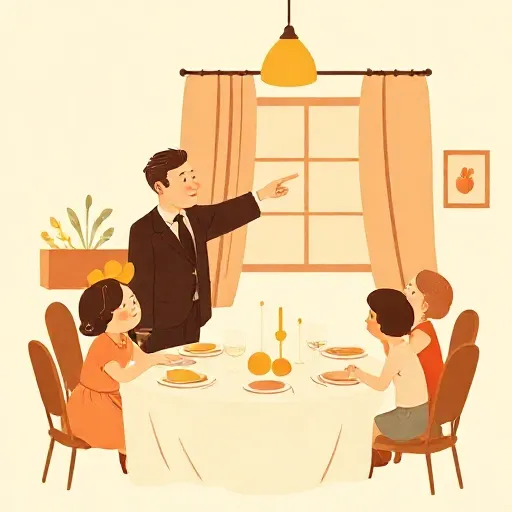
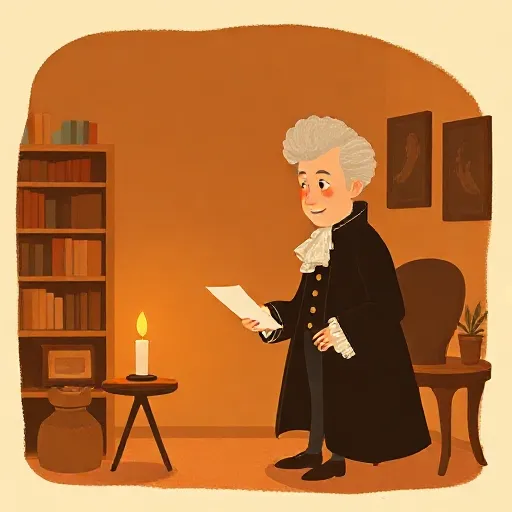
It is November 1, 1790. In a quiet study in England, a sixty-year-old politician named Edmund Burke (1730–1797) has just published a book. Across the English Channel, France is ablaze. The Bastille prison has been stormed, a king’s power is crumbling, and banners declare “Liberty, Equality, Fraternity.” Most British thinkers are excited. A new age of freedom seems to be dawning.
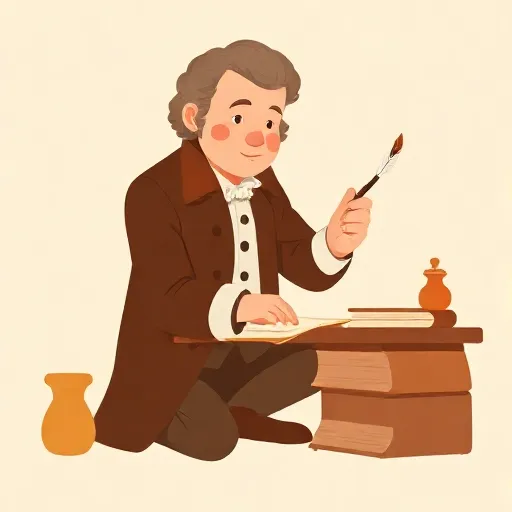
Burke is not excited. He is furious. His book, Reflections on the Revolution in France, argues that the revolutionaries are not building freedom — they are building a cage made of empty words. He warns that their shiny new slogans will lead to violence, military rule, and misery.
Burke was not against all change. He himself had fought for American colonists, defended oppressed Irish Catholics, and tried to reform corruption. So why did he see the French Revolution as a catastrophe? The answer lies deep in his unusual way of thinking about words, the human mind, and how societies really hold together.
Words Are Not Lego Blocks
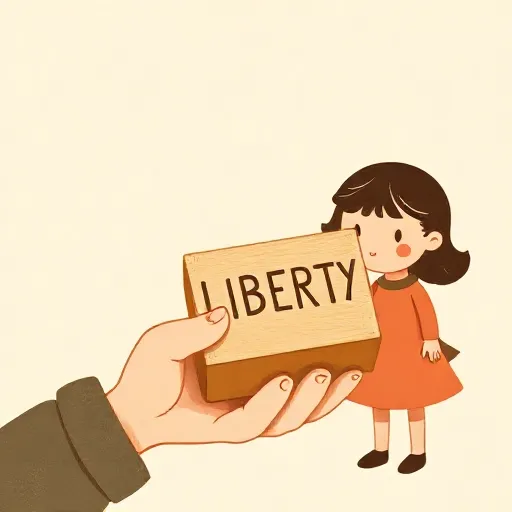
Burke’s philosophy begins with a puzzle about language. Take a word like “horse.” That word calls to mind a clear image — a four-legged animal with a mane and tail. Now take a word like “liberty.” What do you actually see in your head? Burke’s answer: probably nothing sharp at all. You don’t picture some single, simple thing. Instead, a whole fog of feelings and half-remembered experiences washes over you.
Burke, who studied the philosopher John Locke carefully at Trinity College in Dublin, believed the human mind builds ideas in layers. Simple ideas — red, round, pain, pleasure — come directly from your senses. But important political words like virtue, honour, justice, and liberty are what Burke called compound abstract words. They have no single picture attached. Instead, they stir images from your past — a story your grandmother told, a moment you felt free, a flag you saw, a punishment you dreaded.
This wasn’t just a curious fact for Burke. It meant that when a speaker or writer uses those words, they are not giving you a neat, fixed definition. They are touching your emotions and your memories. The power of political language does not come from logic alone. It comes from how it links to the life you have already lived. Change those links suddenly, and the words lose their force — or worse, they start to mean anything any angry crowd wants them to mean.
The Danger of Empty Slogans
If “liberty” is a cloud of associations rather than a crisp definition, then it can be shaped. For Burke, this meant that leaders in a society have a huge responsibility. They must carefully attach those powerful words to institutions, habits, and stories that actually make people’s lives better. Rip the words away from those moorings, and you leave a society mentally bare.
This is what Burke believed the French revolutionaries were doing. They shouted “Liberty!” but they were destroying every custom, every old building of habit, that gave the word its meaning for ordinary French people. A king was no longer a figure wrapped in centuries of loyalty and ceremony; as Burke put it, a king is only a man, and a queen only a woman. Burke predicted that once you strip away all the inherited feeling and reverence, you do not get a nation of enlightened thinkers. You get a “swinish multitude” that can only be controlled by raw force — by soldiers, not by persuasion.
His reasoning was grounded in his psychology. People learn to love their community because their minds connect the warm, familiar parts of daily life to the big words of politics. A French peasant’s idea of “justice” might be tangled up with the sight of a local court that his grandfather respected. Destroy that court overnight in the name of a pure, abstract “Justice,” and you tear a hole in the peasant’s mental world. The abstract word suddenly has no home in his experience. Burke thought that a society built on such unmoored abstractions was doomed to collapse into chaos, and from chaos into tyranny.
Change That Preserves, Not Destroys

So was Burke against any improvement? Far from it. He wrote that a state without the means of some change is without the means of its conservation. He believed in reform — slow, careful, almost invisible reform — that respects the roots of the things it changes. His political method was not “never change,” but rather “never break the links.”
Burke used a concept from his philosophical training: relation. He thought you could not judge anything — a law, a custom, a parliament — by looking at it in isolation, torn out of the web of other things. You had to see how it connected to the whole. A practice that looks ugly by itself might, in its real connections, prevent a greater harm. For example, Burke never denied that old European societies contained real misery and gross inequality. Miners and chimney sweeps lived dreadful lives. But he argued that you could not fix those evils by demolishing the entire social system that, however clumsily, also produced security, law, and the very standards of decency that made people notice the misery in the first place.
His own approach to reform was to quietly adjust the existing relationships. When he wanted to cut wasteful royal spending, he did it by trimming the king’s household budget through Parliament, not by declaring the monarchy useless. He thought the job of a statesman was like a doctor who knows the patient’s whole history, not like a mathematician who solves an equation on a blank slate. The worst thing a politician can do, he warned, is to act with a “simple view of the object in all the nakedness and solitude of metaphysical abstraction” — that is, to treat a living, messy society as if it were a pure philosophical puzzle.
America and the Idea of “Empire”
Burke’s skill at thinking in connections, not absolutes, shines in his handling of the American Revolution. By the 1770s, British colonists in North America were furious about being taxed by a Parliament across the ocean where they had no elected members. The British government insisted it had an absolute right to legislate for the colonies — end of story. Most politicians saw only two choices: crush the colonists with force, or let them break away entirely.
Burke refused both. He used his philosophical habit of taking compound ideas apart and recombining them. The idea of sovereignty, he argued, was not a simple, indivisible block. A parliament could have “two capacities.” In one, it was the local legislature for Britain. In another, it was an “imperial character” — an overseeing body that guided and supervised colonial assemblies but did not crush them. Sovereignty, Burke wrote, “was not in its nature an idea of abstract unity; but was capable of great complexity and infinite modifications.”
He was not just playing with words. He was applying his deepest insight: that a complex political reality demands a complex idea to match it. The right to tax, he said, could belong to Parliament in principle but be deliberately left unused in practice. That way, the colonists’ mental links to the British crown — their inherited feeling of being British subjects with ancient liberties — would not be snapped. “Let the Colonies always keep the idea of their civil rights associated with your Government,” he pleaded. “They will cling and grapple to you.” If you made those two ideas separate in their minds — if government meant only force, and their privileges existed in a separate universe — the psychic cement of empire would crumble. His advice was ignored, and war came, but his philosophical defense of flexible, relational thinking remains a masterclass in political imagination.
Why This Matters When You Argue Today

You have probably never read Burke, but you live in his thought experiment every week. Scroll through any social media feed, and you will see people throwing around enormous compound words: freedom, justice, equality, tradition, revolution. Burke would ask you to pause and ask a strange question: “What actual experience, what specific image, is that word pulling from your memory — and what is it pulling from the memory of the person you are debating?”
His wager was that no amount of pure, clean theory can ever replace the silent, slow work of accumulated habits and affections. He was not against reason — he used careful reasoning to show the limits of detached reason. This makes him an uncomfortable figure for any side that justifies its plans with one simple, shining principle. He would suspect modern plans to reinvent everything from scratch just as much as he suspected the French revolutionaries’ plans.
He lost his immediate political battle; the French Revolution roared on, and many of his contemporaries thought he had lost his mind. But his challenge has never faded: can human beings build a decent society if they treat the language of morality and politics as a set of neatly definable Lego blocks? Or are we creatures who can only navigate group life by feeling our way along the tangled, often unfair, but time-tested threads of inherited sentiment? Burke did not give a tidy answer. He gave a style of attention — and a warning that creating a fairer world requires the hands of a slow gardener, not the roar of a bulldozer.
Think about it
- If a word like “honour” means something different to you than it did to your great-grandparents, should your generation keep using it the old way, or is change always fine? What would Burke fear?
- Think of a rule or tradition at your school that seems pointless to you. If you could snap your fingers and erase it forever, what else — what hidden connections — might break around it?
- Can a politician who uses warm, history-soaked language to persuade you actually be more dangerous than one who uses cold, clear logic? Why might Burke’s own skill at persuasion make some people uneasy?