Can a Marble Really Be a Monster’s Horn? A Radical Buddhist Idea
A Marble on the Ground
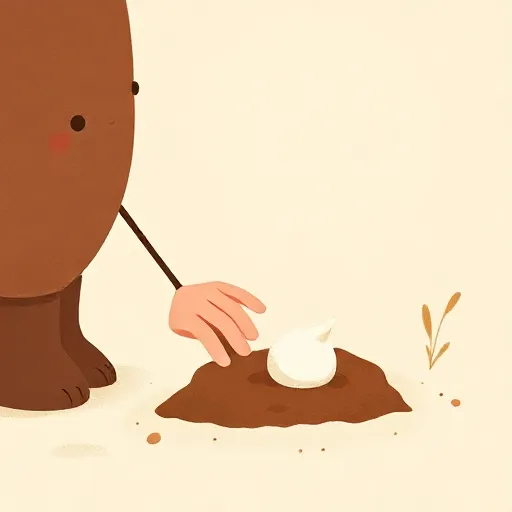
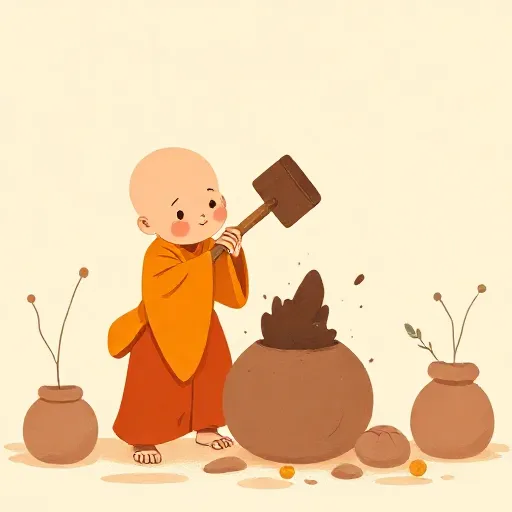
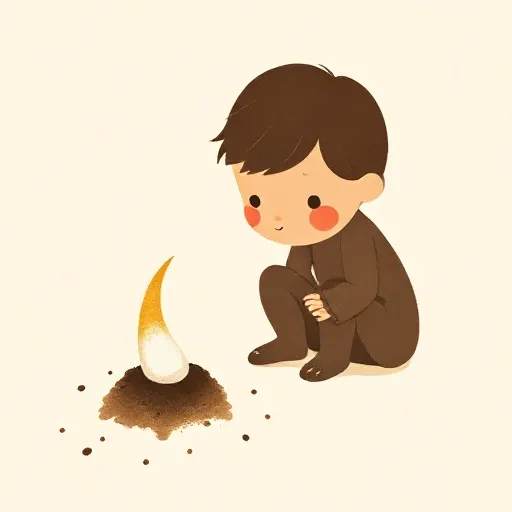
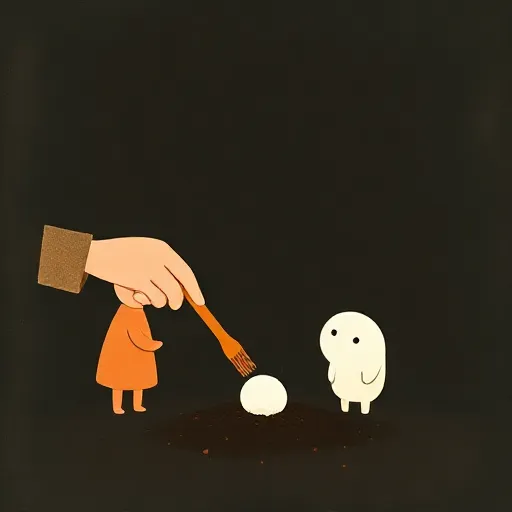
You spot a small white marble on the ground. It looks round, smooth, and easy to pick up. But when you try to lift it, it’s stuck. You dig around it and discover it isn’t a marble at all — it’s the tip of a long, thin rod. Digging deeper, you find the rod widens into a cone, then plunges into a scaly surface. Suddenly the ground shakes and a giant two‑horned monster rises up. The tiny “marble” was actually the very tip of one of its horns.
Now look at that tip again. It still looks the same as before — but it also doesn’t. You saw it as round, but the whole horn is sharp. Up close it seemed white, but against the monster’s body it appears speckled green. The tip hasn’t changed; it’s the larger context that changed how you see it.
The Chinese Buddhist school of Tiantai (founded by Zhiyi, 538–597) thought all things work like this. Every object, person, feeling, or fact is like that marble tip: you never see the whole story. And that insight completely overhauled how Buddhists thought about reality.
The Three Truths: Nothing Is Just One Thing
Most Buddhist schools before Tiantai divided truth into two levels: temporary, everyday truths you use like a raft, and an ultimate truth — the final reality that you reach when you let go of all rafts. Tiantai flipped this on its head. Zhiyi argued that any attempt to say something is just what it is always falls apart, because for something to be itself it must be different from everything else. Yet it can never be completely separate, because everything exists only by being related to other things. You can’t have “round” without “not‑round” somewhere else. So Tiantai replaced the two‑truth model with three aspects of every single thing:
- Emptiness — the thing is not only what it seems; its identity always overflows the label we give it.
- Provisional Positing — it does appear as a definite this or that (a marble, a cup, a horn) and that appearance is real, not an illusion.
- The Center — the fact that the thing is both empty and provisionally posited, at the very same time, and that these two sides are inseparable.
These three aren’t steps or levels. They are three ways of describing the same whole, three angles on one reality. Tiantai thinkers summed this up with the phrase “neither same nor different.” The horn tip and the marble are neither completely identical nor completely separate. The tip is both round and sharp, depending on what larger picture you include.
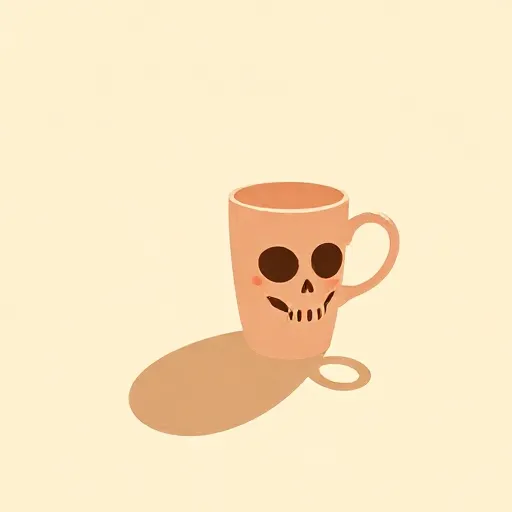
This means that ontological ambiguity — built‑in blurriness about what something really is — is not just a trick of perception. It belongs to the very being of things. Zhiyi used the goofy word “moretoitivity” for this: everything always has more to it than any single description can capture. A cup is a cup, but it is also a weapon in a mystery novel, a doorstop, a molecule dance, a piece of a future archaeological dig. All of those identities are truly present in it right now, depending on which context you choose.
The Joke That Explains Everything

Tiantai had a clever way to explain how provisional truth and emptiness relate. It’s like the setup and punchline of a joke:
Two strangers chatted on a bus. One said he was taking his dog to a biology lab. “He was born with no nose,” the man explained.
“Really?” said the other. “How does he smell?”
“Awful.”
When you hear “How does he smell?” it sounds like a serious question about a medical condition. It’s not funny at all. But after the punchline, it becomes hilarious — precisely because it wasn’t funny before. The setup is funny in the mode of being serious. The punchline recontextualizes it, and suddenly both are part of one humorous whole.
Tiantai calls this “opening the provisional to reveal the real.” Provisional truth (the ordinary appearance of things) is like the setup; ultimate truth (emptiness, the bigger picture) is like the punchline. They are not two separate worlds. One becomes the other, and both change their meaning in the process. After the punchline, “serious” also means “what can turn out to be funny,” and “funny” means “what was serious a moment ago.” Reality, the school claimed, always works like this: every local truth gets rewritten when you zoom out, yet the rewrite doesn’t erase the original — it makes it something new while keeping it the same.
Can Every Opinion Be True?
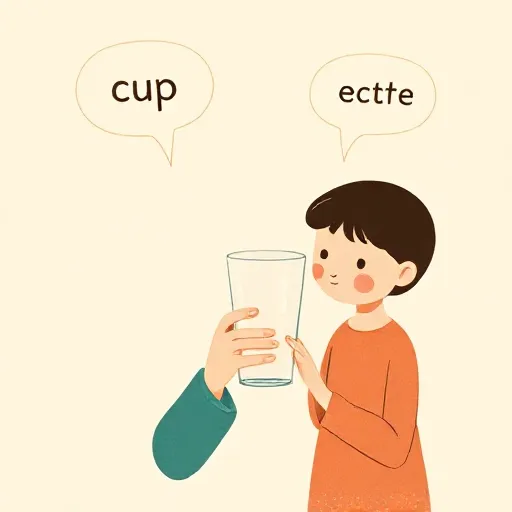
If everything is always more than it seems, then no statement is just flat‑out false. In the Two Truths model, “This is a cup” could be a helpful conventional truth, but “This is an elephant” would be simply wrong. Tiantai’s Three Truths said otherwise. From some perspective, for some stretch of time, the cup really is an elephant — maybe metaphorically, maybe as a design, maybe in a dream. The same object can be read infinitely many ways, and each reading is true as a local coherence. The school didn’t deny that you need to pay attention and choose carefully; it just insisted that every viewpoint, however wild, has a context in which it holds.
This doesn’t mean you should believe everything mindlessly. Traditional Tiantai held that all teachings — even contradictory ones — are upāya, skillful means. A statement is “true” not because it matches a fixed reality, but because it can, in the right circumstances, lead you beyond itself — out of suffering and narrow habits of thought. The trick is to ask not “Is it true?” but “In what context and for whom is it liberating?”
To make this practical, Zhiyi sorted Buddhist teachings into an intricate system. He showed that earlier doctrines, like the simple claim “all things are impermanent,” are partial truths that flower into fuller insights when re‑situated. In the big picture, “all things are impermanent” and “all things are permanent” turn out to be two ways of saying the same both‑ness. Tiantai’s goal was to help people move flexibly among perspectives, never getting stuck on any single raft.
One Flash of Mind Holds the Whole Universe
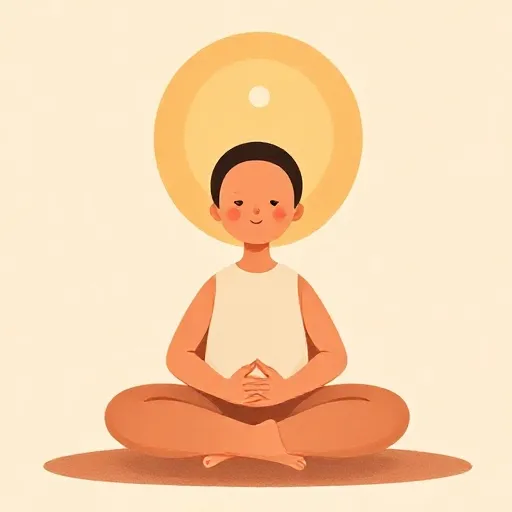
If every thing is always connected to everything else, then in some sense the whole cosmos is present in any tiny piece of it. Tiantai meditation tried to make that idea a direct experience. Zhiyi’s most famous practice involved contemplating “Three Thousand Worlds in a Single Moment of Thought.”
The number 3000 was just a way of saying “everything”: ten realms of experience (from hellish suffering to Buddhahood), each containing all the other ten, times ten types of characteristics, times three spheres (body, mind, environment). Meditators were asked to go through this vast list, then suddenly pull their attention into one bare flicker of mental activity — the very instant they noticed themselves noticing. The aim was to isolate that moment completely, to feel its tiny, fleeting nature.
But something surprising happens. When you try to exclude everything else and squeeze awareness into a pinprick now, all the listed contents — thoughts, objects, past and future — flood back, not as separate things but as inalienable parts of this flash. The instant turns out to be inseparable from all that you tried to leave out. You experience directly that the moment is neither same nor different from other moments, neither permanent nor impermanent. Its transience is its connection to everything; its smallness holds the whole.
Why This Still Matters: You Are Never Just One Thing
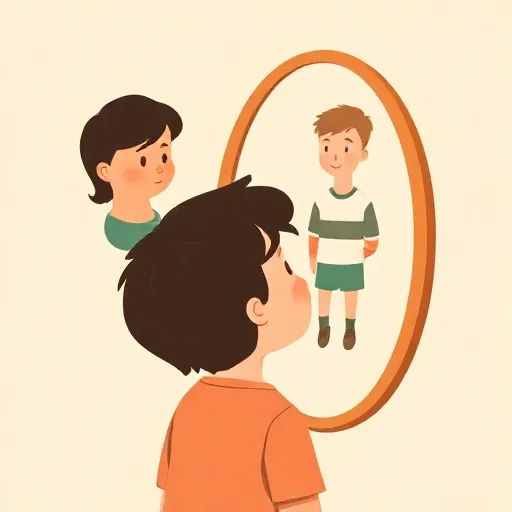
You might not spend your afternoons counting to 3000, but the Tiantai way of seeing things hits close to home. Think about how people describe you: “shy,” “talkative,” “clever,” “athletic.” Each label captures only a tiny tip of a much bigger horn. Depending on the context — at a party, under pressure, with your favorite song on — you might switch from one description to another. None of them is the final truth, and all of them are genuinely you in that moment.
Tiantai’s message is that this isn’t a problem. It’s the engine of life. When someone — including you — gets stuck on one rigid story (“I’m just bad at this,” “They’re always mean”), suffering follows. But if every identity can be recontextualized, then even painful experiences can be “opened up” to reveal something more. Hard moments, like the serious setup of a joke, can be re‑read later in a larger frame and appear differently, without erasing what they were.
The next time you feel boxed in by a single version of yourself or a situation, you might remember the marble on the ground. The tip was never just round; it was also sharp, green, dangerous, and part of a living giant. The world never stops offering more to see.
Think about it
- If everything you perceive is only a “tip” of a larger iceberg, what does that mean for how confident you can ever be about a fact? Is that freeing or frightening?
- Have you ever been absolutely certain about something — a first impression of a person, for example — only to discover later that you were missing a huge piece of the story? What does that tell you about truth?
- Imagine a society where every belief is treated as true in some context. Would that make disagreements easier to work through or harder? Why?