
The Hall of Mirrors That Showed Everything Is Everything Else
A Room of Mirrors at the Imperial Court

One day around the year 700 CE, a Buddhist monk named Fazang (643–712) did something that looked like a magic show for the Empress of China. He set up a hall whose walls, ceiling, and floor were all mirrors. Then he placed a small jewel in the middle. Instantly, every mirror reflected the jewel, and those reflections appeared in other mirrors, bouncing back and forth forever. The Empress stared into a dizzying infinity. Fazang told her that this is exactly how the universe works: every single thing contains every other thing, and all of them are contained in each one.
Fazang belonged to a school of Chinese Buddhist philosophy called Huayan (pronounced hwa-yen), which grew out of ideas that had traveled from India centuries earlier. Huayan thinkers took the Indian idea that nothing has a separate self and pushed it even further. They argued that the entire universe is a single, seamless web where every part depends on every other part. That might sound abstract, but their arguments are still startling today—and they lead straight to a radical view of compassion.
Why the Buddha Said You Do Not Really Exist

To understand Huayan, you need to go back to the Buddha himself, who lived in South Asia sometime between the 6th and 4th centuries BCE. The Buddha’s most famous insight was that ordinary life is soaked in dukkha—a word often translated as “suffering,” but which also means something like the nagging dissatisfaction of things never quite being right. The cause of dukkha, he said, is our deep belief in a permanent, independent self. We think, “I am a real, separate thing that needs to own and control other real, separate things.” That belief leads to endless craving, because nothing we grab ever makes the “I” feel safe for long.
The Buddha’s solution was to see that there is no such permanent self. The technical term is anātman—no-self. When you fully realize that you are not a solid, isolated soul but a flowing, constantly changing process, the craving falls away. And once craving stops, you can see the world without distortion. That seeing is called nirvāṇa.
Indian Buddhists also developed the idea of emptiness (śūnyatā). Emptiness does not mean nothingness. It means that everything is empty of a fixed, independent nature. A table is not a “table” all by itself; it is made of wood, which came from a tree, which grew from sunlight and rain, which depended on… everything else. Nothing stands on its own.
China Turns Emptiness Into a Web of Connections

When Buddhism reached China by the first century CE, Chinese thinkers inherited these ideas but also transformed them. They used a classic Indian image: the god Indra’s net. According to pre‑Buddhist myth, Indra has a net that stretches through all space. At every knot sits a jewel so bright that it reflects every other jewel in the entire net—and every jewel, in turn, reflects those reflections. It is an image of total mutual reflection.
A monk named Dushun (557–640) gave this picture a new philosophical vocabulary. He used two Chinese words to distinguish the two sides of reality. Lǐ (principle, pattern) names the boundless, ceaseless activity that underlies everything—the unified, flowing whole. Shì (things, events) names the countless individual items we encounter: a cup, a sneeze, a thought. Dushun then made a startling claim: lǐ and shì pervade each other completely. The boundless whole is present in every single thing, and every single thing spreads through the boundless whole.
Dushun used a water‑and‑wave metaphor. Think of the ocean as lǐ, and the waves as shì. A wave is nothing but ocean; the whole ocean is present in any wave, because a wave does not have a sharp boundary, it just is the ocean rising up for a moment. Similarly, every distinct thing in our experience is really the whole universe appearing in a particular shape. The edges we think we see are illusions.
One Rafter, a Whole Building: Fazang’s Mind‑Bender

Fazang, Dushun’s intellectual grandson, turned these ideas into sharp arguments. He picked up a simple rafter and asked: what is a building? A building, he observed, is nothing more than the sum of its parts—rafters, beams, tiles. So each part is essential to the building’s identity. Without this very rafter, the building would not be the building it is. In that sense, the building is the rafter, because the building’s whole existence depends on it.
Now turn it around. What makes a rafter a rafter? It is the fact that it plays the role of a part in a certain building. Take the rafter away and it could become a bench, a teeter‑totter, or just firewood. Its very identity depends on the whole it belongs to. So the rafter is the building. One is all, and all is one.
This way of thinking means that every single thing in the universe—a speck of dust, a memory, a far‑off star—contains and shapes everything else. Fazang’s mirror hall was meant to make this visible. Every jewel in Indra’s net holds the whole cosmos in miniature.
The Golden Lion That Is Not a Lion
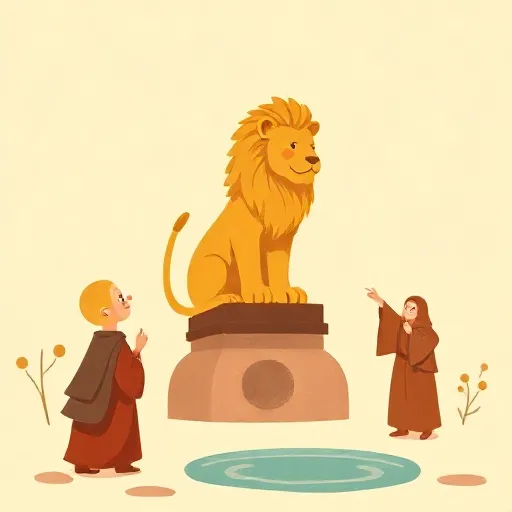
You might object: “But things look separate. I see a table, not a universe.” Huayan philosophers were ready for this. Fazang told the Empress to look at a golden statue of a lion. We all see a lion—the shape, the mane, the paws. But think carefully: is there any “lion” there beyond the gold? The gold can be melted and turned into a bowl or a necklace, yet the gold itself never changes. The lion is just a temporary arrangement. The universe is the gold; the separate things we experience are temporary shapes.
The slogan that captures this is “nirvāṇa is saṃsāra.” Saṃsāra is the everyday world of separate things and suffering; nirvāṇa is the awakened vision that sees no separate selves. The slogan means that these are not two different places. The world of separate things is the awakened world, seen through a confused lens. There is nothing wrong with the gold; we just forget that the lion is only gold.
What This Means When Someone Makes You Angry

The point of all this is not just intellectual gymnastics. Huayan says that selfishness is the root of all trouble, and selfishness is caused by the illusion that you are a separate self. When you truly see that you are part of a single, interconnected whole, universal compassion becomes natural. Hurting someone else would be like refusing to bandage a cut on your own arm because it is “your arm’s problem,” not yours.
Fazang’s philosophy challenges us to rethink anger, blame, and love. It does not say you should never feel upset, but it suggests that the person you are furious at is, at the deepest level, not a separate island. You share a single, shimmering web. The same idea lurks in the background of later Chinese philosophy—Neo‑Confucians borrowed the term lǐ and turned it into a central concept—and even today mathematicians like Graham Priest use set theory to model how everything could include everything else.
The mirror hall is not just a clever trick. It is a picture of a universe in which you are never truly cut off from anything. When you next feel hurt or lonely, you might remember the jewel in Indra’s net: every jewel holds your reflection, and your jewel holds them all.
Think about it
- If every part of the universe contains every other part, does that mean your best friend’s thoughts are somehow inside you right now—or is there a difference between containing something and thinking it?
- When you feel angry at a bully, would it change how you act if you truly believed that bully is just another piece of the same reality as you? Why or why not?
- If everything is interconnected like a giant web, who is responsible when someone does something wrong—the individual, the whole web, or both at once?