Do You See a Person or a Thing? Buber’s I and Thou
A boy with a book and a world of people

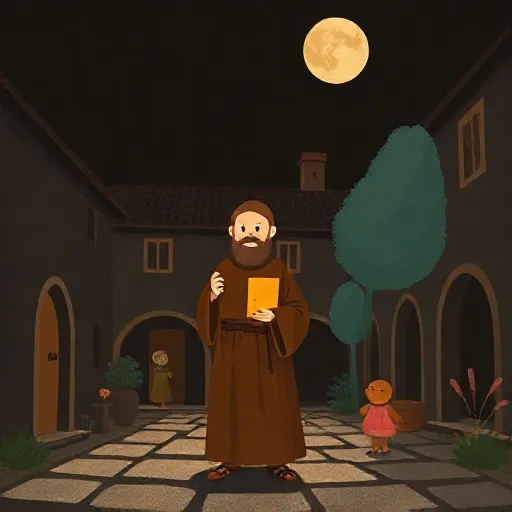
Vienna, 1882. When Martin Buber (1878–1965) was four, his parents separated. He went to live with his wealthy grandparents in Lemberg, far from the life he knew. His grandfather was a respected scholar who published ancient Jewish texts, and the house was full of books, languages, and long, quiet afternoons. Young Martin soaked up Hebrew, Yiddish, Polish, and German, and spent hours in his own imagination. He had few friends his age. The boy who would later write one of the most startling books about human connection spent his childhood feeling a little bit apart from everyone else.
That early loneliness planted a seed. Buber grew up to become a philosopher who was not interested in clever systems or abstract puzzles—he wanted to know what happens when two people really meet. His short book I and Thou (1923) did not offer a set of rules. Instead, it drew a bold line down the middle of human experience. On one side, he said, we treat others as objects. On the other, we meet them as full, living beings. Those two ways of relating, he argued, shape everything from our closest friendships to the way nations are built.
I and Thou: the encounter that changes everything

Buber’s big idea rests on a pair of primal words. He called them I-Thou and I-It. You cannot say either word all by yourself; each one already includes a relationship. When you say “I-It,” you stand at a distance from a thing. You experience it, you measure it, you use it. A chair, a number, a weather forecast—all can be its. The trouble comes when you treat a person that way. A classmate who becomes just a source of homework answers, a sibling reduced to a nuisance, a stranger you glance at as if they were a lamppost: in those moments, the other is an object, not a presence.
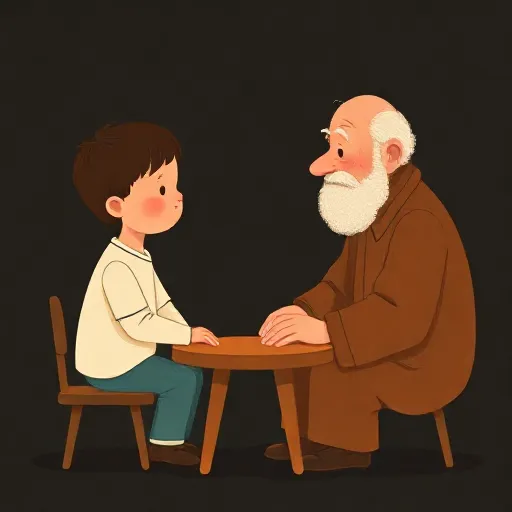
An I-Thou encounter is entirely different. You don’t experience the other or turn them into information. You meet them. The meeting happens in what Buber called the in between, a space that belongs to neither person alone. It is mutual, unpredictable, and alive. Buber believed that an I-Thou moment can flash up with another human being, with an animal, with a tree, or even with what he called the eternal Thou—God. When it does, you are not a detached observer. You are completely there. He used the word presence to capture this, contrasting it with the ordinary experience of a mere object. You can hold an object in your mind, but a Thou stands before you and changes you.
According to Buber, a life lived only in I-It mode would be cold, lonely, and thin. Yet he never said we should abandon I-It altogether. You cannot build a bridge, fix a computer, or take a science test without treating some things as its. The danger begins when I-It takes over the spaces where only I-Thou can nourish us.
From art to community: the danger of dreaming too big

Before Buber wrote I and Thou, he was searching for unity in a different way. As a young writer in Berlin, he was fascinated by Gestalt—a German word for a living, dynamic shape that emerges from raw material. He believed that an artist wrestles a dead block of stone until a hidden form comes alive. He loved poetry, dance, and myth, and he hoped that the Jewish people could become a kind of living Gestalt, a community renewed through creativity and intense feeling.
Then, in 1914, World War I broke out. Buber saw the chaos as a forge: a terrible storm that might melt a scattered society into a true national community. He wrote that the war gave modern Jews a chance to discover a new wholeness. His closest friend, the anarchist Gustav Landauer (1870–1919), was horrified. Landauer wrote to Buber that his thinking was “aestheticism and formalism” and that to wrap mass death in shining ideals was “inadequate and outrageous.” The criticism shook Buber deeply. He began to realize that forcing everything into a beautiful, unified shape could blind a person to real suffering and to the stubborn, broken facts of life.
That turning point pushed Buber toward the rougher, more honest dualism of I and Thou. He stopped trying to dissolve all differences into a single glowing form. Instead, he insisted that the I-Thou relation does not erase the other; it respects the other’s separateness. And the I-It world, however imperfect, is necessary for building tools, laws, and daily routines. Buber never again romanticized a war.
Can a nation be built on dialogue?

Buber took his philosophy of meeting into politics. From early on, he was a Zionist—he believed the Jewish people needed a home in the land where their ancient story was born. But his version of Zionism puzzled many. He refused to call for a Jewish state that would rule over Arabs. Instead, he argued for a bi-national partnership, where Jews and Arabs would live side by side in a shared land, neither group dominating the other.
Behind this political vision lay a startling religious idea: the kingship of God. Buber read the Book of Judges in the Hebrew Bible and fixed his attention on a leader named Gideon. When the people wanted to make Gideon their king, he refused. God alone, Gideon insisted, was king. Buber took this as a serious political claim: true authority cannot be handed to a human ruler, a government, or a state. Any attempt to lock divine power into a throne or a flag turns the Thou into an It on an enormous scale.
The modern experiment that came closest to Buber’s ideal was the Jewish village commune in Palestine—the kibbutz. In these small, agricultural communities, people shared work and decisions, constantly adjusting the balance between individual freedom and group life. Buber called them “an experiment that did not fail.” There was no single boss, no distant government calling the shots. Day by day, members had to meet each other as real partners. For Buber, that was politics at its most human: a network of I-Thou moments woven into a fragile, living pattern.
Why critics say it’s not that simple

I and Thou is not a book that proves its claims step by step. It speaks in short, poetic bursts, and that has always stirred argument. Even Buber’s friend and collaborator Franz Rosenzweig (1886–1929) complained, “In your setting up the I-It, you give the I-Thou a cripple for an opponent.” Rosenzweig worried that Buber made the world of objects look like a wreck, useful only as raw material. If tables, clocks, and legal systems are just dead things, how can we build a just society that needs rules?
Other scholars objected to the way Buber read Hasidic Jewish mysticism. The great historian Gershom Scholem (1897–1982) argued that Buber’s favorite Hasidic folk tales left out an important side of the tradition: a deep distrust of the physical world. Buber’s later writings, Scholem said, painted Hasidism as too cheerful and world-embracing. At the same time, some philosophers found Buber’s language maddeningly vague. The American translator Walter Kaufmann (1921–1980) called I and Thou an “oracular” performance that “mistook deep emotional stirrings for revelation.” For a thinker who insisted on the power of real meeting, Buber gave readers remarkably little to hold onto when they tried to turn his vision into clear, testable ideas.
An I-Thou moment, after all, cannot be planned or measured. It cannot be stored in a notebook. The moment you try to pin it down with words, you have already stepped back into the I-It world. How, critics ask, can you base an entire ethics on something so fleeting?
Why it still matters when you text a friend

Imagine you are scrolling through messages before bed. You see a friend’s name, tap the chat, and fire off a quick reply. Now ask Buber’s question: in that exchange, did you meet a Thou, or did you just handle a bundle of typed words? You might have answered without pausing to picture your friend’s face, with no sense that someone is waiting to be seen. Buber would not say that every text message is shallow, but he would warn you that our tools make it dangerously easy to slip into treating people as its.
The same worry runs through school hallways, sports teams, family dinner tables, and video calls. Anywhere humans gather, we face the choice: am I scanning a crowd of useful objects, or am I letting a real person appear before me? Buber’s insight is that no law, no app, and no clever rule can force an I-Thou meeting. It depends on the quality of attention you bring.
The boy who once felt alone in a grand library spent his whole life trying to describe the moment when loneliness cracks open and a genuine meeting floods in. He never claimed that such moments last forever. But he believed they are the only thing that can keep a person, a friendship, or a whole society from turning into a machine of cold, efficient use. Even now, in a world packed with screens, the space between an I and a Thou is waiting to be filled.
Think about it
- If you treat a classmate as an “It” all day—ignoring their feelings and only using them for help with homework—do you harm them even if you never get caught?
- Can a group of people govern themselves without a boss, just by talking and really listening? What might go wrong?
- Have you ever had a moment with a friend, a family member, or even a pet where you felt completely understood without words? What made that moment different from an ordinary chat?