

Can You Build a Universe Inside Your Head?
A stranger in the world of math

Brouwer and Hilbert, 1909. They meet in a Dutch seaside village. Brouwer, then 28, is full of excitement. He writes to a friend that Hilbert is “a beautiful new ray of light through my life.” Hilbert, at 47, is the most powerful mathematician alive — he believes that all of mathematics can be built from a few clear rules, like a perfect machine. The two become colleagues, allies. You can almost hear the sea outside the window as they talk late into the night about the foundations of logic.
Twenty years later, the same two men are locked in a bitter war. Hilbert moves to remove Brouwer from the editorial board of a top journal. Brouwer is so crushed he withdraws into isolation. What could break such a friendship? A single, almost childlike question: Do mathematical truths already exist, waiting to be found — or do we invent them inside our own minds?
Brouwer spent his life defending the second answer. To him, mathematics was never a dusty museum of perfect objects. It was a languageless activity, something you do alone, in time, with nothing but your own thinking. And that made him one of the most radical philosophers you’ve probably never heard of.
The builder and the camera

Luitzen Egbertus Jan Brouwer (1881–1966) grew up in the Netherlands, trained under the top mathematician Diederik Korteweg, and absorbed a wild mix of influences: Kant’s philosophy, Schopenhauer’s pessimism, and the new, strange logic of his teacher Gerrit Mannoury. By his twenties, Brouwer had already published a little book called Life, Art and Mysticism — it said society was sick, language was a trap, and the inner life was the only real thing.
When he turned to mathematics, he brought this mystical attitude with him. In his 1907 dissertation, he argued that math does not happen on paper and it does not happen in some eternal realm of numbers. It happens in the pure intuition of inner time — the steady, silent ticking of moments inside your head. Counting is not about objects; it is about the experience of one thought, then another, then another. A mental construction, he called it.
This was a huge break from the mainstream. Most mathematicians, including Hilbert (1862–1943), treated math like a camera: it takes pictures of a landscape that was already there. That view is called platonism (with a small p). Others, the formalists, said math is just a language game with symbols and rules — like chess. Hilbert leaned that way. Brouwer said both were wrong. Platonism gives you a beautiful picture but can’t explain how a human mind ever gets to see it. Formalism gives you perfect rules but empties math of meaning, as if playing chess without knowing what winning feels like. Brouwer’s own philosophy came to be called intuitionism.
The domino that refused to fall
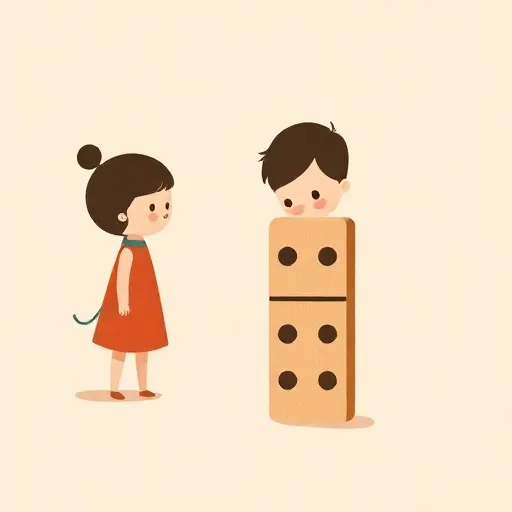
If math is mental construction, then a statement is true only when a thinker actually constructs its truth. You could state a problem like “Every even number greater than 2 is the sum of two primes” — the Goldbach conjecture. For Brouwer, that sentence is not already true or false somewhere in heaven. It becomes true when someone builds a proof. Until then, there is no truth about it. He put it simply: There are no non-experienced truths.
That leads to a serious shake-up in logic. Classical logic relies on the Principle of the Excluded Middle (PEM), which says that for any proposition (p), either (p) is true or not-(p) is true. There is no third option. A domino either falls or it doesn’t. Brouwer argued that in mathematics, if you have not yet constructed a proof for (p) and you have not yet constructed a proof against it, you cannot honestly claim “(p) or not-(p).” The domino is still wobbling in the air.
In 1908, he published a paper called “The Unreliability of the Logical Principles,” where he gave what are now called weak counterexamples. He didn’t prove PEM false — he showed situations where you have no good reason to assert it yet. For instance, imagine a number defined by an unsolved problem. If the problem ever gets solved, the number behaves one way; if not, another. Until that problem is solved, you cannot say “the number is either rational or irrational” — because to do so you’d need to have already finished an infinite search through the digits, which you haven’t.
This sounds subtle, but it becomes explosive when you apply it to the whole set of real numbers. Classical mathematics treats a real number as a completed infinite decimal expansion. Brouwer replaced that with choice sequences — potentially infinite sequences of numbers that a mathematician (the creating subject) chooses step by step over time. You can never finish such a sequence, so its properties are not all settled in advance. This let him reconstruct analysis — the study of continuous change — in a new way. And here, some classical theorems broke.
The war of the titans

By the 1920s, Brouwer was no longer a young prodigy; he was a full professor at the University of Amsterdam and a member of the Royal Academy. And he had begun systematically rebuilding mathematics without the excluded middle. In lectures across Europe, he showed that not every real number has a decimal expansion you can actually write down (1921), and that every function from the interval ([0,1]) to the reals is continuous — a result that classical mathematicians would flatly reject because it contradicts standard analysis.
Hilbert watched this with growing anger. For him, Brouwer was like a carpenter who walks into a finished house and starts tearing out the foundation beams. In 1922, Hilbert fired back in a paper titled “The New Grounding of Mathematics,” calling intuitionism a threat to the whole enterprise. He famously declared that no one should drive them from the paradise that Cantor had created. The Grundlagenstreit, or Foundational Debate, had begun.
The conflict turned personal. In 1928, thinking he was dying, Hilbert maneuvered to expel Brouwer from the editorial board of the prestigious Mathematische Annalen. The move was legally improper, and Einstein — another board member — refused to take part in it. But most others stayed silent, and Brouwer was pushed out. He was mentally shattered. His creative output slowed drastically. The debate between intuitionism and formalism effectively ended, not because it was resolved, but because the two main fighters could no longer stand in the same ring.
Yet the ideas didn’t die. Brouwer’s students — especially Arend Heyting — turned his philosophy into a formal system of intuitionistic logic, which you can study today just like classical logic. And Brouwer himself, in his later years, returned to produce strong counterexamples that involved the creating subject’s own temporal activity. He showed that the double-negation rule “if not-not-(P), then (P)” could lead to a contradiction when you mix classical and intuitionistic meaning — not a disproof of classical math, but a proof that the two worlds don’t translate cleanly into each other.
A truth that waits for you

Brouwer died in 1966, hit by a car outside his house in Blaricum at age 85. His library and papers were scattered, then painstakingly reassembled by later scholars. He had been a difficult man — proud, pugnacious, and sometimes morally brave, like when he refused to remove Jewish editors from his journal under Nazi pressure and hid people in his institute during the war. But his real ghost is not in those stories. It is in a question that won’t go away: Is a mathematical truth real before anyone thinks it?
This isn’t just about equations. It connects directly to your own life every time you face an open question with no obvious answer. Does an undiscovered song “exist” before a composer writes it? Is a future event already determined, or does it wait to be made? Intuitionism says that some realities depend on a conscious subject to construct them, step by step.
If that sounds strange, you’re in good company. Hilbert thought it was madness. Many mathematicians still use classical logic and don’t lose sleep over it. But the intuitionistic approach has found new life in computer science, where proofs are literally programs, and every truth must be built to be used. The fight that broke a friendship still echoes. It turns out that asking what really exists — and who gets to say so — is never just a game.
Think about it
- If no one ever proves a mathematical conjecture and no one ever disproves it, could it still be “true” or “false” in any sense that matters?
- When you figure something out in your head — a puzzle, a new idea — does it feel more like discovering something that was already there or like building something new?
- Could two people honestly disagree about a mathematical fact if one has constructed a proof and the other hasn’t yet — or must one of them simply be wrong?