Who Owns the Line Between Maryland and Pennsylvania?
What Happens When You Cross the Line?
Imagine you are in a car driving north on Interstate 95. You pass a green sign: “Welcome to Pennsylvania.” A moment ago you were in Maryland. Now you are in Pennsylvania. But think about the exact spot where one state ends and the other begins. Is there a last inch of Maryland road, and right after it a first inch of Pennsylvania? If so, what lies between those two inches? If nothing, then the two states are touching. But if they touch, do they share a border line? And whose line is it?
The ancient Greek philosopher Aristotle (384–322 BCE) defined a boundary as the “extremity” of a thing: the first part within which every part lies, and beyond which no part can be found. That sounds clear. The Mason-Dixon Line is the boundary between Maryland and Pennsylvania — no part of Maryland is north of it, no part of Pennsylvania south of it. But there is a catch. Between any two points on a continuous line, there are infinitely many other points. So you cannot have a last point of Maryland right next to a first point of Pennsylvania. Either there is no last point (so Maryland never quite “touches” Pennsylvania) or only one state can own the boundary line. Both options seem strange. Philosophers call this the puzzle of contact.
Leonardo da Vinci (1452–1519) asked: what divides the atmosphere from the water? Is it air or water? The line itself seems to have no substance. Francisco Suárez (1548–1617) wondered: if a wall is half brilliant white and half jet black, what color is the line where they meet? It cannot be both black and white, but it cannot be neither either. And Plato (c. 428–348 BCE) raised a version about time: at the exact instant a moving object stops and becomes still, is it in motion or at rest? That instant seems to belong to neither state, yet it must be one or the other.
Four Possible Homes for a Boundary
Philosophers have dreamed up four main ways to solve the puzzle of who owns a shared boundary. Picture again the border between Maryland and Pennsylvania.
1. The boundary belongs to neither. Leonardo thought the line is a sort of “nothing” that separates two things without being part of either. Maryland ends, then there is a boundary that is not Maryland or Pennsylvania, then Pennsylvania begins. The states never truly touch — a gap remains, even if it has no thickness. In time, the Roman thinker Epicurus used a similar idea: when we exist, death is not with us; when death comes, we no longer exist. So there is no moment when a dying person is both alive and dead. Yet many find it odd to say two solid things can be in contact without sharing anything.
2. The boundary belongs to one side. In standard mathematics, one region is “closed” (it includes its boundary) while the other is “open” (it does not). Maybe Maryland ends exactly at the line, while Pennsylvania starts just after it. But which one? The choice seems arbitrary. And it would mean only one state truly “owns” the border — hardly fair.
3. The boundary belongs to both at once. Aristotle himself held that when things touch, their boundaries merge into one single entity — one in number, though we can talk about it as Maryland’s boundary or Pennsylvania’s. However, a single line shared by a black spot and a white background would have to be both black and white, which looks like a contradiction. Most philosophers resist that.
4. There are really two boundaries, one on top of the other. The 19th-century thinker Franz Brentano (1838–1917) argued that the black spot has its own black boundary line, the white background has its own white boundary line, and the two lines exactly coincide — sit in the same place without merging. This avoids saying one line is both colors, but it challenges the rule that two physical things cannot occupy the same space. Still, many find this the least troublesome option.
All four answers belong to a realist family: they assume boundaries are real, though they depend on the things they bound (a line cannot float in mid-air). Later we will meet the opposite idea.
Lines We Draw vs. Lines the World Draws
Even if we solve the ownership puzzle, another question looms. Did the boundary exist before humans came along, or did we invent it? Geographers distinguish between bona fide boundaries (natural, mind-independent) and fiat boundaries (artificial, created by agreement).
The Mason-Dixon line is fiat — surveyed and drawn in the 1760s. The coastline of Britain seems like a natural, bona fide boundary. Yet when you zoom in, the coastline gets longer and more twisted; its exact length depends on how finely you measure. The mathematician Benoît Mandelbrot (1924–2010) showed that a coastline has no single true length. So even a “natural” boundary involves human choices.
Zoom in further: a table’s surface looks smooth, but under a microscope it is a swarm of atoms. Where exactly is its boundary? Some philosophers say the physical world has no perfectly sharp natural boundaries — all boundaries are fiat, drawn by us for convenience. If that is true, then not just borders but everyday objects (a forest, a constellation, a baseball game) are shaped by our ways of carving up the world. As the philosopher Nelson Goodman (1906–1998) put it, we make a star as we make a constellation, by drawing boundaries around a group of stars. This does not mean objects are illusions; it means their individuality depends on our minds. The North Sea is still real, even though we decided where it begins and ends.
This idea has huge political weight. When leaders call a border “natural,” they often use it to justify taking land. Recognizing that many boundaries are fiat reminds us that borders are human creations, not facts of nature — which matters for peace and justice.
When a Boundary Gets Fuzzy
Mount Everest has a boundary, but can you say exactly where the mountain stops and the surrounding rock begins? Some rocks are part of the mountain, some are not — yet there seems to be no sharp line. This is a fuzzy boundary. The problem appears everywhere. When does a heap of sand stop being a heap if you remove grains one by one? At some point it is not a heap, but no single grain makes the difference. This is the ancient sorites paradox (from the Greek word for “heap”).
Philosophers split on why boundaries get fuzzy. One camp says the fuzziness is in the world itself: there truly is no fact of the matter about whether a certain rock belongs to Everest. This is a de re (about the thing) view. Another camp says the fuzziness is just in our words: we have not picked a precise meaning for “Everest,” so many possible sharp boundaries exist, and our language does not choose one. This is a de dicto (about the word) view. If you lean toward boundaries being fiat, you might think fuzziness is de dicto. If you believe in bona fide boundaries, you might think fuzziness would have to be de re — but then the world itself would be blurry at the edges, which some find unsettling.
Fuzzy boundaries create real headaches for logic. If there is no sharp line, how can we say something is either on one side or the other? Yet we cross fuzzy borders all the time. The sorites paradox remains a hot topic.
The Thickness of Nothing — Are Boundaries Just Thin Layers?
Look at a cue ball. It has a surface. Common sense says a surface has no thickness — it is purely two-dimensional, a boundary between the ball and the air. But how can you see or touch something with zero thickness? The philosopher H. H. Price once complained there is really no such entity as a surface; there are only solid things that are surfaced. The British psychologist James J. Gibson argued that what we see is actually a thin layer of the ball’s material, a “skin,” not a geometrical surface.
This split runs deep. Brentano insisted that boundaries are lower-dimensional entities that depend on the things they bound: a line is one-dimensional, a point zero-dimensional. Such boundaries are real but have less “being” than the things they limit. Yet the alternative is to treat boundaries as abstractions: they do not really exist out there; we construct them in thought to make sense of the world.
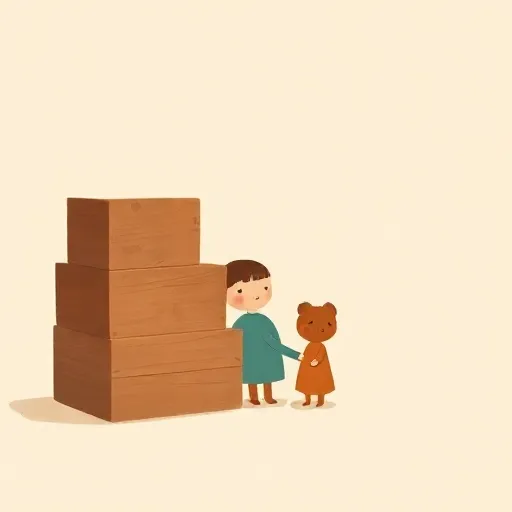
The most famous abstractionist was the mathematician–philosopher Alfred North Whitehead (1861–1947). He showed how to define a point without assuming points exist. Imagine a series of nested boxes, each smaller than the last, like a Russian doll set with no smallest box. The place where the series “converges” is a point — but you never need an actual point, just the infinite sequence of boxes. All of geometry, even surfaces and lines, can be rebuilt from talk of extended objects and their overlapping relations. In such a boundary-free picture, boundaries become higher-order logical constructions, not physical things. This neatly sidesteps puzzles about ownership and thickness, but raises a new question: if boundaries are just mental, how can we perceive them? We seem to see lines and edges every day.
Why the Puzzle Still Matters
Boundary puzzles are not just for geometry class. They shape wars, laws, and everyday life. When countries argue over a border, they argue over a line that may have no physical existence — yet people fight and die for it. As the political geographer Stephen Jones noted, a boundary can have “diseases of its own or reflect the illnesses of the body.”
Boundaries also define who we are. When does a person’s life begin? The line between a fetus and a newborn is hotly debated and depends on where we draw a boundary. When does someone die? Brain-death laws set a boundary that is partly a fiat choice. Even your personal space — how close someone can stand before you feel uncomfortable — is an invisible boundary that matters every day.
The deep philosophical questions persist. Are boundaries real features of the world, or are they mental tools we project onto reality? Is there a fact of the matter about where one thing ends and another begins? Next time you see a line on a map, remember: you are looking at a problem that has puzzled human minds for over two millennia. It is not just about geography — it is about how we carve up reality itself.
Think about it
- If two countries share a river as a border, does the border run down the middle of the river, or along one bank? Can you think of a fair rule, and what makes it fair?
- Imagine a cloud that slowly changes shape and moves across the sky. When does it stop being the same cloud? Could you ever decide for sure?
- Think of a line you draw in your own life — maybe between “play time” and “work time,” or between “being a kid” and “growing up.” How do you know where to draw that line? Is the line real, or just a habit?