
Can a Simple Switch Explain the Limits of Mathematics?
The Switch That Thinks

Imagine you walk into a room and flip a switch. The light is either on or off. No dimmer, no maybe — just two possibilities. Now imagine you have two switches: one controls a lamp, the other a fan. The room’s state is just a combination: both on, both off, only lamp on, only fan on. This tiny universe of on/off — of true/false, 1/0 — is where Boolean algebra begins. It is a branch of mathematics that studies what happens when you combine true and false with operations like AND, OR, and NOT. But Boolean algebra turned out to be much more than a tool for designing circuits. It revealed a hidden bridge between logic, sets, and the entire universe of mathematics — and it led to one of the biggest surprises of the 20th century: the existence of statements that can never be proved true or false.
A Tiny Mirror That Reflects All of Logic
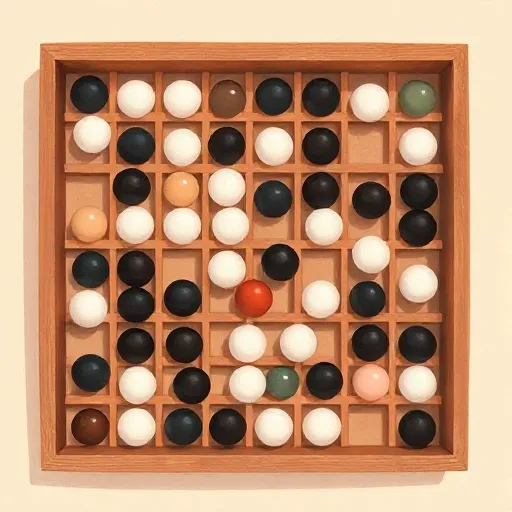
In a Boolean algebra, truth values (true and false) act like numbers you can compute with. The operation conjunction (AND) takes two statements and gives true only if both are true. Disjunction (OR) gives true if at least one is true. Negation (NOT) flips true to false and false to true. These three operations obey algebraic laws — for example, (x \cdot (y + z) = (x \cdot y) + (x \cdot z)) — just like addition and multiplication, but reinterpreted for truth.
The most stunning fact is this: any equation built from these operations holds for all possible Boolean algebras if and only if it holds for the simplest one, the two‑element algebra {true, false}. That means you can check whether a piece of logical reasoning is always valid by drawing a truth table with just two values. It’s like having a tiny mirror that reflects the whole logical universe. The logician Alfred Tarski proved that the entire elementary theory of Boolean algebras is decidable — there is an algorithm that can always tell you whether a statement about Boolean algebras is true. So the algebra of true and false is, in a deep sense, completely knowable.
Sets, Spaces, and the Shape of Logic

Boolean algebra is not just about truth values. Think of a collection of objects — all the books in a library. You can take the union of two sets (all items in either set), which acts like OR, and the intersection (items in both), which acts like AND. The complement (everything outside a set) acts like NOT. Surprisingly, every Boolean algebra, no matter how abstract, can be seen as a collection of sets in disguise.
The Stone representation theorem shows that any Boolean algebra can be embedded into the set of all subsets of a certain space. The points of that space are special objects called ultrafilters — consistent collections of elements of the algebra that, for every statement, contain either it or its negation. This result means that logic and set‑theoretic structure are two ways of describing the same thing. Some Boolean algebras are atomic: they contain smallest particles of truth — atoms — that cannot be split into smaller bits. Others are completely smooth, with no atoms at all. An algebra can also be complete, meaning you can take infinite unions and intersections and still stay inside the system — a property that will become crucial for the biggest leap.
Turning Sentences into Symbols

One of the most elegant uses of Boolean algebra is the Lindenbaum‑Tarski algebra of a logical theory. Take any collection of sentences in a formal language — like the axioms of geometry — and say two sentences are equivalent if each logically follows from the other under those axioms. The equivalence classes of sentences then form a Boolean algebra where disjunction, conjunction, and negation correspond exactly to the logical connectors. So any mathematical theory can be turned into a single algebraic object.
For simple, decidable theories, mathematicians can fully describe this object. For example, the theory of linear orders gives an algebra that looks like a certain interval algebra built from rational numbers. This means the structure of logical deduction is encoded in a Boolean algebra — and that turns logic into a problem algebraists can attack with all their tools. It also prepares the ground for what comes next: what if you replace the two truth values with a whole Boolean algebra?
The Dimmer Switch That Rewrote Set Theory

In the 1960s, mathematicians pushed the idea further. Instead of a statement being simply true or false, they assigned it a truth value inside a complete Boolean algebra. Imagine a dimmer switch, not just on/off, but with many fine gradations between 0 (absolutely false) and 1 (absolutely true). Using this idea, Paul Cohen built a whole new universe of sets, called a Boolean‑valued model, where the truth of set‑theoretic statements is measured by elements of a complete Boolean algebra.
This was an equivalent way of looking at Cohen’s powerful forcing method. It allowed mathematicians to show something astonishing: some statements about infinity can never be proved or disproved from the standard axioms of set theory. They are genuine “unprovable truths.” Boolean algebra, born from the simple rules of AND, OR, and NOT, turned out to be the key that unlocked the limits of mathematical knowledge.
Why the Light Switch Still Matters

Today, Boolean algebra is everywhere: in the logic gates of your computer, in search engines that combine keywords with AND and OR, in the circuits that power your phone. But its deepest legacy is philosophical. It shows that truth — or at least the structure of reasoning — follows precise algebraic laws. And it demonstrates that even those laws have limits: there are statements that can never be assigned a definite truth value without breaking the system.
So the next time you flip a switch, remember you are touching a simple example of an idea that reshaped mathematics and revealed the boundaries of provable knowledge.
Think about it
- If a statement can never be proved true or false, does it still have a truth value? Or is it meaningless to talk about a truth that exists beyond all possible proof?
- Why do you think it matters to know that some mathematical questions have no answer within a given set of rules? Could that idea apply to arguments about ethics or politics?