Can You Walk From a Rock to God? Bonaventure’s Journey of the Mind
A Vision on a Mountain
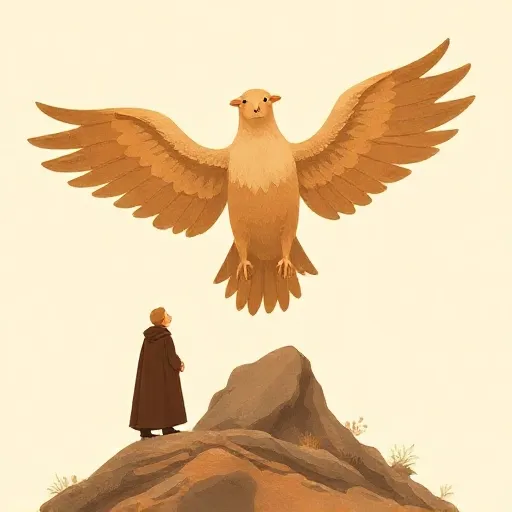
It was October 1259. The Franciscan friar Bonaventure (around 1221–1274) climbed Mount Alverna in Italy, the very spot where, decades earlier, his hero Francis of Assisi had a mystical vision of a six-winged angel and received the wounds of Christ. Standing there, Bonaventure had his own flash of inspiration: what if the wings of that angel were not just a vision, but a map? A map of how every human mind can travel from the everyday world all the way to God.
He rushed to write a short, dense book called The Journey of the Mind to God. It begins with the things you can touch and see, then climbs inward to your own thoughts, and finally rises to something beyond all thought. The book is a kind of spiritual expedition guide — but one that uses the sharp tools of philosophy at every step.
A Double Life: Professor and Peacemaker
Bonaventure didn’t spend his whole life on mountaintops. For years he studied and taught at the University of Paris, the intellectual powerhouse of Europe. He became a Master of Theology, which meant he lectured on the Bible, held public debates, and preached. At the same time, he led the entire Franciscan order — tens of thousands of friars — as its Minister General, walking from town to town and settling disputes.
This double life shaped his thinking. He loved the philosophy of Aristotle (384–322 BCE), newly rediscovered in the West, but he also revered Augustine (354–430 CE), the great Christian thinker who turned inward to find God. Bonaventure didn’t see philosophy and faith as enemies. He believed that reason could be placed inside theology like a scaffolding inside a cathedral — supporting, not replacing, what you believe.
In a letter he wrote, Bonaventure explained that the writings of pagan philosophers are often valuable for understanding truth and refuting errors. Many questions of faith, he said, cannot be settled without them. That didn’t mean reason was enough by itself; it meant that hard thinking was part of the journey.
The World Is Full of Footprints

Look around you. A rock, a tree, a squirrel — Bonaventure saw all of them as signs. He used the word vestige, which literally means “footprint.” Every physical thing, he said, is a vestige of God because it owes its existence to a cause outside itself. That idea leans heavily on the doctrine of creation ex nihilo: the universe was made from nothing, not out of some pre-existing cosmic stuff.
Bonaventure argued that only two views of the universe really make sense. Either matter has always existed, as many ancient Greek philosophers thought, or the whole thing had a beginning and depends completely on something else — God. He rejected a middle path, claiming it was contradictory to say the world was both created from nothing and eternal. If the world came from nothing, it had to have a moment when it started. Therefore, a past that stretches back forever was impossible.
Within that created world, he imagined a primordial state of matter that possessed a sort of built-in program. He called these latent patterns seminal reasons — invisible seeds planted at creation that would later unfold into different kinds of plants, animals, and bodies, under the right conditions. It wasn’t evolution in the modern sense, but it showed Bonaventure trying to explain how a dynamic natural world could still be entirely God’s work.
He even gave light a starring role. Light was the first form that gave physical stuff extension and visibility, a gift that prepares the way for everything else. Sunlight streaming through a window was, for him, a hint of a deeper giving.
Looking Inside: Your Mind as a Mirror

The next step on the journey is closer to home: your own mind. Bonaventure noticed something remarkable. When you truly know something — say, that a whole is always greater than its parts — you’re gripping a truth that doesn’t change. It’s not just probably true; it’s necessarily true, everywhere and always. But your mind is limited, changeable, and sometimes wrong. How can a wobbly mind hold onto an unshakable truth?
His answer was illumination. Just as your eyes need light to see colors, your intellect needs a kind of light to see certain, unchanging truths. That light, he argued, is God. God doesn’t put thoughts into your head directly; your own agent intellect does the work of abstracting ideas from what you sense. But when you know something with perfect certainty, you are, for a moment, borrowing the infinite certainty of the divine mind.
This is where Bonaventure met Aristotle halfway. He agreed that all knowledge starts with the senses, but he insisted that sense-experience alone can’t deliver the “must be so” feeling of a genuine proof. For that, you need a stable anchor beyond yourself.
He also saw a deeper pattern in the mind’s structure. Your memory, understanding, and will are three distinct powers that continually interact — one calling up the past, one grasping the present, one reaching toward the future. That triadic dance, Bonaventure believed, was an image of God, a more vivid sign than any footprint in the dirt.
The Boldest Argument: God Must Exist
Most people think you need to look at the world to prove God exists. Bonaventure took a bolder route. He revived an argument first made by Anselm of Canterbury (1033–1109): the ontological argument. It tries to prove God’s existence just from the meaning of the word “God.”
Bonaventure gave this argument several fresh coats of paint. In one version, he started with the idea of the best. If you can honestly think “the best is the best,” you’re thinking of a being that is absolutely complete. A being that complete cannot lack existence — existence is part of being complete. So the best must actually exist.
In another version, he focused on being itself. Imagine the concept of a being that has no hint of non-being at all, a completely pure actuality. That’s not a real thing you’ve seen; it’s an idea built into the very notion of something as opposed to nothing. Bonaventure argued that if you fully understand what “pure being” means, you see that it cannot be a mere idea — it has to be real.
He knew the classic objection: you can imagine a perfect island, but that doesn’t make it real. His reply was that islands, no matter how perfect, are limited kinds of things — they have imperfections built in. But “the best” or “pure being” is not a limited kind of thing; it’s what he called a transcendental, a feature so basic it applies to everything that exists. Transcendentals, he thought, don’t play by the same rules as imaginary islands.
These arguments didn’t stand alone. Bonaventure also used more familiar aitiological arguments (from the Greek aitia, cause) that start from features of the world — like the fact that things are true or good only partially — and reason back to a source that is perfectly true and good. All routes, he concluded, converge on the same destination.
Why the Journey Still Matters

Bonaventure died in 1274 at a church council, still trying to build bridges. His vision of a universe full of signs might sound like a story from a dusty past, but the questions he asked are still yours.
Whenever you wonder why anything exists at all, or whether your mind can reach truth beyond your own opinion, you’re standing where he stood. His big idea was that you don’t have to choose between being a thinker and being a believer — you can be both, with each strengthening the other. The world, in his eyes, was not just a collection of atoms; it was a quiet invitation.
Think about it
- If you saw a perfect footprint in the sand, you’d think someone walked there. Could the universe itself be a kind of footprint of something older — or is that comparison too simple?
- Bonaventure believed that just thinking about “the best” or “being itself” could prove God exists. Can an idea in your head ever prove that something is real outside your head?
- He thought the world is full of signs pointing beyond themselves. Pick an ordinary object near you right now — a pen, a lamp, a window. Could it be a sign of something deeper? What would it take to treat it that way?