

Atoms Don’t Just Jump — They Dance to a Hidden Tune
A Danish Puzzle: Why Don’t Atoms Collapse?
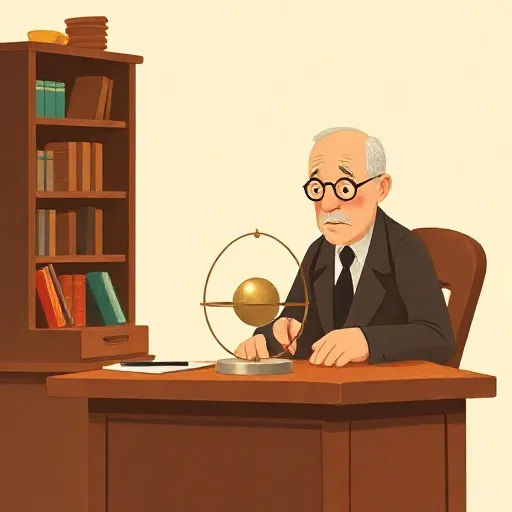
In 1913, in the city of Copenhagen, a Danish physicist named Niels Bohr (1885–1962) stared at a problem that made no sense. Scientists had recently discovered that an atom is mostly empty space: a heavy little nucleus sits in the middle, and tiny electrons whiz around it, like planets around the sun. But according to the physics everyone trusted at the time, an orbiting electron should quickly lose energy and spiral straight into the nucleus — like a bike that stops pedaling and falls over. If that were true, every atom in the universe would have collapsed long ago. And you would not be here.
Bohr realized that the old rules of physics had to be wrong inside the atom. So he made a daring new rule: electrons can only travel in certain special allowed paths, which he called stationary states. While an electron stays in one of these states, it doesn’t radiate energy and doesn’t fall. It just hums along quietly.
But atoms do sometimes give off light. Bohr explained that with a second rule. An electron can leap from one stationary state to another — a quantum jump — and when it jumps, it sends out a burst of light. The color (or frequency) of that light follows a simple formula: the energy lost in the jump divided by a tiny number called Planck’s constant. This is the Bohr-Einstein frequency condition. Together, these two rules were the beginnings of what we now call quantum theory.
That solved the collapse problem. But Bohr quickly noticed something even stranger — something that would become his most famous philosophical idea.
The Swing and the Electron’s Secret Rhythm

Think of a child on a swing. If you sat and watched, you’d see the swing go back and forth at a steady beat. But if you could look really closely, you’d notice that the swing’s motion isn’t perfectly smooth — it has little faster wiggles on top of the main sway. These faster wiggles are called harmonics. Every repeating motion, from a swing to a guitar string, can be broken into a sum of harmonics: a main frequency, then twice that frequency, three times, and so on. This trick of breaking up motion into a set of pure rhythms is called a Fourier series.
Bohr took this classical idea and applied it to an electron orbiting a nucleus in one of his stationary states. Even though nobody could see the orbit, Bohr imagined its path as a repeating motion that could be split into harmonics — just like the swing. Then he asked a strange question: could these imaginary classical harmonics tell us anything about real quantum jumps?
What he found startled him. Suppose an electron is in a stationary state labeled by a number (n). If the electron jumps to a state one quantum number away (say from (n=100) to (n=99)), that jump is allowed only if there is a first harmonic in the imaginary classical orbit. If it jumps two numbers away (to (n=98)), the jump is allowed only if the orbit has a second harmonic. If a particular harmonic is missing from the classical motion, the corresponding quantum jump is simply forbidden.
Bohr called this connection the correspondence principle. In its simplest form, it says: each allowed quantum jump between stationary states corresponds to one harmonic component of the electron’s classical motion. This is now often called Bohr’s selection rule. It’s like a hidden rule book that the atom follows — and the rule book is written in the same rhythms that a classical swing would follow.
More Than Just a Coincidence: Bohr’s “Law” of Quantum Jumps

At first, Bohr described what he had found as a “formal analogy” between the old physics and the new quantum rules. But he soon changed his mind. The connection was too powerful, he argued, to be just an analogy. It was a law of quantum theory — a universal rule that held even for small quantum numbers, not just for huge orbits.
Why did Bohr think so? Because whenever physicists looked at the light given off by a hot gas, they saw a pattern of bright spectral lines — but never all the lines that simple arithmetic would suggest. Some jumps, like the one from (n=100) to (n=98), simply never happened if the classical orbit had no second harmonic. The correspondence principle explained that “capricious” silence.
Even when Heisenberg’s new matrix mechanics arrived in 1925 and replaced Bohr’s older model, Bohr claimed that the correspondence principle lived on inside the new mathematics. He wrote that Heisenberg’s “the whole apparatus of the quantum mechanics can be regarded as a precise formulation of the tendencies embodied in the correspondence principle.”
Yet many of Bohr’s fellow physicists misunderstood him. Some thought the principle only applied to frequencies, not to the existence of jumps. Others — like his own student Léon Rosenfeld — thought it was just about large (n) limits. When Rosenfeld once mentioned the idea that quantum mechanics should recover classical results for large orbits, Bohr shook his head and insisted that was just an obvious requirement, not his correspondence principle. For Bohr, the principle was the direct link between a quantum jump and a classical harmonic — at all scales.
The Skeptics: Why Some Physicists Called It a “Magic Wand”
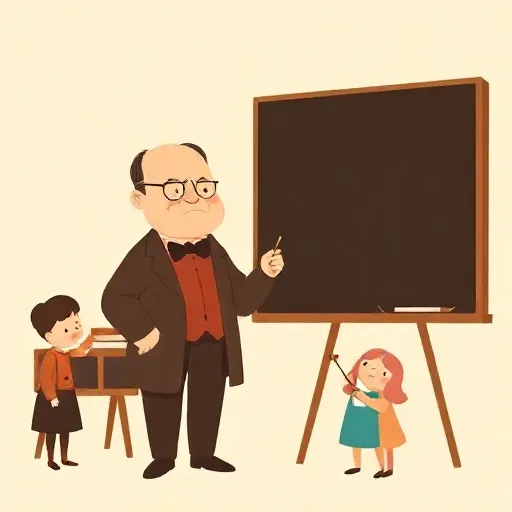
Not everyone loved the correspondence principle. Arnold Sommerfeld (1868–1951), one of the most respected physicists of the time, called it a “magic wand.” He preferred a quantum theory that was self-contained, with formal rules you could deduce step by step. Mixing up classical orbits with quantum jumps felt, to him, like cheating.
Sommerfeld’s students Wolfgang Pauli (1900–1958) and Werner Heisenberg (1901–1976) inherited some of that unease. Pauli doubted that the correspondence principle could explain why electron shells close. He joked about Bohr’s “correspondence principle imperialism” and pushed for a fresh quantum mechanics that would not rely on imaginary orbits at all. In the end, it was Pauli’s own exclusion principle that would explain the closing of electron groups.
Heisenberg, too, grew uncomfortable. Although he had once defended the principle enthusiastically, he later described the correspondence between quantum probabilities and classical amplitudes as a “purely formal result” — a useful mathematical trick, not a deep law of nature. He preferred to think of quantum mechanics as a closed theory, complete in itself, needing no borrowing from classical physics.
Yet here is the irony: the matrix mechanics Heisenberg invented was built almost entirely on the correspondence principle. The very idea that you could replace classical harmonic components with a table of numbers — each entry representing a possible quantum jump — came straight from Bohr’s insight. So even the skeptics could not escape that hidden tune.
What the Atom’s Music Teaches Us About the World

Why should you care about a dusty rule from 1920? Because the correspondence principle isn’t just about atoms. It’s about how we make sense of the universe when the old picture fails.
Every time scientists invent a radical new theory — one that tears up the old rule book — they face a problem. The new theory must still explain why the old theory worked so well in everyday life. Bohr’s principle was a first attempt at that: a bridge between the unfamiliar world of quantum jumps and the familiar world of swings and orbits. It says, “If you want to know which strange new things are possible, look at the rhythms of the old things you already understand.”
Today, physicists still argue about the best way to connect quantum and classical worlds. They worry about things like decoherence and chaos. And they still find that in many cases, a system’s quantum behavior is hinted at by the harmonics of its classical motion. Bohr’s basic idea — that the allowed jumps of a system are not random but follow a hidden musical score — echoes through modern physics.
So next time you’re on a swing, or you hear a guitar string, remember that something similar is happening inside every atom in your body. The universe doesn’t just jump blindly. It dances.
Think about it
- If you found a hidden pattern that could predict which changes are allowed in a game, would you call it a “law” of the game, or just a helpful guideline? Why?
- Bohr trusted a rule that came from a purely imaginary orbit — no one could ever see it. Is it okay for a real scientific law to rely on something you can only picture in your mind?
- Imagine you build a new video game that completely rewrites the physics engine, but you want it to behave like an older game when objects are large and slow. Does that remind you of the correspondence principle? In what way?