

Is That Really Your Hand? The Strange Inside Story of Your Body
The Bus Mirror: How Do You Know That Body Is Yours?

It’s a rainy afternoon. You step onto a crowded bus, shaking water off your jacket. At the back, a tall mirror shows a tired kid with messy hair. You think, “Who is that?” Then you blink and realize: it’s you.
Ernst Mach, a physicist and philosopher, had the same shock in 1914. He boarded a bus, saw a man who looked like a “shabby pedagogue,” and only later understood he was staring at his own reflection. Our eyes can fool us about our own bodies.
But close your eyes and cross your legs. You know instantly that your legs are crossed. You didn’t see them, and the person next to you might have crossed their legs too. Yet you feel no doubt about whose legs are whose. This is the puzzle at the heart of bodily awareness — the special way each of us knows our own body from the inside.
Philosophers have asked: what makes this inside mode so different? Why can’t you rationally doubt that the legs you feel are yours? And if it’s so reliable, how do illusions like the rubber hand trick it so easily? Answering these questions touches on who you are — just a mind, or a mind that is fundamentally a body.
The Body from the Inside: Why You Can’t Be Wrong About Your Own Legs
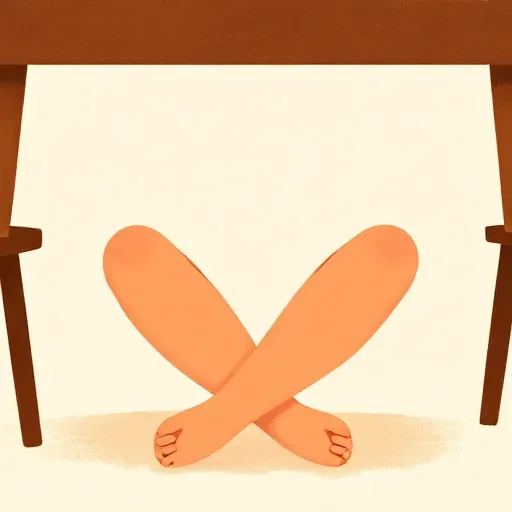
Normally, we learn about objects around us through our external senses: sight, hearing, touch. A rock, a bird, another person’s arm — we see them from the outside. But our own body gives us a second, private window: we feel it from the inside. This inside access includes proprioception (your sense of where your limbs are), balance, pain, hunger, and even the diffuse feelings of thirst or fatigue.
Brian O’Shaughnessy, writing in 1980, called the relationship between you and your body a “highly unusual relation.” After all, your body is a material object, like all the others, yet you experience it in a way you experience nothing else.
The most striking feature of this inside mode is something philosophers call immunity to error through misidentification. That’s a long name for a simple idea: when you know something about your body through these inner sensations, you can’t rationally wonder, “But is that body mine?” If you feel a pain in your thumb, you can’t doubt that it’s your thumb. By contrast, if you see a broken arm in a tangle of limbs after a sports pile-up, you might mistake someone else’s arm for yours (the philosopher Ludwig Wittgenstein pointed this out in 1958). Inner sensations don’t need an extra step of identification — they just arrive already marked as “mine.”
Gareth Evans, in 1982, argued that this immunity shows something deep: the self that owns these experiences is not a ghostly Cartesian ego, but a bodily thing. Yet others, like Sydney Shoemaker (1968) and Annalisa Coliva (2012), have questioned whether bodily immunity is truly as absolute as the immunity we have for our own mental states. In a wild thought experiment, what if a scientist wired your proprioceptive system to someone else’s leg? You might feel that leg’s position as if it were yours. Real illusions, like the rubber hand, suggest the boundary is not unbreakable.
Is Bodily Awareness Like Seeing or Like Knowing Without Looking?

If bodily awareness is so intimate, is it just another kind of perception — a “sixth sense”? Or is it something radically different?
The philosopher Elizabeth Anscombe (1919–2001) argued that knowing where your limbs are is not like seeing the sky is blue. She called it knowledge without observation. When you reach for your backpack, she said, ‘nothing shews him the position of his limbs’; you simply know, because you know how to move it. You don’t rely on a sensation that tells you that your arm is extended. It’s practical knowledge — knowledge in action.
Others push back. They point to bodily illusions: if a vibrating device is placed on your biceps tendon, you can “feel” your arm moving even though it stays perfectly still. That seems like a real, though misleading, sensation. So maybe bodily awareness is perceptual after all, just a strange kind.
Some, like Michael Martin (1992, 1995), insist that touch and proprioception form a genuine perceptual field — but one that presents just a single object: your own body. Others, like A. D. Smith (2002), say true perception requires being able to view an object from different angles, which you can’t do with your body from the inside. This debate remains lively, with no clear winner.
What makes the discussion especially modern is the discovery that our inner body senses constantly blend with vision. Ears and eyes work together. Your brain combines sights, sounds, and body-position signals automatically, often so fast you never notice. That blending — multimodality — blurs the line between the “pure” inside mode and the outside view. Our felt body is already shaped by what we see.
The Brain’s Map of Your Body

How does your brain keep track of all this? In 1911, neurologists Henry Head and Gordon Holmes proposed that the brain stores a body schema — a constantly updating model of your body’s shape, posture, and capabilities. Later, the surgeon Wilder Penfield (1950) mapped the brain’s touch area and found a bizarre “homunculus”: a twisted little man with huge hands and lips, because those body parts get extra brain territory for fine sensation and movement.
Philosophers like José Luis Bermúdez (1998) and Brian O’Shaughnessy argue that such mental representations are necessary. They explain why amputees can still feel a “phantom limb”: the brain’s map still includes the missing part. They also explain how someone with xenomelia can feel that a perfectly healthy leg doesn’t belong to them — the limb never got properly entered into the body map.
But not everyone agrees. Some thinkers, following the phenomenologist Maurice Merleau-Ponty (1945), say we don’t need an inner map. The body is “its own best model.” We simply pay attention to it when needed. The debate turns on whether you think the brain builds a picture of the body or whether the body just skillfully interacts with the world without needing one. A single body map, or many local maps for different tasks? There’s little agreement.
The Rubber Hand That Feels Like Yours
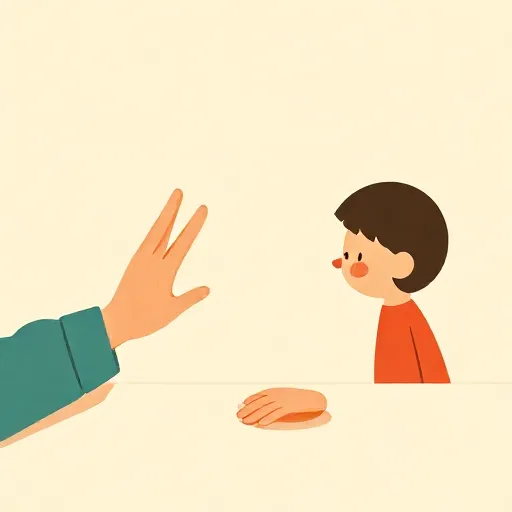
In the famous rubber hand illusion, a participant hides one hand under a table while a lifelike rubber hand rests on top. A researcher strokes both the hidden real hand and the visible rubber hand with paintbrushes in perfect sync. Within minutes, many people report feeling that the rubber hand is their own — and they even flinch when it’s threatened.
This illusion challenges the simplest theories about the sense of body ownership. According to a “deflationary” view (defended by Martin and Bermúdez), when you feel sensations in a body part, you automatically experience that part as yours. But here, touch sensations are referred to a piece of rubber, and you feel ownership for it. So the feeling of “myness” can’t just come from the sensations themselves.
Alternative views have sprung up. A cognitive conception (Alsmith 2015) says you experience a hand as yours only if you think of it as yours — the illusion is partly a trick of expectation. An agentive conception (Peacocke 2017) ties ownership to your ability to act: you feel a limb is yours because you know what it would be like to move it. An affective conception (Vignemont 2023) connects ownership to the body’s special value for your survival: you care about your own body in a way you don’t about other objects, and that unique threat response tells you it’s yours. Evidence shows that when the rubber hand is threatened, people’s arousal spikes — but not so in patients with somatoparaphrenia, who deny their own real limb belongs to them.
Which answer is right? None has won the day. The rubber hand is a simple experiment that keeps philosophers as busy as neuroscientists.
Why Your Body Matters to Being You

We usually take our bodies for granted. You wake up, stretch, feel the bed beneath you, and know without thinking that this is your body, here, alive. But philosophy shows that this ordinary miracle rests on a complex network of sensations, brain maps, and deeply personal attitudes of ownership and care.
Why does this matter for you? Because questions about bodily awareness are really questions about the self. Are you a thinking mind that merely pilots a fleshy vessel, like Descartes’ famous “pilot in a ship”? Or is your body part of what makes you you — so that losing your bodily feelings would change your very sense of identity? When you say “my arm,” the “my” is not like “my backpack.” You can’t just swap it out. The deep connection you feel is what philosophers are trying to understand.
Next time you close your eyes and touch your nose, pause to notice the inside feeling. You’ll find a whole invisible geography that is yours alone — and that, in a small way, you have begun to philosophize.
Think about it
- If a VR headset gave you a completely different digital body that you felt from the inside, which body would you say is truly “yours” — the physical one or the one you experience?
- Could someone ever have a body they feel is theirs but that they cannot control at all? What would that do to their sense of self?
- If you suddenly stopped feeling your stomach growl or your heart beat, would you still feel like a single, whole person? Why or why not?