Why Did a Cardinal Risk Everything to Defend Plato?
A Young Monk Changes His Mind at a Great Council
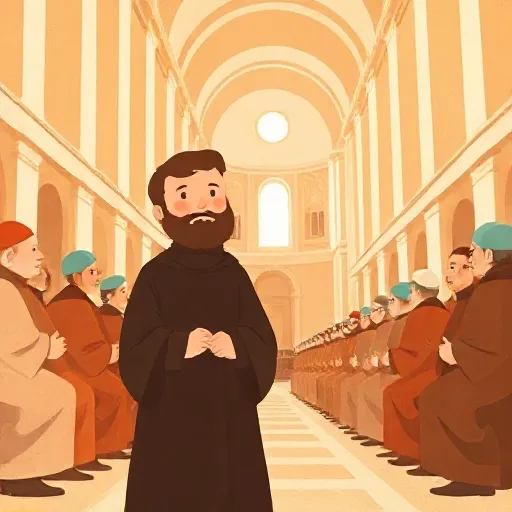
In 1438, a young Greek monk named Bessarion (born around 1400, died 1472) walked into a tense gathering in Ferrara, Italy. He was part of a delegation sent to heal a 400-year rift between the Christian churches of the East and West. The argument that had split them boiled down to a single Latin word: Filioque, meaning “and the Son.” The Greek church said the Holy Spirit came only from God the Father. The Roman church insisted the Spirit came from the Father and the Son. Bessarion arrived certain the Greeks were correct. He had even been trained in a tradition called Hesychasm, a contemplative practice that was deeply suspicious of the Latin way of doing theology.
But over the months of debate, something shifted. Bessarion read the writings of ancient Church Fathers carefully. He realized that their words could be understood to support the Latin position. In April 1439, he gave a speech arguing that Greeks and Latins actually agreed. That summer, he read the act of reunion aloud in Florence. Pope Eugene IV made him a cardinal. Bessarion would never live in Greece again — but he would spend the rest of his life trying to save its intellectual treasures.
Saving the Books That Could Have Been Lost Forever
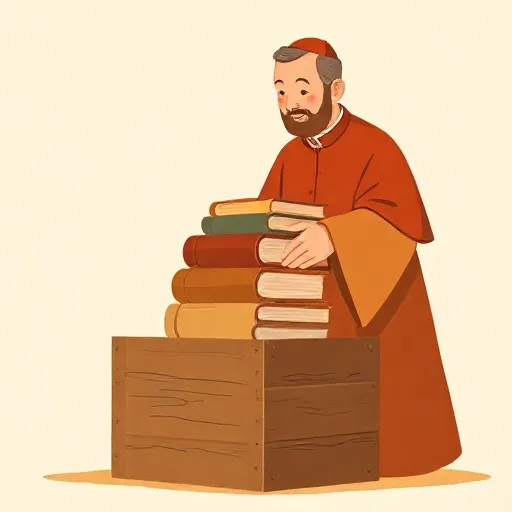
In 1453, the Ottoman Turks captured Constantinople, the capital of the Eastern Roman Empire. For Bessarion, the disaster was not just political — it was an emergency for knowledge. He had been collecting Greek manuscripts for years: works by philosophers, mathematicians, astronomers, and theologians that simply did not exist in Western Europe. Many survived only in the copies he managed to obtain. He wrote that “without books, the tomb would cover the names of men, just as it covers their bodies.” He was consumed with terror, he said, “lest all those wonderful books, the product of so much toil and study by the greatest human minds, those very beacons of the earth, should be brought to danger and destruction in an instant.”
Bessarion decided that Venice — a city built on water, with close ties to the Greek world — would be a safe harbor. In 1468, he donated his collection to form the first core of the Biblioteca Marciana, one of the world’s great libraries. His act of rescue meant that hundreds of ancient texts survived for future readers. But he also knew that books were only part of the struggle. Ideas themselves could be attacked, and soon one of the philosophers he most admired would need his defense.
The Slanderer of Plato: A Dangerous Attack
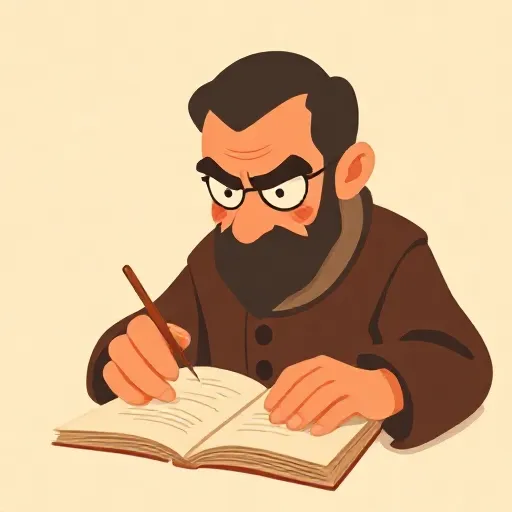
Around 1458, a humanist scholar named George of Trebizond (1395–1472) wrote a furious book called the Comparatio philosophorum Platonis et Aristotelis — a comparatio, or comparison, of Plato and Aristotle. He attacked Plato as ignorant, impious, and vicious, while praising Aristotle as the perfect model for Christian thinkers. George went further: he connected the rise of Plato’s ideas to the fall of the Byzantine Empire and prophesied that a “fourth Plato” — after Epicurus and the prophet Mohammed — would bring ruin to the Latin West. He did not name that fourth figure, but many readers suspected it was either Bessarion or Bessarion’s old teacher, Gemistos Pletho (d. 1454).
The attack was personal as well as philosophical. If Plato was an enemy of true religion, then a cardinal who loved Plato looked suspicious. Bessarion had no choice: he had to respond, not just to protect his own reputation but to argue that ancient Greek philosophy could be a genuine ally for Christian faith.
Bessarion’s Secret Strategy: Plato and Aristotle Can Agree

Bessarion spent about ten years crafting his masterwork, the In calumniatorem Platonis — “Against the Slanderer of Plato.” He first wrote it in Greek, then translated it into Latin and had his secretary Niccolò Perotti polish the style. He also took advantage of the new printing press, publishing the finished work in 1469 to ensure it spread widely.
The core of Bessarion’s argument was a brilliant reconciliation. He claimed that Plato and Aristotle did not truly disagree. Instead, Aristotle was a natural philosopher who studied the physical world, while Plato was a theologian who wrote about higher, spiritual realities. Apparent contradictions between them were just matters of viewing things at different levels. This move let Bessarion defend Plato without directly attacking Aristotle — a wise choice, since many powerful thinkers in the Roman Church were devoted Aristotelians.
He filled six books with evidence. The first book proved Plato’s wisdom, showing that ancient authors and Church Fathers considered him sublime. The second book tackled piety: Bessarion argued that Plato’s ideas about creation, the soul, and matter were closer to Christian teaching than George had claimed. For example, he explained Plato’s talk of souls being reborn — metasomatosis — by treating it as an allegory, a story with a hidden spiritual meaning. The third book exposed George’s ignorance of Aristotle himself, revealing that Aristotle never actually taught the Christian doctrines George attributed to him. The fourth book defended Plato’s moral character, giving a spiritual interpretation of love from the Symposium and Phaedrus and arguing that the collapse of the Greek Empire was a natural cycle, not a punishment for reading Plato. The fifth book listed translation errors in George’s Latin version of Plato’s Laws, painting him as incompetent. The sixth, written earlier, explored how nature and art relate — and it was the first place Bessarion openly stated his view that the two philosophers could be harmonized.
Throughout, Bessarion drew on Scholastic authorities like Thomas Aquinas and Albert the Great — the very tradition George claimed to champion — to show that even Aristotle’s greatest followers did not see Plato as an enemy.
Why a Five-Hundred-Year-Old Quarrel Still Speaks to You

Bessarion did not live to see the full impact of his work. He died in Ravenna in 1472, still trying to convince European rulers to send a crusade to free Greece. But his defense of Plato helped shape the Renaissance. Thinkers like Marsilio Ficino used his arguments to build a bridge between ancient philosophy and Christian faith. Even university professors who disagreed about the soul found ammunition in his book.
The deeper lesson, though, is not just about Plato. Bessarion’s story shows what it looks like to take ideas seriously enough to rescue them. He believed that books matter so much that they are worth saving from literal fire. He also believed that sharp disagreements — like the one between the Greek and Latin churches, or between lovers of Plato and lovers of Aristotle — don’t have to end in enemies. When he found evidence that changed his mind at the Council of Ferrara-Florence, he did not dig in his heels; he revised his thinking. That takes courage, especially when powerful friends might turn against you.
Today, you might never hold a 1,000-year-old manuscript in your hands. But you will face moments when two things you care about seem to clash — your faith with science, your family’s views with your own experience, or the ideas of two people you admire. Bessarion’s gamble suggests that understanding might be possible on a deeper level, if you’re willing to read, to compare, and sometimes to change your mind.
Think about it
- If you could save only five books from a disaster that would destroy all others, which ones would you choose and why?
- Is it possible for two very different philosophers to both be right about the same big question, or does one of them always have to be wrong?
- Bessarion changed a deeply held belief after studying old texts. Can you think of a time you changed your mind about something important? What convinced you?