What If Your Mind Is Just What You Do? The Behaviorist Gamble
A Rat, a Lever, and a Revolution
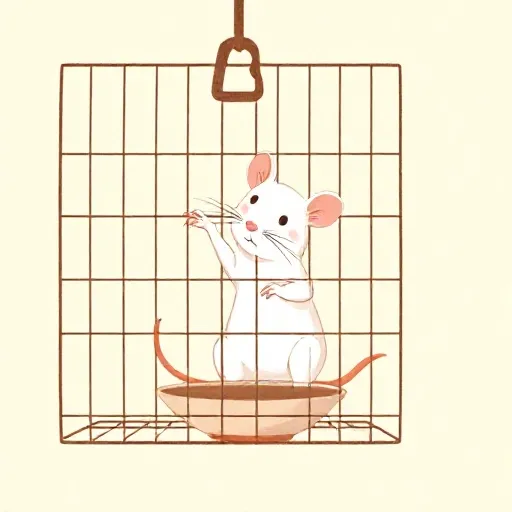
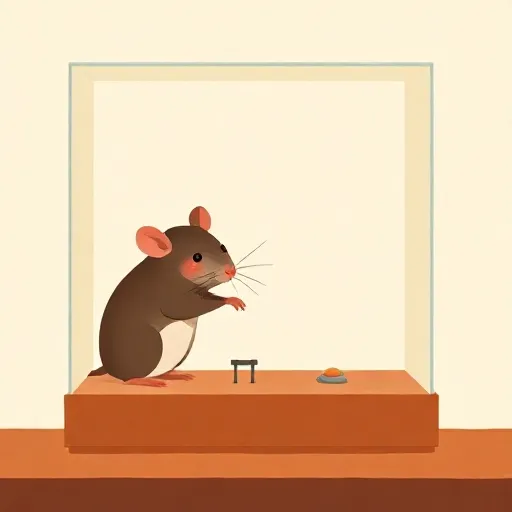
Imagine a hungry rat in a glass box. Every time a tiny light clicks on and the rat presses a metal lever, a food pellet drops into a tray. At first the rat explores. Soon it learns: when the light is on, pressing the lever means food. The rat does it again and again. No one asks what the rat is thinking. The behavior alone tells the story.
This real experiment, performed by B. F. Skinner (1904–1990) in the mid‑20th century, lies at the heart of a radical idea called behaviorism. Behaviorism, as a strict doctrine, says that psychology—the science of mind and action—should explain everything people and animals do without pointing to hidden inner states like beliefs, desires, or feelings. The only thing we can truly observe and measure is behavior, and the only proper explanations are those that link what an organism does to what happens in its environment.
Behaviorism wasn’t just a method. It was a bold gamble: try to build a complete science of the mind while refusing to talk about the mind itself. For decades it dominated psychology. It launched therapies, designed classrooms, and even imagined ideal societies. But it also set off one of the liveliest fights in the history of thinking about who we are.
Three Ways to Be a Behaviorist

The doctrine of behaviorism came in three flavors, each with its own focus.
Methodological behaviorism is about the rules science should follow. Its champion, John B. Watson (1878–1958) , argued that psychology must be a purely objective natural science, just like physics or chemistry. Psychologists should study only visible behavior in humans and animals. Talk of inner thoughts or feelings, Watson said, adds nothing useful—those things are private and can’t be checked by anyone else. The goal is to predict and control behavior given a known stimulus.
Psychological behaviorism is a research program that explains behavior using external physical events, learning history, and outcomes. Think of Skinner’s rat. The light is a stimulus. Pressing the lever is a response. The food is a reinforcement—it makes the response more likely to happen again in the future. This process of learning through consequences is called operant conditioning. Psychological behaviorism says that all behavior, from a pigeon’s peck to a human’s skill at chess, can be understood as webs of stimuli, responses, and reinforcements built up over a lifetime.
Analytical behaviorism (also called logical behaviorism) is a philosophy about the meaning of mental words. When you say, “Maya believes it will rain,” you are not pointing to a secret inner picture inside Maya’s head, according to the analytical behaviorist. You are really describing how Maya is likely to act: she’ll grab an umbrella, close a window, or warn a friend. The philosopher Gilbert Ryle (1900–1976) argued that talk of minds is just a way of talking about patterns of behavior and dispositions to behave. To attribute a mental state to someone is to describe how they would behave in various situations.
These three strands sometimes blend. Skinner’s own “radical behaviorism” tried to combine all of them: ignore the inner, explain by environment and reinforcement, and translate any remaining mental talk into behavioral terms.
Why Behaviorism Looked Like the Future

For a long stretch of the 20th century, behaviorism seemed almost unstoppable. Why?
First, it made evidence the star. To know whether someone really believes something, you look at what they do. If two people act exactly the same way in every possible situation, is there any evidence that one believes something the other doesn’t? For the behaviorist, the answer is no. Warrant for attributing a mind state comes entirely from behavior. And if a belief just is a set of behavioral tendencies, then mental life becomes as public and measurable as a rat’s lever press.
Second, behaviorism was deeply anti‑nativist. Many theories of mind assume that we are born with some built‑in knowledge or rules for learning—a kind of mental starter kit. Behaviorists rejected that. For Skinner, learning is simply what an organism does when it bumps into the world and gets feedback. Rules, he said, are derived from experience, not planted in the brain ahead of time. This appealed to thinkers who wanted a lean, experience‑based picture of how we become who we are.
Third, behaviorism promised to avoid a frustrating loop. Suppose you try to explain why Layla screamed at the spider by saying she represented the spider as dangerous or thought “That’s scary!” The critic, including Skinner, would object: you are explaining one piece of behavior (the scream) by pointing to another piece of behavior (the inner act of classifying or thinking), which itself needs explaining. Where does the chain stop? Behaviorism aimed to stop it in the environment, not inside a mental black box that merely copies the outer world in a hidden form.
These reasons—clarity about evidence, a learning story without inborn rules, and a fear of circular explanation—made behaviorism enormously popular among psychologists and philosophers for decades.
The Case Against: Three Big Problems

Behaviorism didn’t go unchallenged. Three problems, especially, chipped away at its empire.
The first problem is representation. When you walk toward an object you see as an ice‑cream cone, your behavior isn’t just a direct reaction to the light hitting your eyes. It’s shaped by how you see it. If you don’t represent the thing as ice cream—if you think it’s a weird sponge—you won’t reach for it, no matter how many times you’ve been reinforced for eating ice cream in the past. The environment matters only as you interpret it, and interpretation seems to require inner processing that behaviorism wanted to outlaw.
The second problem is qualia—the raw, felt quality of experience. To be in pain is not simply to wince, moan, and pull your hand away. There’s a like‑thisness to pain that can’t be captured just by listing behaviors. A creature could, in theory, produce exactly the right pain‑behavior while feeling nothing at all. If the what‑it’s‑like part of pain is real, behaviorism misses something huge about the mind. The philosopher‑psychologist U. T. Place (1924–2000) argued that these felt qualities are not dispositions to act; they are instant happenings that underlie our tendencies to behave.
The third problem came from linguistics. Noam Chomsky (born 1928) , in a famous review of Skinner’s book Verbal Behavior, showed that behaviorist principles can’t easily explain how young children master language. By age four or five, a typical child can produce and understand sentences she has never heard before, without step‑by‑step reinforcement for each new word or phrase. The environment simply doesn’t provide enough reward or practice to account for the explosion of linguistic ability. Chomsky argued that the human mind must contain an inborn, abstract grammar—a mental system that generates language. If behaviorism can’t handle the most creative, most human of behaviors, something must be wrong with it.
These criticisms didn’t destroy behaviorism overnight, but they pushed it from the center stage. The idea that you can explain all of human life without talking about internal representations, inner experience, and innate structure began to look too restrictive.
Why a Rat’s Lever Press Still Matters

So behaviorism lost its throne. But it never disappeared. The rat in the box still has lessons for us.
Behaviorist habits survive every time a therapist helps someone overcome a fear by gradually facing it and being rewarded with a sense of safety. They live on in the token economies that help people build skills, and in the self‑reinforcement strategies you might use to finish your homework before gaming. The core question behaviorism raised—How much of what we do can be explained without peeking inside the head?—remains a live puzzle.
And the battle isn’t over. Neuroscientists who study how rewards sculpt the brain’s wiring often walk in Skinner’s footsteps, even if they now talk about inner representations. The emerging field of neuroeconomics, for instance, examines how brain systems assign value to choices, blending behaviorist experiments with high‑tech imaging. Behaviorism forced us to be honest about what counts as real evidence, and that discipline still sharpens every debate about thinking, feeling, and choosing.
When you reach for your phone because a notification buzzed, or when you study harder after a good grade, you’re acting in ways that a strict behaviorist could describe with nothing but stimuli, responses, and reinforcement. Whether that description captures everything about you—whether you are more than a bundle of habits shaped by your history—remains one of the deepest, most personal questions you can ask. The lever presses; you decide what it means.
Think about it
- If a scientist could predict everything you’ll ever do based on your past rewards and environment, would you still feel that your choices are truly free?
- Can you imagine a way to tell if your pet feels pain as you do without relying on what it does—its squeaks, flinches, or cuddles?
- Suppose a friend tries to explain your entire personality by listing your habits. What would that list miss about who you really are?