Is Beauty a Secret Code in Things — Or Just a Feeling?
Two Friends, One Song

Last week you and your friend argued about a song. You said it was the most beautiful thing you’d ever heard. Your friend pulled off her headphones and said, “It sounds like a broken dishwasher.” Who was right? That little fight is the same one philosophers have been having for over two thousand years. The question is whether beauty is objective — a real feature of the thing itself, like its shape or size — or subjective — just a feeling inside you, like ticklishness or a favorite flavor. If beauty is objective, then your friend is simply wrong. If it’s subjective, then you’re both right and there’s nothing more to say. But things get messy fast, because we often argue as if beauty were objective, yet we also accept that people have different tastes. This puzzle matters far beyond music: it shapes who gets called beautiful, who feels invisible, and how we see ourselves.
The Classical Code: Beauty by the Numbers
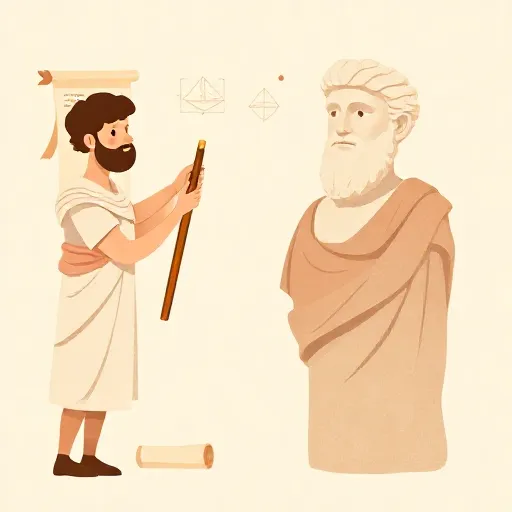
For a long time, many thinkers treated beauty as an objective quality, a kind of hidden code. The ancient Greek sculptor Polykleitos (5th/4th century BCE) created a statue called the Canon to demonstrate perfect bodily proportions. He also wrote a now-lost book explaining exactly how long each finger should be relative to the hand, the hand to the wrist, the wrist to the forearm, and so on. The idea was that beauty could be achieved by reproducing the right mathematical ratios, especially the golden section — a ratio of about 1 to 1.618 that appears in nature and was thought to be especially pleasing. The philosopher Aristotle (384–322 BCE) captured this classical conception when he wrote that beauty requires “order and symmetry and definiteness.” The Roman architect Vitruvius listed proportion, symmetry, and harmony as the ingredients of a beautiful building. The universe itself seemed to be arranged by these invisible rules.
But critics poked holes in the mathematical recipe. The Irish thinker Edmund Burke pointed out that a swan has a very long neck and a short tail, while a peacock has a short neck and a giant fan of a tail — yet both are considered stunning. A rose and an apple blossom have completely different shapes, but nobody says one is ugly. If beauty were one fixed formula, every beautiful thing would have to follow the same measurements. Since nature cheerfully ignores any single recipe, many philosophers concluded that beauty cannot be just a code in objects.
Hume’s Turn: Beauty Moves Inside You
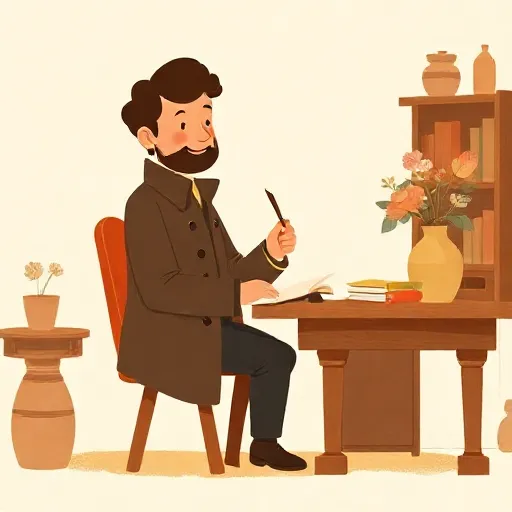
By the 1700s, a dramatic shift was underway. Thinkers influenced by the new science of the day began to treat beauty not as a property of things but as a sentiment in the perceiver. The Scottish philosopher David Hume (1711–1776) wrote bluntly: beauty is not a quality in the things themselves; it exists only in the mind that contemplates them. What you call “beautiful” is really a description of your own pleasure. If no one were around to feel delight, there would be no beauty — just as a world without eyes would have no colors. This makes intuitive sense when you notice how differently people react. The same sunset that fills you with awe might leave someone else bored; the painting your friend loves might look like a mess to you.
But Hume didn’t stop there. He saw that we do argue about beauty, and we often respect some people’s taste more than others. That’s the antinomy of taste: taste seems completely personal, yet we treat it as if it can be better or worse. Hume’s solution was to shift the focus from the object to the critic. A good judge of beauty, he said, needs “strong sense, united to delicate sentiment, improved by practice, perfected by comparison, and cleared of all prejudice.” Over time, the agreement of such prepared critics — the people who have looked widely, thought carefully, and set aside their quirks — becomes the practical standard of taste. So while beauty is still a feeling in you, not every feeling carries equal weight.
Kant’s Balancing Act: A Feeling That Speaks for All
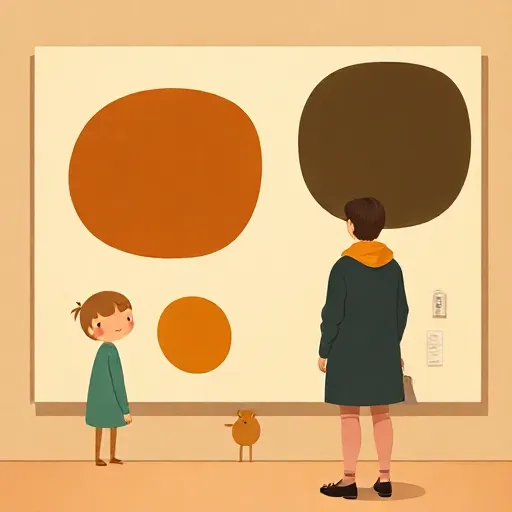
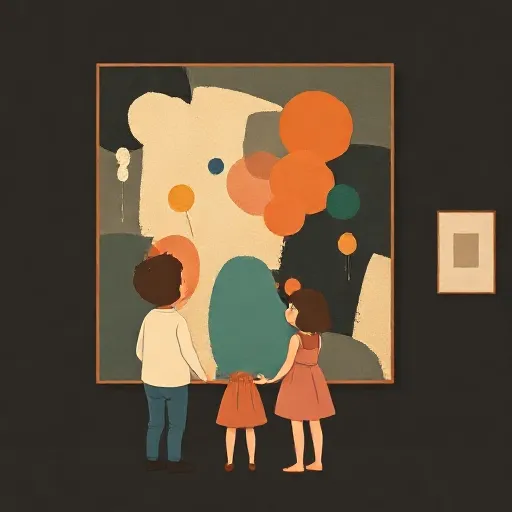
The German philosopher Immanuel Kant (1724–1804) also started with the idea that beauty is subjective — you must feel the pleasure directly, and no logical proof can force you to find something beautiful. But he noticed an important difference between merely liking something and calling it beautiful. You might enjoy a song because it reminds you of a happy holiday, but that’s a private, interested pleasure: it’s about you and your memories. Kant argued that a genuine judgment of beauty is disinterested. When you experience something as beautiful, you don’t care whether you own it, whether it’s useful, or even whether it actually exists. You are simply taking pleasure in its form — the way its lines, colors, shapes, or sounds are arranged for their own sake.
Because you are not responding to anything peculiar to you — no hunger, no plan to sell the painting, no personal nostalgia — you feel that anyone else in the same situation ought to have the same experience. Built into the judgment “this is beautiful,” Kant said, is a quiet universal claim: everyone similarly situated should agree. That doesn’t mean they always will, but it explains why we bother to argue about art and why we find other people’s taste puzzling when it’s wildly different. For Kant, beauty is neither a cold objective fact nor a purely private mood. It is a feeling that reaches beyond itself, trying to speak for a whole community.
Beauty as a Weapon and a Shield

These philosophical questions are not just abstract puzzles. For centuries, specific standards of beauty have been used to control and exclude. Many feminist thinkers have shown how norms of “beauty” often objectify women, treating their bodies as things to be looked at rather than as full persons. The writer Naomi Wolf, in her 1991 book The Beauty Myth, described how images in advertising and film hammer home impossible ideals that can lead to eating disorders and low self-worth. Racial standards of beauty have also done deep harm. The Black nationalist leader Marcus Garvey (1887–1940) pointed out that European beauty ideals made Black people feel they had to lighten their skin or straighten their hair to be considered attractive. Malcolm X (1925–1965) recalled painfully “conking” his hair with lye as a young man, calling it a step toward self-degradation. Beauty, in these cases, was a weapon of oppression.
Yet the same force can be turned around. In the 1960s and 1970s, the Black Power movement celebrated the slogan “Black is beautiful,” rejecting white standards and honoring natural hair, darker skin, and African aesthetics. Disability arts movements have challenged the idea that only certain bodies can be beautiful, showcasing dancers and performers whose bodies don’t follow old rules. Feminist artists have reclaimed the female form on their own terms, creating art that speaks from inside the experience rather than for an outside gaze. Beauty, it turns out, is something groups can reshape when they refuse to accept narrow definitions.
This is where the old philosophical puzzle touches your own life. Every time you scroll through social media or watch a movie, you run into images of what “counts” as beautiful. The pressure is real, but so is the power to ask: “Says who?” Hume and Kant were right that we share and argue about beauty — and in that arguing, we build communities of taste. The debate over what beauty is and who gets to define it is not a dusty museum piece. It’s happening in your school hallway, in the clothes you choose, and in the way you see your own reflection.
Think about it
- If everyone in your class agreed that a certain movie was beautiful but you found it boring, would you be wrong? Why or why not?
- Imagine a world where nobody ever argued about what’s pretty or ugly. Would anything important be lost?
- Can an object be beautiful if making it harmed people? Does that change how you see its beauty?