Can You Really Be Yourself? The Surprising History of Authenticity
The Mask You Wear at Lunch

It is lunchtime at school. Your friends are arguing about a video game you do not really care about. You laugh at a joke you do not find funny. Inside, you would rather be sketching a comic or reading a book. But you say nothing, because you want to belong. Later, you feel a small, quiet ache — as if you betrayed someone. But who? Maybe you feel like you were not really being yourself.
This feeling is old. In the past few hundred years, thinkers gave it a name: authenticity. To be authentic is to be true to yourself, to act from what really matters to you instead of just following the crowd. Today, we hear “just be yourself” everywhere. But what does that actually mean? And is it always good advice? The story of authenticity is a story about masks, freedom, and a big fight among philosophers that is still going on.
The idea took shape in Europe during the 1600s and 1700s. Before that, being a good person mostly meant being sincere — honestly playing the role society gave you. If you were a baker, you tried to be an honest baker; if you were a princess, you tried to be a virtuous princess. Sincerity meant not pretending to be different from what your social position demanded. Your identity came from your place in a larger whole, like a piece in a puzzle.
But something shifted. People began to see themselves more as unique individuals than as placeholders in a system. Autobiographies and self-portraits exploded in popularity. A new awareness of inwardness — an inner space that is just yours — spread through the culture. The philosopher Jean-Jacques Rousseau (1712–1778) became one of the loudest voices for this inner self. He believed that modern society forces us to wear masks through endless competition and role-playing. To find out who you really are, he wrote, you must turn away from the noisy public stage and listen to a voice inside you. In his novel The New Heloise, characters who ignore their deepest feelings pay a terrible price: they become strangers to themselves.
Over time, the old virtue of sincerity — being truthful to others so society runs smoothly — gave way to the new ideal of authenticity, understood as being true to yourself for your own sake. It was not just a strategy for getting along; it became something worth choosing all by itself.
The Philosopher Who Wanted You to Own Your Life

By the 1800s, the Danish thinker Søren Kierkegaard (1813–1855) saw a problem. He looked at the modern world and saw people living like interchangeable parts, all blending into a “crowd.” In that state, he argued, we fall into a quiet despair. We drift through life without ever truly becoming ourselves.
Kierkegaard’s solution was not to sit alone and search your feelings. He thought the self is not a thing but a relation — a project you build over time through passionate commitment. To “become what one is,” you must care deeply about something outside yourself, something that gives your life direction and meaning. For Kierkegaard, that ultimate something was his relationship to God. The point is not what you commit to, but that you commit with your whole heart and shape your life around it. Without that, you remain hollow.
The German philosopher Martin Heidegger (1889–1976) gave authenticity an even more intense makeover. He invented a word, Eigentlichkeit, which literally means “ownedness” — as if your life is something you own rather than just rent. He believed that we are not objects with fixed properties. Instead, a human being is a being whose existence is always at stake for them. We care about who we are. In living our lives, we are constantly taking a stand on what kind of person we will be — even if we do not realize it.
But most of the time, Heidegger said, we let society make those choices for us. We absorb what “one does” from the people around us — what he called the They. You become a They-self when you uncritically follow the norms of your friends, your school, or your culture without ever asking if those norms fit you. This is not evil; it is the easy, everyday way of living. Heidegger called it falling. We drift along, distracted.
Then, once in a while, a jolt can wake you up. Heidegger pointed to three experiences. First, anxiety: a sudden sense that the world you leaned on feels meaningless and empty, and you are completely alone with no external supports. Second, the awareness of your own death, the possibility that all possibilities will end, which sharpens the question of what you are doing with your life. Third, the call of conscience, which tells you that you owe yourself something — you are falling short of what you could be.
An authentic life, for Heidegger, is one where you own your choices with resoluteness. You do not just pick a path; you hold steady to it, day after day, with clear-sighted commitment. It is not about your inner feelings or desires being “pure” — it is about the steadiness and integrity with which you live out your life-project. Authenticity becomes a kind of backbone virtue that makes real moral agency possible.
Sartre’s Warning: You Cannot Escape Bad Faith
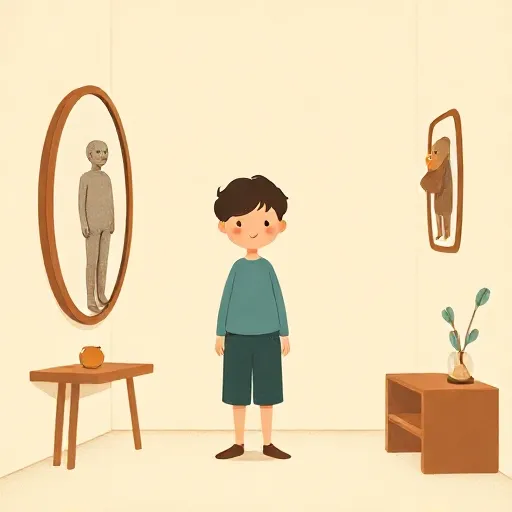
The French thinker Jean-Paul Sartre (1905–1980) took these ideas in a bracingly honest direction. He said human life is torn between two sides. On one side is facticity: the sheer given facts about you — your body, your past, your social circumstances, the cards you have been dealt. On the other side is transcendence: your power to step back from those facts, interpret them, and choose what to make of them. You are never simply a finished thing. You are always a freedom that reaches beyond what you already are.
But this freedom terrifies us. So we often hide from it. Sartre’s famous diagnosis is bad faith — a kind of self-deception where you pretend you are just a thing with a fixed nature. For example, you tell yourself, “I’m just a shy person, it’s how I am,” as if that fact were written in stone, denying that you could shape yourself differently. Or you convince yourself that you have no choice, when really you are simply refusing to face the anxiety of choosing. Bad faith is lying to yourself about your own freedom.
The tricky part is that Sartre also argued we can never fully escape bad faith. If you try to become completely solid and certain — to believe with absolute “good faith” — you are still denying your inescapable ability to question everything. There is always a gap between your commitments and you. That gap is freedom. So Sartre suggested that authenticity might not be about achieving some perfect state, but about lucidly accepting the ambiguity. He wrote that authenticity means “having a true and lucid consciousness of the situation, in assuming the responsibilities and risks it involves.” You see that you are both facticity and transcendence, both constrained and radically free, and you take responsibility for that tension without pretending it will ever resolve.
Simone de Beauvoir (1908–1986) built on Sartre’s picture and gave it a social heart. She argued that willing your own freedom only makes sense if you also will the freedom of others. If you are an engaged freedom — always already caught up in the world — then being authentic cannot mean retreating into solitary self-regard. It means acting in the world with clarity and courage, while recognizing that your freedom is bound up with everyone else’s. An authentic person, for Beauvoir, fights for a future where all people are free to become what they choose.
The Dark Side of “Being Yourself”

Not everyone cheered. From the start, critics warned that the ideal of authenticity could turn sour. If all that matters is your inner voice, what prevents you from becoming self-absorbed? The cultural critics Christopher Lasch and Allan Bloom argued in the 1970s and 80s that a culture obsessed with authenticity was breeding narcissism — people who are so focused on their own feelings that they lose empathy, altruism, and any sense of a shared public good. The quest to “be yourself” could make you narrow and self-centered.
A deeper worry came from thinkers like Theodor Adorno and Michel Foucault. Adorno (1903–1969) charged that the talk of inner depth and true selfhood was often just a fancy way of hiding conformity. The jargon of authenticity, he thought, covered up the fact that people were still obeying social powers without realizing it. Foucault (1926–1984) went further: he argued there is no hidden authentic self waiting to be discovered. The self is something we create, like a work of art, not a buried treasure we dig up. The idea that you have an “essential” core that is true and good is a myth. If we are always making ourselves up, then “authenticity” might just be whatever feels right to you in a given moment — a thin and fragile guide.
There is also a darker view of human nature lurking behind these critiques. What if your inner self is not kind? Friedrich Nietzsche (1844–1900) and Sigmund Freud (1856–1939) suggested that our inner lives contain violence, disorder, and unreason as much as generosity. If that is true, then an ethic that simply tells you to follow your deepest drives could be dangerous, not liberating.
Can Authenticity Be Saved? And Why It Still Matters

Many recent philosophers think authenticity is worth saving, but only if we understand it in a richer, more social way. The Canadian thinker Charles Taylor (born 1931) argues that the original ideal of authenticity was never meant to be about doing whatever you feel like. It contained a crucial element of self-transcendence — reaching beyond your own narrow desires and connecting to something worthy. For Taylor, you cannot define what really matters to you all by yourself. Meaning comes from “horizons of significance,” a background of shared values and languages that a community provides. Being authentic means finding your own voice, but that voice can only make sense against a larger conversation about what is good. Without those horizons, authenticity collapses into meaninglessness and a hollow “self-determining freedom” that actually makes life flatter.
Alessandro Ferrara takes a different route. He sees authenticity as self-congruency — a harmony between who you are and the life you live. This harmony, he thinks, can serve as a new kind of universal standard that does not depend on rigid rules but on exemplary ways of being human. It is like looking at a life as a beautiful, coherent story. Similarly, Charles Guignon (1944–2020) insists that authenticity is a fundamentally social virtue. Being authentic does not mean retreating from the public world; it means having the courage to be clear about your convictions and express them openly — exactly the kind of trait a healthy democracy needs. In that view, to be authentic you must also care about maintaining a society where such honesty is possible.
So what does all this mean for you, right now? In a world of social media, curated selfies, and pressure to fit in, the demand to “be authentic” is everywhere. But the philosophers’ centuries-long wrestling match shows that there is no simple answer. Authenticity might mean listening to your inner voice, but also questioning whether that voice is really yours. It might require courage to stand apart from the crowd, but also the humility to recognize that you need others to even have a self. Perhaps the most honest thing you can do is not to claim you have found the real you, but to keep asking the question — with resoluteness, with charity, and with a willingness to take responsibility for the person you are becoming.
Think about it
- If your deepest desire right now is to do something that hurts someone else, does “being true to yourself” still sound like good advice? Why or why not?
- Can you be authentic while also trying hard to fit in with a group — or are those goals in permanent tension?
- Think about the version of you that shows up in your social media posts compared to the you that lies awake at night. Which one is more real? What makes you say so?