

Can You Build a Perfect Country with Pure Reason?
When France Decided to Start Over
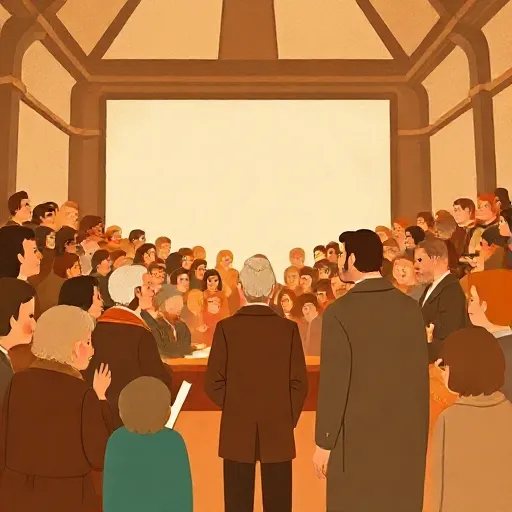
In 1791, the National Assembly in Paris buzzed with excitement. The old monarchy had collapsed. Now the deputies were designing a brand‑new government for France. They spoke of reason, liberty, and equality. Many believed that pure reason could tell them exactly how to build a perfect state—just as a mathematician solves a problem. But in the German town of Hannover, a quiet civil servant named August Wilhelm Rehberg (1757–early 1800s) watched with growing alarm. He thought the whole project was a dangerous mistake.
Rehberg wasn’t a royalist who wanted to bring back the king’s absolute power. He agreed that France needed reform. But he was a skeptic—someone who doubts that reason can give us the kind of certainty the revolutionaries claimed. He believed you can’t design a country from scratch. Something essential was missing: the weight of history, the slow wisdom of tradition, and a certain skill called judgment. His opposition to the French Revolution launched a life‑long battle of ideas, including a famous clash with the philosopher Immanuel Kant.
A Teenager Who Doubted Metaphysics

Rehberg was born in 1757 into a middle‑class Protestant family in Hannover. He was a brilliant student. Before he turned fifteen he could read Greek, Latin, French, English, Italian, and Spanish. He attended the University of Göttingen but was bored by the popular philosophy of the day. So he educated himself, diving into the works of Leibniz and Spinoza.
By the age of fourteen, Rehberg had stopped believing in Christianity. He became a lifelong unbeliever, but that was only the beginning. He soon questioned all of metaphysics—the branch of philosophy that asks what reality is really like, beyond what our senses show us. He thought every grand metaphysical system, whether Leibniz’s or Spinoza’s, rested on shaky first principles that could never be proved. His skepticism deepened in the 1780s during an intellectual firestorm called the Pantheism Controversy. To Rehberg, that debate showed that pure reason cannot decide between a godless universe and a personal God—so perhaps reason is useless for answering the biggest questions.
Two thinkers became his guides. David Hume (1711–1776), the Scottish philosopher, showed how skepticism could actually serve a conservative political cause: if reason can’t settle everything, we should be cautious about tearing down established institutions. And Immanuel Kant (1724–1804) gave Rehberg powerful tools. Rehberg agreed with Kant’s teaching that our knowledge is limited to what we can experience through our senses—we can never know things as they are in themselves. But Rehberg parted ways when Kant tried to extend morality into politics. Kant thought pure reason could supply the one true principle of right. Rehberg thought that was exactly the kind of overreach that led revolutionaries astray.
Why Reason Can’t Draw a Map for Government

The French radicals believed that the principles of pure reason could tell them exactly what laws to write and what institutions to create. Rehberg called this hyperrationalism: the idea that pure reason, all by itself, can provide a blueprint for society. He thought this was the central fallacy of the Revolution. Reason, he said, can give us the most general moral rules—like “treat people fairly” or “don’t harm others.” But it can’t tell us which specific laws make a country just in the real world. Should we have a king or a president? Should property be inherited? How should taxes work? Reason alone doesn’t answer.
So what bridges the gap between broad principles and concrete decisions? Rehberg’s answer was judgment. Judgment is the mental skill that lets you apply a general rule to a messy, particular situation. It’s like knowing how to ride a bike: a rulebook on balance won’t keep you upright; you develop a feel for it through experience. In politics, judgment comes from age, experience, and sometimes technical expertise. The French revolutionaries, in Rehberg’s view, had too much faith in reason and not nearly enough in judgment. They thought each principle automatically contained the instructions for applying it—as if “all citizens are equal” told you precisely how to organize a legislature.
Because reason can’t dictate the shape of government, Rehberg argued, we should respect tradition. A country isn’t a blank whiteboard. It’s the product of centuries of trial and error. The customs, laws, and institutions that survive have likely adapted to local circumstances. To bulldoze them all is to throw away the hard‑won wisdom of your ancestors. Rehberg even insisted that children inherit duties and obligations from their parents—without this, no state could last long. If every generation could start from zero, who would keep any promise? He didn’t think traditions should never change; he only said change should come slowly, from wise reform, not from a wrecking ball.
This led him to defend an unequal society. Rehberg believed in aristocracy—not nobility of birth alone, but rule by the most talented and experienced people. He feared that full democracy would turn into mob rule, and that extreme equality ignored real differences in people’s abilities. In his ideal, the old German Stände (representative bodies) would be reformed so educated commoners could join, but property owners still held the vote. It was a modest, conservative path—not turn back the clock, but evolve toward something like the British Parliament.
The Showdown with Kant: Can Morality Alone Govern a Nation?

In 1793 Immanuel Kant published a famous essay claiming there is no gap between theory and practice in politics. Reason, he argued, is practical not just in private morality but in public life. Using his famous categorical imperative—act only on principles that could become universal laws—Kant maintained that pure reason supports a republican constitution with freedom, equality, and independence for all citizens. This was a direct challenge to Rehberg’s whole position.
Rehberg fired back in 1794. He agreed with Kant that the basic principle of morality comes from reason alone, not from experience. He even praised Kant for showing that the rule “act so that your maxim could be a universal law” is purely rational. Then came the big disagreement. Rehberg argued that the categorical imperative is formal—it’s like an empty test that many different maxims can pass. It tells you to be fair and universal, but it doesn’t tell you what counts as fair in concrete cases. Imagine two tax policies: one taxes the rich heavily, the other taxes everyone equally. Both could be universalizable, but which is correct? The categorical imperative doesn’t pick; you need to look at consequences, history, and what fits a particular society.
Rehberg also pointed out that Kant’s principles assume people can live independently without relying on each other. But in reality, we depend on others just to survive. That dependence means a ruler has to care about utility and not just abstract rights. Sometimes, he said, even utility can’t decide—then we must fall back on tradition and convention. For Rehberg, Kant’s attempt to make pure reason the sole guide for politics failed. The gap between theory and practice remained wide open. The work of deciding specific laws and constitutions must be done by experienced judgment, weighing utility and respecting the historical ground beneath our feet.
What Rehberg Left Behind: The Power of History

Rehberg wasn’t just a critic of the French Revolution. He became a founding figure of historicism—the idea that each nation’s laws, customs, and values grow organically out of its unique history, like a plant from its soil. Historicists argued that you can’t judge one culture by the standards of another, and you can’t wipe the slate clean and start from abstract principles. Rehberg’s most famous heir in this tradition was Friedrich Savigny, the founder of the historical school of law, who praised Rehberg’s resistance to the Napoleonic legal code that France tried to impose on Germany.
Today, we still live with the tensions Rehberg explored. When people argue about whether to rewrite a constitution from scratch, or whether to respect long‑standing traditions even when they seem unfair, they’re replaying his debate with the radicals. Should we use pure reason to design a better voting system, or trust the one that’s evolved over centuries? Should we prize expert judgment over direct democracy? Rehberg’s answer—to walk a middle path, reforming slowly with an eye on history—remains one powerful voice in that conversation.
His skepticism about hyperrationalism is also a warning. It reminds us that no matter how smart our theories are, real life is messy. Solving social problems isn’t like solving an equation. And that’s okay: judgment, experience, and respect for the past are real strengths, not weakness.
Think about it
- Imagine a group of students redesigns their school’s rules from scratch using only logic. What could go wrong? What might they miss?
- When a tradition seems unfair—like an old rule that only certain families can hold power—how should a society decide whether to change it slowly or quickly?
- If politics requires judgment and expertise, should we trust political decisions to a small group of trained experts, or does that risk ignoring the voices of ordinary people?