Is the Mona Lisa Just a Canvas, or Something Else?
The Painting and the Perfect Copy

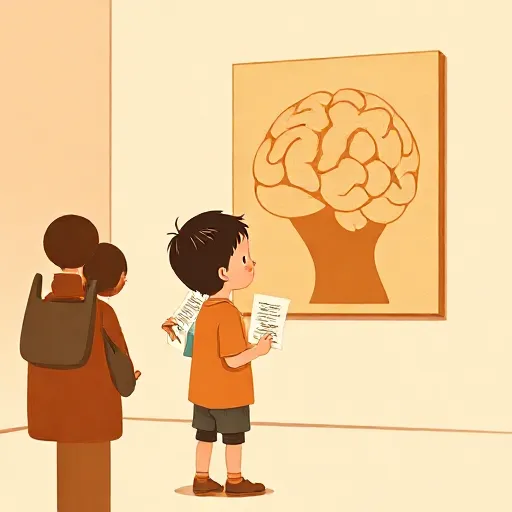
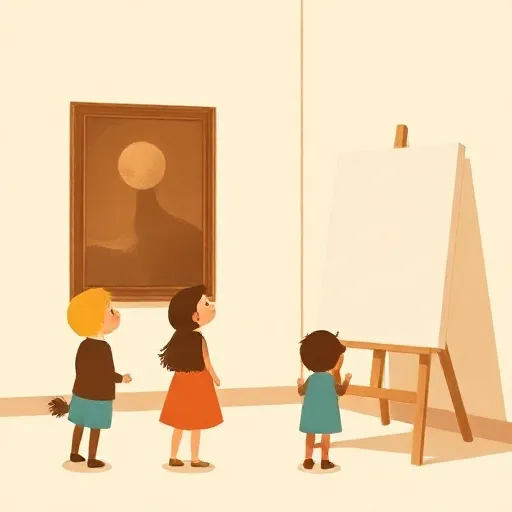
Imagine you are standing in a museum, staring at a famous painting. Now imagine that a robot scans the canvas and prints a copy so precise that even the artist could not tell which one was the original. Is the copy the very same work of art as the one on the wall? Most people would say no — the copy is just a copy, not the real artwork. But working out why it is not the same turns out to be surprisingly difficult.
One straightforward answer is that a work of art simply is a physical object. The American philosopher Monroe C. Beardsley, writing in the 1950s, defended this kind of realism. On his view, a painting just is a particular canvas covered with paint, and a sculpture is a shaped block of marble. Once the artist makes it, it exists entirely on its own, independent of what anyone thinks or feels about it.
This idea makes sense when you can walk up to a single unique thing and touch it. But it quickly runs into trouble. Think about a novel. If Beardsley is right, then where is the novel? Is it the author’s original manuscript? That seems wrong — millions of people might enjoy the story without ever seeing the manuscript. Maybe the novel exists as many physical copies spread around the world. But then it would be possible for the novel to exist in two libraries at the same time, which is different from a single painting being in only one place. Right away, we can see that not all works of art behave like a one-of-a-kind physical object.
A French Poet Tries to Rewrite Don Quixote
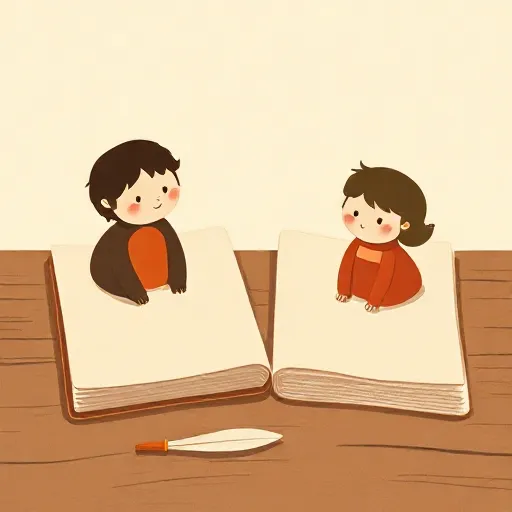
In 1939, the Argentine writer Jorge Luis Borges published a strange little story about a fictional French poet named Pierre Menard. Menard does not want to copy the novel Don Quixote — he wants to compose it again, word for word, as an original work of his own. If he succeeds, the text he produces would be verbally identical to the one Miguel de Cervantes wrote in the early 1600s. Yet Borges’s narrator insists that Menard’s version would be a much richer and more subtle piece of writing, simply because it was created three centuries later and in a different cultural setting.
Philosophers love this thought experiment because it shakes up the commonsense idea that a literary work just is its string of words. If two people independently produce exactly the same text but in radically different historical moments, are they really the same work? Many art philosophers — including Jerrold Levinson in the 1980s — answered no. What makes a work what it is includes the artistic context in which it was made. The same sequence of sentences, when authored in seventeenth-century Spain, means something artistically different from an identical sequence produced by a twentieth-century symbolist in Paris.
The Menard puzzle points to a bigger insight: a work of art is not identical with its vehicle — the physical object or event that carries it to our senses. The novel is not just the printed pages; the symphony is not just the sound waves hitting your eardrums. There is something more.
The Building That Exists Only When You Daydream
In 1953, the German philosopher Nicolai Hartmann argued that a work of art always has at least two layers. The first layer is the foreground — a piece of stone, colors on a canvas, or the sounds you physically hear. The second layer is the background, which is not literally there in front of you. You perceive it only by using your imagination.
For example, if you look at a grand cathedral, you can point to the visible stone and glass. But the aesthetic qualities of the building — calling it “majestic” or “solemn” — are not just physical facts about the stone. Hartmann would say those qualities are in a sense fictional. They exist only because you, the viewer, treat the stone building as if it were a majestic presence. The experience is a kind of lucid make-believe, like a child knowing that a cardboard tube is really just cardboard yet using it as a castle tower anyway. The contemporary philosopher Kendall Walton developed a similar idea: we appreciate works of art by playing a sophisticated game of make-believe, where the physical artifact serves as a prop.
Does that mean the artwork disappears when nobody is daydreaming? Some thinkers have bitten that bullet, suggesting that a piece of art has an intermittent existence — it flickers in and out of being depending on whether someone is attending to it imaginatively. Other philosophers found that too strange. They insisted that a symphony existed ever since it was composed, even when no one was listening. This disagreement pushed art ontologists to search for a more stable home for the work.
The Riddle of the Symphony You Can’t Create

Think about Beethoven and his Fifth Symphony. Common sense says Beethoven created that piece of music. Yet many philosophers have argued that the patterns of sounds in a musical work are abstract objects, like numbers or shapes. Numbers were not created by anyone — they were discovered. If a symphony is just an abstract sound-structure, then it seems Beethoven could not have created it any more than Pythagoras created the idea of a triangle. This is the paradox of creation:
(A) Works of art are created.
(B) Abstract objects cannot be created.
(C) Works of art, at least musical ones, appear to be abstract objects.
One way out is to deny that musical works are pure abstract objects. Jerrold Levinson offered a compromise: a musical work is a sound-structure as indicated by a particular composer at a particular time. The structure of pitches might have been available forever, but a composer turns it into a work of art by selecting it and prescribing how it should be performed. That act of indication — “this structure, to be played by these instruments, in this way” — brings a new entity into existence. On this picture, the work is a relational thing that ties together a pattern and a creative human act. Not everyone is convinced that this solves the riddle neatly, but it shows how hard philosophers must work to explain how art can be both repeatable and genuinely created.
Why You Still Care About the Original
All these dusty debates resurface in your own life more often than you might guess. Ever seen someone pay more attention to an original painting than to a framed poster of it, even if they look the same? Ever felt that hearing your favorite song through cheap earbuds is somehow not the “real” experience? These feelings rest on unspoken assumptions about what a work of art truly is.
If you thought the artwork were nothing but private feelings inside your own head, then looking at a perfect copy would be exactly the same as looking at the original. But almost nobody acts that way. We treat originals as special because we sense, however dimly, that a work’s identity is tied to the actual physical history of its making — where and when it was created, by whom, and under what circumstances. The philosopher Carl Georg Lange, way back in 1899, made exactly this point. He imagined a forgery so perfect that no expert could tell it apart from the original. Even then, he argued, the copy would give us a drastically different kind of enjoyment. What we admire in a work of art is not just a pattern of colors or sounds, but the achievement of an artist overcoming real difficulties in a particular moment in history.
So the next time you watch a flawless digital reproduction of a masterpiece, or argue with a friend about whether a remixed song is still the “same” track, you are stepping right into the middle of a philosophical puzzle that has not been settled. You are asking where the work really is — and that question determines what you think you are appreciating when you stop and pay attention.
Think about it
- If a robot that knows nothing about art randomly arranges words and accidentally produces a text identical to your favorite poem, is that poem a work of art? Why or why not?
- Imagine a musical score is destroyed and every performance is forgotten, but one person can hear it perfectly in her imagination. Does the piece still exist?
- Suppose you could own a molecule-perfect replica of any painting in the world. Would it matter to you that the original sits in a museum? Try to explain where that “mattering” comes from.