
What If No Voting System Could Be Completely Fair?
A Pizza Problem That Loops

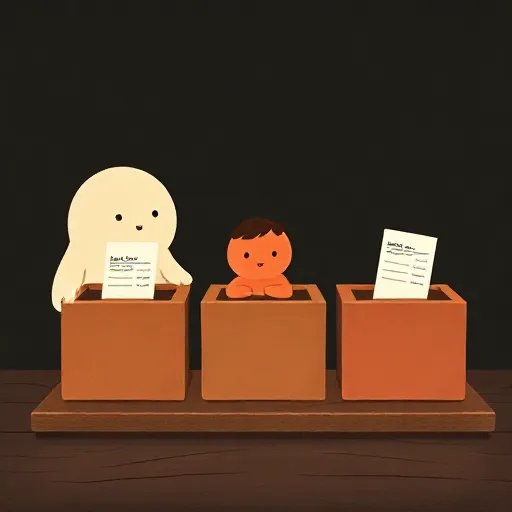
You and two friends are trying to pick one food to share. The choices are pizza, tacos, and burgers. You love pizza, think tacos are okay, and can’t stand burgers. Your first friend is crazy about tacos, doesn’t mind burgers, and would skip pizza. Your second friend is a burger fan, places pizza next, and tacos last. So you each rank the three options from best to worst:
- You: Pizza → Tacos → Burgers
- Friend 1: Tacos → Burgers → Pizza
- Friend 2: Burgers → Pizza → Tacos
It seems fair to let majority rule decide. First, you hold a vote between pizza and tacos. You and Friend 2 prefer pizza to tacos, so pizza wins that pair. Next, tacos vs. burgers: you and Friend 1 prefer tacos, so tacos win. By this logic, pizza beats tacos and tacos beat burgers. So you’d expect pizza to beat burgers, right?
But when you actually vote on pizza vs. burgers, Friends 1 and 2 both pick burgers over pizza. Burgers win, even though pizza beat tacos and tacos beat burgers. The preferences loop: pizza > tacos, tacos > burgers, burgers > pizza. There’s no winner. Instead, you’re stuck in a circle.
When Majority Rule Spins in a Loop

This headache has a name: Condorcet’s paradox. It was discovered by the Marquis de Condorcet (1743–1794), a French mathematician and philosopher, in 1785. He noticed that even when every person’s preferences are perfectly clear, combining them with majority votes between pairs can produce a cycle — a preference loop where nothing wins outright. In philosophy, this means the group lacks a social ordering: you can’t rank the options from best to worst without going in circles, so there is no “will of the people” that clearly picks one best thing.
Condorcet’s paradox isn’t just an odd brainteaser. It shows that the way we add up votes can lose the rational structure each person had. Each of you had a tidy personal ranking (no loops), but the group’s decision was a mess. And the problem isn’t about a few strange preferences — it can happen with any three options whenever people disagree in a certain pattern.
For over a century, people hoped this was just a fluke of majority voting between pairs. Maybe a smarter voting rule could always avoid cycles and be fair. In the 1950s, an economist named Kenneth Arrow (1921–2017) set out to find such a rule. What he found instead shocked everyone.
Arrow’s Five Rules for a Fair Vote

Arrow imagined that a group is given a set of alternatives (pizza, tacos, burgers — or candidates, or laws) and every person has a personal ranking, called a preference profile. A social welfare function is a rule that turns the profile into a single group ranking. Arrow wanted this rule to be logical and democratic. He proposed five conditions that any good voting rule should satisfy. In philosophy, these are called axioms — basic principles you judge a system by.
Unrestricted Domain (U): The rule must work for any possible set of individual preferences. It can’t demand that people think a certain way. Whether they love or hate the options, the method still has to produce a group ranking.
Social Ordering (SO): The output must always be a clear ranking of all the alternatives — no cycles, possibly with ties. The group can say “this is best, that is second‑best,” and so on.
Weak Pareto (WP): If literally every person strictly prefers option A to option B, then the group must prefer A to B too. Unanimous agreement can’t be ignored.
Non-Dictatorship (D): No single person’s strict preferences can automatically become the group’s preference every time. A dictator would be someone whose strict rankings always overrule everyone else’s.
Independence of Irrelevant Alternatives (I): When deciding whether the group prefers A to B, you can look only at how individuals rank A and B. People’s feelings about some third option C — even if C is still on the ballot — are treated as “irrelevant” to that one pair.
These conditions seem reasonable. Pairwise majority voting satisfies WP, D, and I, but we’ve already seen that it can fail SO (by creating cycles) if there are at least three alternatives. So maybe another method can do better.
The Proof That Shook Democracy

Arrow’s stunning result, now called Arrow’s impossibility theorem, says: If there are more than two alternatives, no social welfare function can satisfy all five conditions. In other words, any method that works for every possible set of preferences (U), always gives a clear ranking (SO), respects unanimous agreement (WP), avoids having a dictator (D), and ignores irrelevant alternatives (I) — such a method simply does not exist.
The theorem isn’t about one flawed election; it’s about the very idea of combining many tastes into one “common will.” No matter how clever the voting rule, at least one of those five fairness ideals must be sacrificed. Many philosophers and political scientists were deeply troubled. Some, following William Riker (1982), argued that democracy conceived as government by a single people’s will is an incoherent illusion. Others saw Arrow’s conditions as too demanding. But the theorem forced everyone to think more carefully about what we really want from group decisions.
A Way Out: When Voters Agree on a Temperature

Not all hope is lost. If you narrow the domain of possible preferences, you can sometimes avoid the paradox. Imagine three bears arguing over the temperature of their porridge. Papa likes it piping hot; the hotter the better. Mama likes it cold; the colder the better. Baby likes warm porridge, then hot, then cold. Their rankings form a special pattern: each bear has a “bliss point” along a single scale from cold to hot, and each likes options less the farther they are from that point. This is called single‑peaked preferences.
Duncan Black (1908–1991) showed in 1948 that when voters are odd in number and their preferences are single‑peaked on some common ordering (like temperature, or left‑right politics), pairwise majority voting does produce a social ordering without cycles. The winning option is the favorite of the median voter — the person whose bliss point is in the middle. In the bears’ case, Baby is the median, so warm porridge wins. Single‑peakedness can arise naturally when everyone cares about the same underlying feature of the choices, which is why structured deliberation sometimes helps groups make consistent decisions.
Another Escape: Grading Instead of Ranking

Arrow’s framework assumes that voters supply only ordinal information: they rank alternatives but never say how much they like them. He thought strength of preference couldn’t be compared from person to person. But there is a way to give more ordinal information without using hard‑to‑compare numbers: you can let people assign grades — familiar labels like excellent, good, fair, poor, or star ratings.
If we reformulate Arrow’s conditions for grade profiles, the impossibility vanishes. With an odd number of people, a rule called median grading works: for each alternative, find the middle grade when all grades are lined up from top to bottom. Then rank alternatives by their median grades. Median grading passes all five reformulated Arrow conditions. Michel Balinski and Rida Laraki developed a sophisticated version called majority judgment that makes careful use of grade information. Arrow himself later agreed that grading opens doors his original setup had closed.
Why This Matters in Your Classroom

Arrow’s impossibility theorem can sound like a death sentence for democracy, but it’s really a call to be thoughtful. Every voting method — whether in a national election, a talent show jury, or picking a movie with your friends — will break at least one of Arrow’s five ideals. That knowledge doesn’t paralyze us; it helps us pick the shortcoming we can live with.
Maybe you decide that single‑peakedness is common enough in your class, so simple majority vote is fine. Or you might use a star‑rating system to respect intensity of feeling. The deeper lesson is that “what the group wants” isn’t a simple fact waiting to be discovered; it’s something we construct with rules. Understanding those rules — and their trade‑offs — makes you a sharper citizen, a fairer committee member, and a wiser voter, even when the ballot is just about pizza toppings.
Think about it
- If your class votes on three field trip destinations and you end up with a preference cycle, can you invent a fair way to break the tie without just flipping a coin?
- Arrow’s theorem says no voting rule satisfies all five conditions at once. Which of those conditions would you be most willing to sacrifice, and why?
- Some people believe voters should give star ratings instead of just picking one candidate. What problems could that create in a real election, even if it avoids Arrow’s impossibility?