Can You Be Free if God Already Knows Your Choices? Arnauld’s Answer
The Man Who Defended Truth at Any Cost
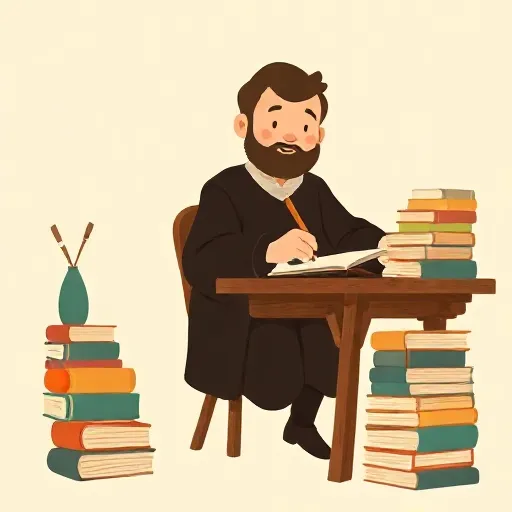
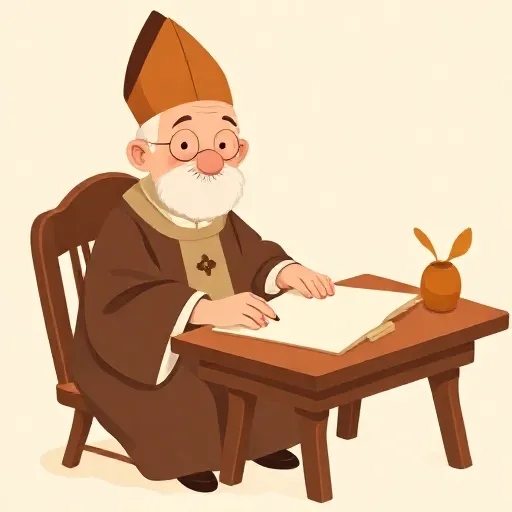
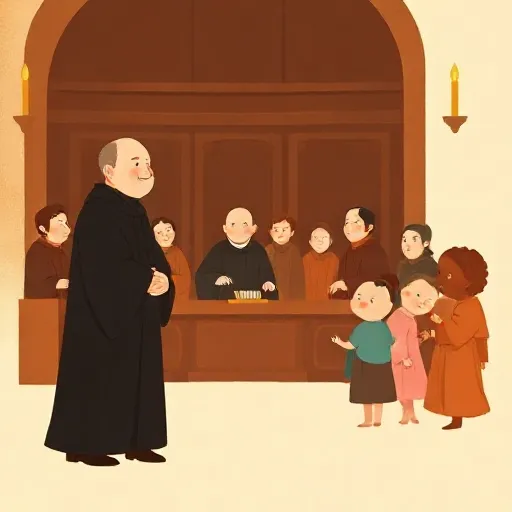
In 1655, a trial gripped Paris. Antoine Arnauld (1612–1694), a respected priest and scholar, was accused of heresy by the powerful theologians of the Sorbonne. The charge? He refused to sign a document condemning five ideas supposedly found in a book by his friend, the theologian Cornelius Jansen (1585–1638). Arnauld believed those ideas were not actually in the book, and he would rather be expelled from the university than lie. After a dramatic trial that lasted two months, he was thrown out. The young mathematician Blaise Pascal (1623–1662) rushed to his defense with a series of witty public letters. Arnauld’s life of conflict had only just begun.
Born into a huge and wealthy family — the twentieth child — Arnauld could have been a lawyer. Instead, his deep faith led him to the priesthood. He joined a group of serious-minded thinkers who lived simply near the convent of Port-Royal, where his sister was abbess. They ran schools, translated the Bible into French, and wrote groundbreaking books on logic and grammar. But Arnauld’s real passion was fighting for what he thought was true, whether in theology or philosophy. When attacks on his friends continued, he fled to the Netherlands in 1679 and spent his last fifteen years in exile — yet those years produced his most original philosophical work.
Arnauld saw himself as both a Catholic theologian and a Cartesian philosopher. For him, the two roles could work hand in hand. Reason, he argued, could help defend the truths of faith. But he also insisted that philosophical questions must be settled by reason, not by religious authority. This boundary mattered deeply to him, and he spent much of his later life accusing other thinkers of blurring it.
Ideas Are Not Pictures in Your Head

When you look at the sun, what happens? Many philosophers in Arnauld’s day believed you form a mental image, a little picture called an idea, that stands between your mind and the real object. Arnauld disagreed fiercely. He said an idea is not a separate object at all. An idea is simply a perception — the act of being aware of something. He put it bluntly: “I know myself in knowing other things.” When you perceive the sun, your perception just is the sun as you experience it. The sun itself deserves the label “idea” only because it is being perceived — an extrinsic denomination, a name that comes from a relation, not from a thing inside your head.
This sounds technical, but it has a big payoff. If ideas were tiny pictures that God implanted in you, there might be room for error you can’t detect. Arnauld’s way preserved direct contact with reality: you are not trapped behind a screen of images. Sensory ideas like pain or cold are clear and distinct if you take them simply as mental states. They become confused only when you wrongly judge that the pain is in your hand, or the cold is a real quality in the ice. For Arnauld, our basic perceptions are never deceptive; the trouble comes when we misuse our freedom and add false judgments.
God’s Plans vs. Our Freedom: The Fight with Malebranche
Arnauld’s biggest battle was with Nicolas Malebranche (1638–1715), a fellow French philosopher who was also a Cartesian. Malebranche held that God is the only true cause in the universe. When a ball hits another ball, God directly makes the second ball move; the first ball is only an occasional cause, not a real cause. The same goes for your mind and body. God causes sensations in your soul when your eyes are stimulated, and He moves your arm when you will it, all according to general laws that He established.
Malebranche used this view to solve a painful puzzle. If God wants all people to be saved, why are some not saved? He answered that God’s wisdom requires Him to create the best possible world in the simplest and most uniform way. Acting by general volitions (broad rules) is a sign of greater wisdom than acting by particular volitions (tailoring each event one by one). Sometimes, following those simple rules means some individuals miss out on the grace that would save them. God wants their salvation but His wisdom restrains that desire.
Arnauld was horrified. He charged that Malebranche was smuggling human-like reasoning into God. God does not consult His wisdom like a king who asks advisors what he should do. God’s will is His wisdom; there is no separate rulebook that holds His will in check. Also, Arnauld argued, God’s volitions are always particular — every creature is created by a specific act, not by a vague general decree. Laws of nature are fine, but they describe God’s activity, they don’t constrain it. Arnauld warned that if you make God act only by general rules, you rob Him of freedom and turn Him into a machine.
Could Adam Have Not Sinned? The Debate with Leibniz

While still trading blows with Malebranche, Arnauld received a letter from Gottfried Wilhelm Leibniz (1646–1716). Leibniz wanted Arnauld’s opinion on his new philosophy. He proposed that every individual substance — you, a cat, a tree — has an individual notion that contains, from eternity, everything that will ever happen to it. So the complete concept of Adam, the first human, includes all his descendants, all their actions, all history. God chose to create Adam’s whole possible world, and thus everything unfolds as it must.
Arnauld immediately smelled fatalism. If Adam’s individual concept includes that he will be the father of Cain, then it seems impossible for Adam not to be Cain’s father. That would mean Adam’s choice to have children was not free — it followed with necessity. Leibniz replied that the connection involved is not a necessity of logic but merely the fact that God saw the whole world and chose it. Being a father is an extrinsic denomination of Adam, a relation that doesn’t force anything inside him.
Arnauld was only partly satisfied. He accepted that this might avoid outright fatalism, but he remained puzzled by Leibniz’s talk of “substances that do not act on one another” and his claim that every true unity must have a substantial form, which sounded like reviving a forgotten medieval idea. Arnauld held fast to the Cartesian view that matter is just extension, a clockwork world, and genuine causal interaction between mind and body is impossible — but he didn’t think Leibniz’s elaborate system of pre-established harmony solved the problem. For Arnauld, God could directly cause both mental and physical events without tying Himself to a single grand blueprint that makes every detail unavoidable.
Free Will and the Power to Do Otherwise

Late in his life, Arnauld worked out his own view of free will. He called it a potestas ad opposita — a power or faculty for opposites. You are free with regard to any limited good precisely because your reason can find some imperfection in it and therefore refuse it. Only the perfect good, happiness itself, forces your will with natural necessity. That view, he said, came straight from Thomas Aquinas (1225–1274).
But there was a catch. Arnauld firmly believed in efficacious grace: a supernatural help from God that infallibly produces a good act in a person’s will without destroying freedom. How can you be guaranteed to choose the good, yet still have the power to refuse it? Arnauld gave the example of a cruel king who has an enemy in his power. You can be almost certain that the king will destroy him, but you still hold the king responsible because he could have acted otherwise. In the same way, when God moves a person by grace, God moves the will in keeping with its own nature — as a self-determining power that chooses among opposites. Arnauld admitted that we cannot fully understand how God does this. God’s causality is a mystery, like “inaccessible light.” But we know from experience that we are free, and from faith that God’s grace is effective, so the two must be compatible.
Arnauld’s position is a form of compatibilism — the idea that freedom can coexist with some kind of determination. But note the limits of his view. He never claimed our choices are determined by brain chemistry or by the laws of physics. In fact, he argued that events that depend on free human choices cannot be necessary consequences of laws of nature. For Arnauld, the determination comes entirely from the intelligent will, whether human or divine, not from blind physical causes.
Why Arnauld’s Battle Still Matters

Arnauld spent decades fighting on two fronts: against a God who was bound by His own rules, and against a world where human choices were fated. In both cases, he tried to rescue genuine freedom — the real experience of being able to choose otherwise.
Today, you might not worry about whether God acts by general volitions. But the tension Arnauld wrestled with still appears. Neuroscience and psychology increasingly claim that your decisions are the product of brain states and past experiences. If a scientist could predict every choice you will make, would that mean you are not free? Arnauld’s answer would be subtle: certainty about what you will do does not take away your power to do otherwise, as long as you yourself are the source of the choice. Whether we can make sense of that power in a physical universe remains one of philosophy’s liveliest questions.
Arnauld’s own life was a testament to his belief. At his trial, he stood before the judges and refused to sign. They could have predicted that he would not bend — his whole personality was set on defense of truth. Yet he insisted he chose freely. When you stand by a difficult decision because it is right, you are acting in the same spirit. The mystery of choice, as Arnauld saw, is not something to solve and put away. It’s something you live.
Think about it
- If a machine could predict your every decision with perfect accuracy, would you still be free? Why or why not?
- Is it fair to blame someone for a bad choice if their brain chemistry left them almost certain to make it?
- You sometimes feel you could have chosen differently in the past. Can that feeling ever be proof that you really could have?